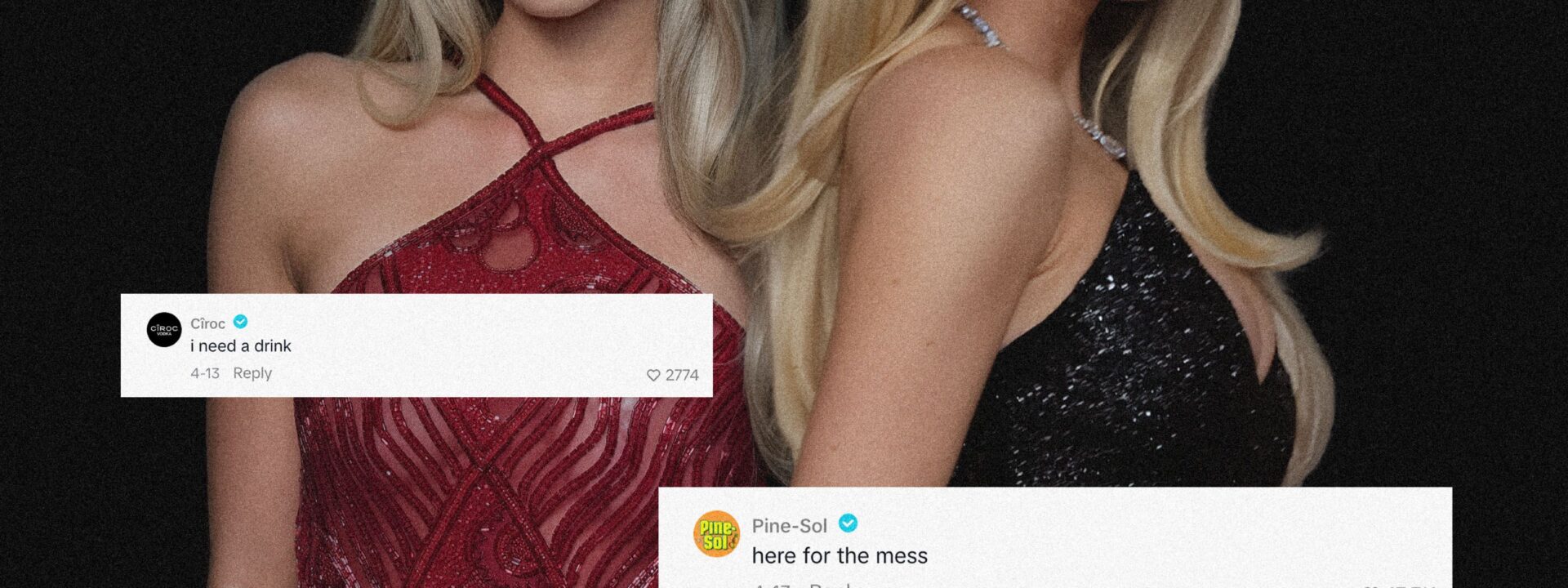
On Instagram and TikTok, where anything goes, audiences have been watching two major content creators go head-to-head for weeks. It started when Alex Cooper, host of Call Her Daddy, posted a TikTok on April 13 calling out internet personality Alix Earle for stirring up “fake drama.” Since then, the online crowd has been following the feud as it heats up and the stakes rise. Last weekend, it even caught the attention of SNL writers, who poked fun at the “Alix versus Alex” showdown with a deliberately shallow spoof.
The comment sections on these videos are mostly filled with the usual social media shade. But it’s not just individual followers grabbing popcorn—brand accounts with blue checkmarks are joining in too. “Cookies and milk for anyone recovering from this level of spice?” asked Subway Germany on Cooper’s original viral video, racking up a cool 127,000 likes. “I think I missed a chapter,” shot back Wingstop. “Things are about to get juicyyyy,” wrote Ocean Spray. And audiences have taken notice: “It’s the big corporations commenting for me,” reads one reply.
Since the early days of Twitter, brands have used comment sections to jump into trending conversations. Companies like Ryanair and Duolingo have made witty comebacks and jokes a key part of their online strategy to seem relatable. But while fast food chains, big household brands, and lifestyle giants can easily get away with sharp humor and edgy comments, fashion and beauty brands have often stayed out of the drama, prioritizing brand safety over visibility. “Now, we’re seeing other brands do this too, but in a less sarcastic way,” says Gemma Lacey, a consultant and contributing editor at Puss Puss Magazine, who previously managed social media for Adidas and Stella McCartney. “Brands are shifting away from using social media just as a broadcast channel and are actually using it socially, making inside jokes.”
In fashion, community-focused, premium labels like Damson Madder and Peachy Den, along with social-first brands like Gap, are jumping into the comments, showing appreciation for their customers with direct replies. Beauty brands like Milk Makeup and The Ordinary have also become frequent commenters on their own or others’ posts. But it’s not without risks—dipping into online debates can quickly land you in hot water.
This new marketing move comes at a time when the comments section is more valuable than ever. In our “Subway Takes” era, everyone is expected to have an opinion, and commenting can help brands break through a tough algorithm. Organic reach on Instagram has dropped from 10-15% in 2020 to just 2-3% in 2025, pushing brands toward paid posts. The comments section offers a rare chance to get noticed by people who don’t follow you. “For fashion brands, this opens up a new kind of visibility. Instead of just posting polished campaigns, they can jump directly into conversations that are already grabbing attention,” says Alexa Kesta, a social media consultant and former social media director of The Face.
According to Vogue Business and youth culture agency Archrival, more than half (52%) of Gen Z in 2025 said they go to the comments section when researching brands and products on social media, compared to only 37% who visit brands’ profiles and posts. And audiences are commenting more often too. Last year, comments on luxury brands’ TikTok videos were up 113% year-on-year, according to the platform. “The comments section has become a new touchpoint in the shopping journey, especially for younger, tech-savvy consumers who see through traditional ads. It’s a way to build brand value and awareness that doesn’t feel like traditional marketing,” says Camilla Cicchetti, UK brand manager for Cetaphil.
Throwing in your two cents might not bring in direct profits or hit the usual KPIs (reach, likes, shares) that drive social media managers. But it does make brands feel more relatable. “I don’tKesta says, “I think the payoff is engagement in the traditional sense. It’s about being included in these moments. Brands aren’t talking to their audience anymore—they’re joining them. The comments section has become as important as the content itself.” She adds that the option to pin your own comments on an Instagram post, introduced in September 2025, gives brands even more room to steer the conversation.
Cutting through the noise
Brands have been paying attention to comments for a while, even before they started joining in. Christina Le, head of marketing at Slate, says, “When I was at Plot, an AI-powered video social listening platform, the comment tracking feature was one of the most requested capabilities from brands like Tory Burch and Victoria’s Secret. It all came down to: help us find the conversations we should be part of, faster.” These companies needed a way to get a word in. Le adds, “I think brands knew the comments section was where cultural relevance lived, they just didn’t have a system for showing up there quickly.”
For the most part, that meant simple engagement with like-minded accounts—like dropping heart and flame emojis on posts from ambassadors and magazines. Sasha Mutchnik, senior social director at GQ, says, “Brands are social, they have their ‘friends of the house,’ and they need to show those relationships to their audience—just like real people comment and engage on social media with their own network.” Mutchnik does the same for her GQ accounts. “I prefer using comments sparingly and mostly for positive impact. Cheering on brand friends, politely calling out aggregators that quote our articles without credit, agreeing with great comments on our posts—all fair game.”
Now, it might be time for fashion brands to say more. Le notes that more social media manager job ads “explicitly mention real-time engagement across comments, DMs, and tags as a core function. And job titles are shifting toward always-on community management.” As a consultant, Kesta is making it a priority. “That behavior has taught me to see comments not as an afterthought, but as an extension of the content.”
The new, unspoken rules
But how should brands join the conversation? In the casual world of social media, something offhand can really connect. Kesta says, “I think Gen Z is especially drawn to brands that can participate, react, and be playful. It mimics the tone of a group chat—fast, informal, and culturally fluent. They’re naturally more flexible with communicating in a playful, informal way.”
“The comments section is one of our favorite places to be,” says Amy Bi, VP of brand at Deciem (owner of The Ordinary). “We bring our playful—and sometimes chaotic—tone to the conversation, keeping everything true to who we are and what we stand for. Our strategy is simple: comment often, fuel the banter, and be as funny as possible.” Recently, the “nobody here knows I’m the X admin” trend—where brands post videos shot by their social media director in the crowd at a big event—has pushed the Instagram manager to not just be the brand’s voice, but also a personality in their own right, breaking the fourth wall for comedic effect.
For luxury brands, though, this irreverent approach isn’t so straightforward. Kesta says, “Luxury fashion feels more complex. Its value is tied to mystique and a certain distance. Jumping into gossipy conversations can be quite jarring.” As Tank Magazine recently explored, a rise in “aggressive visibility” and “forced familiarity” is leading brands into “the friend zone,” at the cost of the desire and aspiration that comes from a sense of separation. Showing up too often in comments can lead to overexposure that hurts exclusivity.
It also requires a quickness that fashion houses can’t always manage. “Fashion hasHistorically, it’s been more of a media business than a social one. The muscle memory is editorial—think magazine covers, campaign imagery, and runways, which are great broadcast formats. You set it up, and it’s done,” says Le. Too much curation or approval, and the moment might slip away. “The comments section is the complete opposite because it’s a conversation, and conversations require you to be a person. So you could say it’s more social than media.”
That’s why creative directors like Marc Jacobs and Simon Porte Jacquemus have found success commenting from their personal Instagram accounts. Other brands are finding ways to engage with comments without actually jumping in. In 2024, TikTok creator @DrKayla_MD posted a viral video saying that if it got 50,000 likes and a comment from Prada, her husband would buy her the brand’s Re-Edition Saffiano Leather bag. Brands like Burt’s Bees, Pizza Hut, Ziploc (and a fake Prada account) showed support. In the end, her husband bought her the bag anyway. Interestingly, though, Prada didn’t comment, but eventually sent her a raffia shoulder bag, showing they’re both online and in the know without directly engaging in the comments.
TikTok content
This kind of relatability is risky. “A Wendy’s reply that flops costs them nothing because the brand is built on being irreverent. For a fashion brand that’s spent decades building a sense of aspiration, getting it wrong in a comments section can feel like a big deal, even when it isn’t,” says Le. But the reward might be worth the risk. Luxury fashion, having found its funny bone in recent years, is more open to showing its playful side. “You can’t get close to culture from the safety of a campaign shoot. You have to be in the room. And the comments section is that room.”
The key is to stay true to your brand. “The criticism right now—especially from marketers, but also from regular people—is that a lot of brands are flooding the comments trying to sound like an average person and end up blending in. It’s like a copy-paste Gen Z voice,” says Le, warning against using slang like “rizz” and instead keeping things authentic.
Social media managers for fashion brands should think before they comment. “The real move is having some conversational discipline,” Le says. “Don’t show up in conversations you weren’t invited to, but do show up where your product, customers, or point of view are already being discussed.” Cicchetti agrees: “The worst thing is when brands try too hard or force themselves into conversations where they don’t belong. If it feels forced to you, it’ll definitely feel forced to your audience.”
High-end fashion houses aren’t likely to stir up online drama anytime soon. “Obviously, Chanel isn’t going to weigh in on podcaster-TikToker drama anytime soon, hopefully never,” says Mutchnik. “But that’s just because those forms of celebrity don’t fit the house’s style.”
Lacey agrees: “High fashion’s value is based on not needing to ask. The product itself is strong enough to tell the brand’s story, and they use carefully chosen creative teams to do that. It’s not appropriate for Prada to drop a lolz emoji on a reel.” But there’s still a clear opportunity to throw caution to the wind and join threads that match their own voice.
Frequently Asked Questions
Here is a list of FAQs about brands engaging in comment sections written in a natural tone with direct answers
Beginner Questions
1 What does it mean when a brand makes a splash in the comments section
It means a brand is actively replying to people on social media postsusually with funny witty or very helpful commentsinstead of just posting their own content Think of it as showing up at a party and joining the conversation instead of just standing in the corner
2 Why would a brand want to do this Isnt it just random chatting
No Its a marketing strategy The goal is to get noticed make people laugh and build a friendly human personality When done well it makes the brand feel more relatable and memorable than a boring ad
3 Is it just for big companies like Wendys or Duolingo
Definitely not Small local businesses can do it too A local coffee shop replying to a customers post about needing caffeine with a simple Weve got your back can build a loyal local following
4 How is this different from regular customer service
Customer service is usually reactive and solves a problem Making a splash is proactive and entertaining Its about branding not just fixing issues
Intermediate Practical Questions
5 Whats the biggest risk of jumping into comments
Looking fake or trying too hard If your brand is super serious and you suddenly start using slang like slay people will cringe The biggest risk is being inauthentic
6 How do we decide which comments to reply to
Look for hightraffic posts from popular accounts in your industry or posts where your product is mentioned Also look for openingsfunny or controversial comments where you can add value or a joke without being pushy
7 Whats the rule for tone Should we be funny or professional
Match the platform On TikTok or Instagram casual and funny works On LinkedIn helpful and insightful is better A good rule be the cool friend who knows their stuff not the class clown