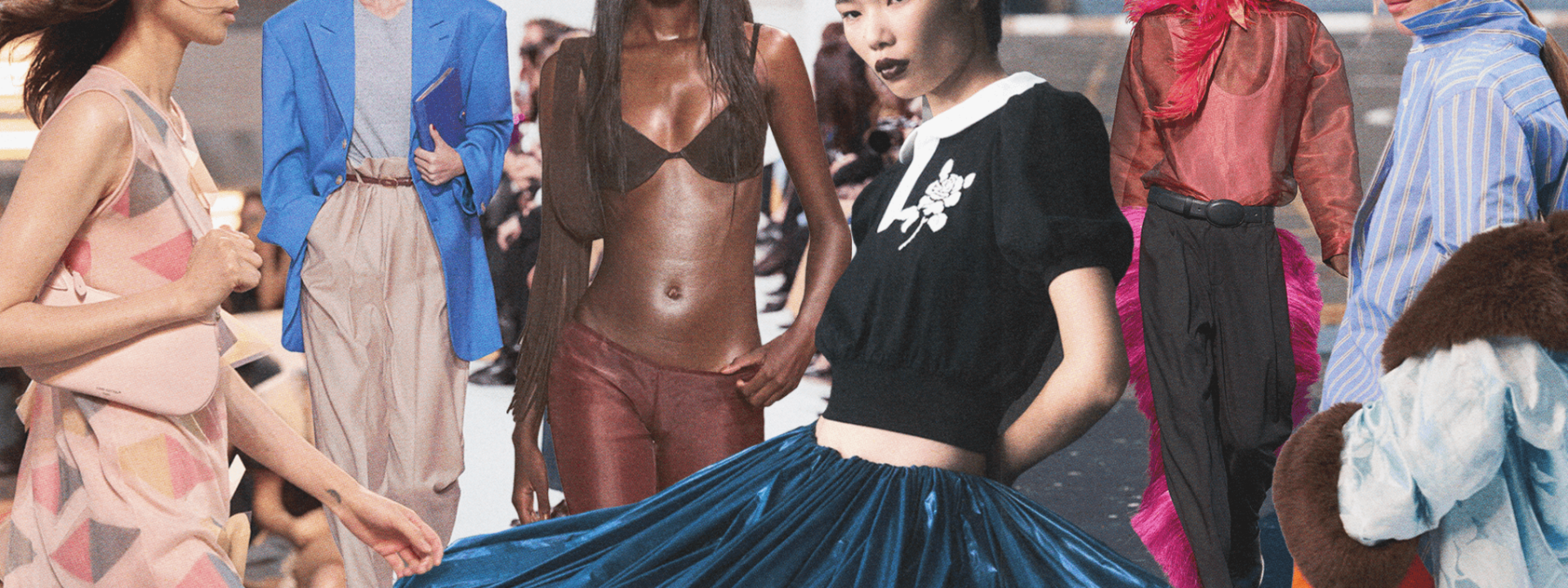
Tokyo, Copenhagen, New York, London, Milan, Paris, Shanghai: The designer quotes here come from hundreds of spring 2027 collection reviews filed by the Vogue Runway team. We’ve organized their words into five categories that capture the season’s main themes. At the top of the list is a back-to-reality mindset; designers are prioritizing relatability and wearability over fantasy and character dressing. As Tokyo-based Viviano Sue noted: “Fashion is supposed to be something people can wear, no matter how crazy it is.” To counter the steady stream of bad news, many big names adopted a glass-half-full mindset for spring 2027, including Chanel’s Matthieu Blazy. “I think there is a space for poetry, beauty, joy, and it’s a good remedy to the dark time,” he mused. “I think fashion should give this to women.” Others noted our warming planet and set out to create lightness in their garments. Hermès’s Nadège Vanhée said her aim was “to walk around a very simple notion of air—a-i-r—and this idea of how the air can be perceptible but also imperceptible.” It was a pretty cool approach. Celine’s Michael Rider leads a group of creatives who seek spontaneous styling, embrace imperfection, and refuse to be bound by rules. This offbeat tendency doesn’t rule out a desire to make a big splash, of course. Dries Van Noten’s Julian Klausner spoke of “this very universal feeling of sometimes wanting to feel glamorous, sometimes wanting to feel like a star.” Shine on.
Realism
“It was the idea of being in the moment, in this time. What I was mainly interested in is working for people now.”—Miuccia Prada, Miu Miu
“The moment we’re living in calls not for fashion magic but for fashion realism.”—Loris Messina and Simone Rizzo, Moschino
“We’re really looking at how to translate all these ideas we’ve been having into a bit more reality and a way of dressing. We’ve been brand building for the last two seasons, creating a new universe that’s resonating…. Now, how do you bring clothes into that conversation?”—Jack McCollough and Lazaro Hernandez, Loewe
Loewe
Photo: Umberto Fratini / Gorunway.com
Loewe
Photo: Umberto Fratini / Gorunway.com
“Martin Margiela was about the anti when he began in the late 1980s, so we really worked with that—the hard and the soft, this kind of contradiction in fabric. I’m trying to really figure out how we can bring a strong concept in and be really consistent in the concept in every garment, but without being scary too.”—Glenn Martens, Maison Margiela
“I wanted to refine everything and let the clothes and shapes speak for themselves, and let the models transform into these real characters. I love shape. I love the human body. And I think me evolving as a woman, and thinking about what I actually want to wear, helped prompt this push.”—Mowalola Ogunlesi, Mowalola
“I felt a sense that high fashion has slipped out of reach for the average person, and so I wanted to figure out how to pass on the kind of fashion I had enjoyed to the next generation and to share that richness.”—Keisuke Yoshida, Keisukeyoshida
“We are making clothes—we’re not making art. Fashion is supposed to be something people can wear, no matter how crazy it is.”—Viviano Sue, Viviano
Joy
“Not to go too philosophical, but I think there is a space for poetry, beauty, joy, and it’s a good remedy to the dark time. I think fashion should give this to women.”—Matthieu Blazy, Chanel
“I wanted to have references to happiness and joy. It’s those kinds of moments that you want to freeze and make that moment into an object or idea that will romantically survive the creator and this container of it.”—Patricio Campillo, Campillo
“[Fashion is] serious work. But there is a type of fun, and I think there should be humor because when we are doing fittings, we’re having so much fun. But we do take it very seriously.”—Duran Lantink, Jean Paul Gaultier
“You know how I approach my universe and my designs—it’s always about this wonderful, beautiful, ideal society wher”Everyone is glamorous and beautiful, and we all live happily ever after in peace, and everyone is welcome.” —Alejandro Gómez Palomo, Palomo Spain
Wabi-sabi
Accidental, spontaneous styling is “what turns me on. I think that’s how I am, and I don’t know how not to do that. That’s what I respond to when I see those things on other people in the world and when the studio and I are out living. I love when real clothes are worn spontaneously.” —Michael Rider, Celine
“We didn’t want the look of something factory made. We thought it was nice to leave in the strange imperfections. We tried to hold onto that, in terms of pattern and fit.” —Matt Empringham, A Letter
“Things don’t need to match. They need to attract.” —Aaron Esh
“I like when things don’t feel perfect. I like things to feel cool, youthful.” —Daniel Lee, Burberry
“I like memory as a source of inspiration because it’s not really fixed. It’s not exact.” —Stuart Vevers, Coach
“I like that moment of something being sensitive and brutal—highlighting the history of something broken but then adding additional value.” —Kozaburo Akasaka, Kozaburo
“It’s always a tension and a battle for me as a 25-year-old Chinese person trying to explore what a woman would really like, and I think that tension is quite interesting in a way. Maybe some things come out that might not be functional or might not be traditional womenswear in a lot of people’s eyes, but I enjoy that offness.” —Zane Li, Lii
“There is a lot of freedom in how women dress here [in New York]. We’re not following rules like eveningwear is only eveningwear, with this type of bag, this type of shoe. I see women in the middle of the day with a gown on, and it’s totally normal and acceptable, and I find that really inspiring.” —Rachel Scott, Proenza Schouler
“We’ve been describing this collection internally as up-down, east-west, here-there, then-now. The up-down is how she really dresses. Evening is not necessarily evening, and day is not simply day.” —Sarah Staudinger, Staud
“I don’t want the normal way, the traditional way to cut. We prototype on the body, then take it off to see how everything is. There are so many mistakes. For example, the bottom should go this way, but we go that way.” —Uma Wang
Let There Be Lightness
“I think it’s about trying to remove the heaviness of the heritage of a brand like Dior. It’s trying to work out what you like in the brand that is opposed to you and, at the same time, trying to find solutions.” —Jonathan Anderson, Christian Dior
“My idea was really to walk around a very simple notion of air—a-i-r—and this idea of how air can be perceptible but also imperceptible.” —Nadège Vanhée, Hermès
“I wanted to return to something very light and colorful, like ice creams. In a way it’s my children, I think, who give me that strength and that desire to use yellow, red, stripes, polka dots, the little slippers that are easy to wear into the water and so on.” —Simon Porte Jacquemus, Jacquemus
“I wanted to express a sensation of simplicity, a feeling of purity. It’s an impression of minimalism, but the work behind this construction—the simplification, making things extremely light—is really complex.” —Nicolas Ghesquière, Louis Vuitton
“We were thinking about solutions for intense weather, where you can still feel chic and live a real life. The reality of urban living in the summer is that you want an escape from it. But it’s also the busiest time of the year for a working woman.” —Lizzie Owens, 6397
“I added all the delicateness to be like, Well, here it is, in one vomit of delicateness.” —Hillary Taymour, Collina Strada
Glam
“When royal life and real life become one.” —Rei Kawakubo, Comme des Garçons
“I thought it was nice—this very universal feeling of sometimes wanting to feel glamorous, sometimes wanting to feel like a star.” —Julian Klausner, Dries Van Noten
“It’s sexy, but absolutely not sexy.” —Meryll Rogge, Marni
“It’s all about that hy“Full-on glamour, kind of like the ’80s.”—Richard Quinn
“When the girls come out, you’ll almost need sunglasses—it’s going to be shiny like a giant glitter ball.”—Caroline Bille Brahe, Caro Editions
“I was thinking about how people need to escape and heal. So I started with the idea of opulent femininity, always with the tension of the utilitarian and that contrast with sportswear.”—Tory Burch
Frequently Asked Questions
FAQs In Their Own Words 37 Designers on the Spring 2027 Season
1 What is In Their Own Words 37 Designers on the Spring 2027 Season
Its a collection of interviews with 37 fashion designers sharing their thoughts on their Spring 2027 collectionstheir inspirations creative process and hopes for the seasontold in their own words
2 Who is this book for
Anyone interested in fashion students aspiring designers industry professionals journalists and general readers who enjoy hearing designers talk about their work
3 Do I need a fashion background to understand it
No The interviews are conversational and accessible A glossary or basic fashion knowledge helps with some terms but beginners can follow along fine
4 What does in their own words mean
It means the content comes directly from the designersquotes and interviewsrather than being summarized or analyzed by a third party
5 Which designers are featured
The book covers a mix of established names and emerging talents Check the table of contents for the full list of the 37 designers
6 What is Spring 2027 referring to
Its the SpringSummer 2027 fashion seasonthe collections designers presented for that season typically shown about six months in advance
7 What kinds of questions do the designers answer
Typically what inspired them how they developed ideas materials and techniques they used challenges they faced and what they want the collection to say
8 What are the main benefits of reading it
You get direct insight into how designers think spot recurring themes and trends for the season and learn practical lessons from real creative processes
9 How is it different from a trend report
A trend report summarizes whats happening in the industry This book shows the whydesigners explaining their choices and inspirations firsthand
10 Can I use it for research or schoolwork
Yes Its a useful primary source for fashion studies journalism and design courses Just cite it properly
11 What common themes come up across the interviews
Recurring topics often include sustainability craftsmanship personal storytelling cultural influences and adapting to changing consumer habits
12 Are there practical tips for aspiring designers
Yesmany designers share