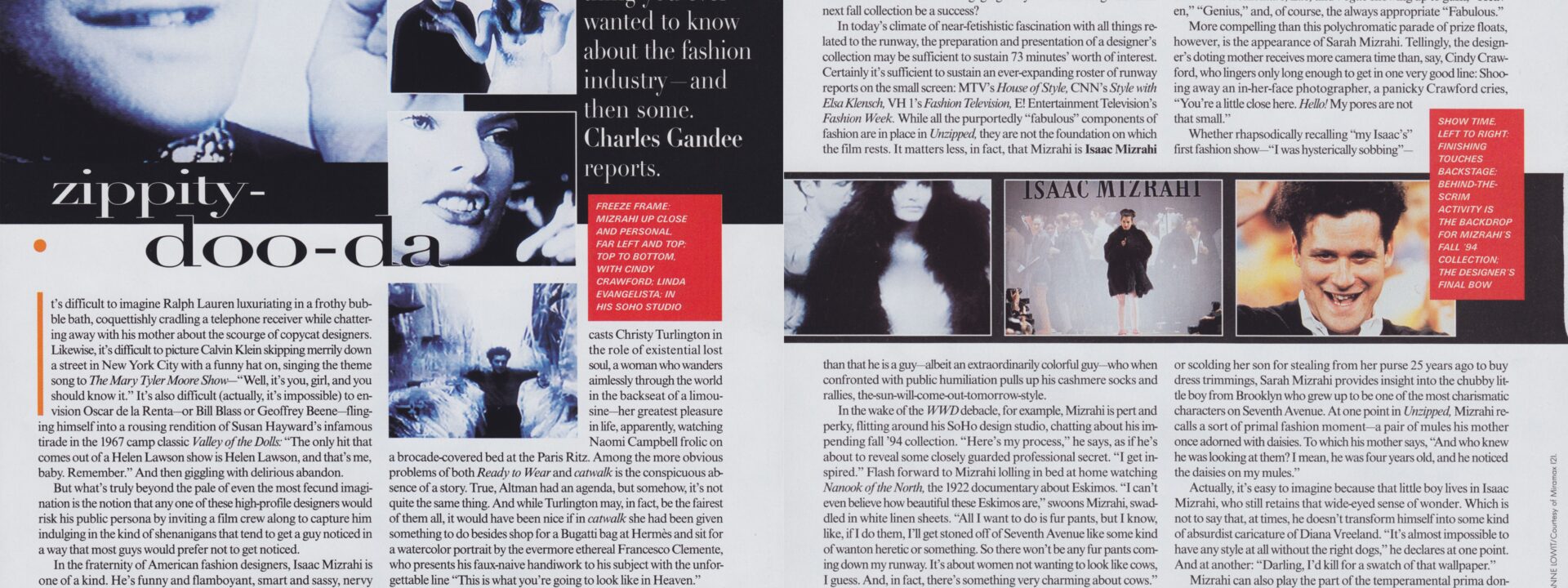
“Zippity-do-da” by Charles Gandee was first published in the September 1995 issue of Vogue. For more great pieces from Vogue’s archive, sign up for our Nostalgia newsletter here.
It’s hard to imagine Ralph Lauren enjoying a bubbly bath, playfully holding a phone while gossiping with his mother about copycat designers. Just as hard as picturing Calvin Klein skipping down a New York street in a silly hat, singing the theme from The Mary Tyler Moore Show—”Well, it’s you, girl, and you should know it.” And it’s impossible to see Oscar de la Renta—or Bill Blass or Geoffrey Beene—bursting into Susan Hayward’s famous rant from the 1967 cult classic Valley of the Dolls: “The only hit that comes out of a Helen Lawson show is Helen Lawson, and that’s me, baby. Remember.” Then giggling wildly.
But what’s truly unimaginable is any of these famous designers risking their public image by letting a film crew capture them doing things that would draw the wrong kind of attention.
Among American fashion designers, Isaac Mizrahi is unique. He’s funny and flamboyant, smart and bold, daring and, as he’d be the first to admit, “nelly.” Mizrahi has the guts to show every side of his personality and the style to celebrate all of it—even the parts that aren’t flattering. It’s this take-me-as-I-am—or don’t—attitude that makes Unzipped, the 73-minute documentary about a year in the life of the 33-year-old designer, such a delight.
And if there’s one thing missing from recent fashion films—meaning those after Funny Face—it’s delight.
There was certainly none in last year’s Ready to Wear, Robert Altman’s awful flop that took aim at the fashion industry with an elephant gun—and missed. Nor is there much in the upcoming Catwalk, a tedious travelogue that accidentally makes Christy Turlington into an existential lost soul, wandering the world in the back of a limousine—her greatest pleasure, apparently, watching Naomi Campbell play on a brocade-covered bed at the Paris Ritz. One of the obvious problems with both Ready to Wear and Catwalk is the glaring lack of a story. Yes, Altman had an agenda, but that’s not the same thing. And while Turlington may be the fairest of them all, it would’ve been nice if Catwalk had given her something to do besides shop for a Bugatti bag at Hermès and sit for a watercolor portrait by the ever-ethereal Francesco Clemente, who presents his faux-naive work to her with the unforgettable line “This is what you’re going to look like in Heaven.”
Thankfully, Unzipped director Douglas Keeve makes no such pretentious claims about his portrait of Mizrahi. Instead, Keeve is happy to show his subject in the here and now. This point is crucial and clear from the first frame of Unzipped, which shows a scruffy Mizrahi heading to his Greenwich Village newsstand at dawn on April 2, 1993, to buy a copy of Women’s Wear Daily—featuring a damning review of his fall ’93 collection. “Was this collection half-full or half-empty?” reads Mizrahi. “That was the obvious question after Isaac Mizrahi’s show Thursday night. What he called a mix was more of a mess. His usually great color sense failed him. His fabric sense failed him. And certainly his sense of how a modern woman dresses after 8:00 P.M. failed him.” As a devastatedMizrahi slinks down the street like a heartbreaking mix of Charlie Chaplin and Charlie Brown. Keeve turns up the emotion with a piece from Debussy’s “Images” and zooms in for a close-up. “It’s just the worst day of my life,” Mizrahi sighs, nearly in tears, so much so that you have to stop yourself from handing him a Kleenex. Then the screen goes black, and a line of white text appears: THIS IS THE STORY OF HOW THE NEXT COLLECTION GETS MADE. Cut the Debussy. Cut to the opening credits. Cue Sandra Bernhard singing Sylvester’s 1978 disco anthem “You Make Me Feel (Mighty Real).” Two minutes into Unzipped, we already have both a sympathetic character and a compelling story: Will underdog Mizrahi’s next fall collection succeed?
In today’s climate of near-fetishistic obsession with everything runway-related, the preparation and presentation of a designer’s collection might seem hard to stretch into 73 minutes of interest. It’s certainly enough to sustain an ever-growing lineup of runway coverage on TV: MTV’s House of Style, CNN’s Style with Elsa Klensch, VH1’s Fashion Television, E! Entertainment Television’s Fashion Week. While all the supposedly “fabulous” elements of fashion are present in Unzipped, they aren’t the foundation the film rests on. What matters less, in fact, is that Mizrahi is Isaac Mizrahi than that he’s a guy—an extraordinarily colorful guy—who, when faced with public humiliation, pulls up his cashmere socks and rallies, in a the-sun-will-come-out-tomorrow kind of way.
After the WWD debacle, for example, Mizrahi is cheerful and lively, flitting around his SoHo design studio, chatting about his upcoming fall ’94 collection. “Here’s my process,” he says, as if about to reveal some closely guarded professional secret. “I get inspired.” Flash forward to Mizrahi lounging in bed at home watching Nanook of the North, the 1922 documentary about Eskimos. “I can’t even believe how beautiful these Eskimos are,” Mizrahi swoons, wrapped in white linen sheets. “All I want to do is fur pants, but I know if I do them, I’ll get stoned off of Seventh Avenue like some kind of wanton heretic or something. So there won’t be any fur pants coming down my runway. It’s about women not wanting to look like cows, I guess. And, in fact, there’s something very charming about cows.”
As such an intimate scene suggests, Keeve had unlimited access to Mizrahi. The filmmaker and the fashion designer met in 1991, when Esquire commissioned Keeve to shoot a portrait of Mizrahi—who later told Out magazine, “I thought he was just another straight photographer who was flirting with me.” Keeve was not. Although the four-year relationship between Keeve and Mizrahi that followed did not survive the making of Unzipped, it did ensure that the film has the clear ring of authenticity. Keeve not only knows Mizrahi well, he knows Mizrahi’s world as well—meaning he got the scenery just right. He also got the cast of characters just right—those fashion-is-my-life hothouse flowers who seem to flourish pirouetting on the edge of self-parody.
Not surprisingly, Keeve devoted plenty of film to the millionaire mannequins so captivating to the public imagination. There’s Christy and Naomi and Kate and, of course, Linda, who deserves a Best Supporting Actress award for her wink-and-a-smile performance as the simpering supermodel from hell (“Isaac, why do you always give me the flat shoes and you give Naomi Campbell the high heels? Do you have something against white women?”). Also adding a bit of stardust to the film is the curious cadre of luminaries Mizrahi trots out for a turn before the camera—Sandra Bernhard, Mark Morris, Liza Minnelli, Eartha Kitt, and, yes, Roseanne. And then, naturally, no documentary about theThe fashion world wouldn’t be complete without editors from Allure, Elle, and Vogue showing up to gush, “Heaven,” “Genius,” and, of course, the ever-appropriate “Fabulous.” But more compelling than this colorful parade of prize floats is the appearance of Sarah Mizrahi. Tellingly, the designer’s doting mother gets more camera time than, say, Cindy Crawford, who lingers just long enough to deliver one very good line: shooing away a photographer who’s in her face, a panicked Crawford cries, “You’re a little close here. Hello! My pores are not that small.”
Whether she’s fondly recalling “my Isaac’s” first fashion show—”I was hysterically sobbing”—or scolding her son for stealing from her purse 25 years ago to buy dress trimmings, Sarah Mizrahi offers insight into the chubby little boy from Brooklyn who grew up to become one of the most charismatic figures on Seventh Avenue. At one point in Unzipped, Mizrahi recalls a kind of primal fashion moment—a pair of mules his mother once decorated with daisies. To which his mother says, “And who knew he was looking at them? I mean, he was four years old, and he noticed the daisies on my mules.”
Actually, it’s easy to imagine, because that little boy still lives in Isaac Mizrahi, who retains that wide-eyed sense of wonder. Which isn’t to say that he doesn’t sometimes transform himself into some kind of absurdist caricature of Diana Vreeland. “It’s almost impossible to have any style at all without the right dogs,” he declares at one point. And at another: “Darling, I’d kill for a swatch of that wallpaper.”
Mizrahi can also play the temperamental prima donna, doling out insults and compliments on a whim. For example, when Nina Santisi, his right hand, hands him a copy of WWD with a front-page story about how Jean Paul Gaultier drew inspiration for his fall ’94 collection—shown weeks before Mizrahi’s—from Nanook of the North, Mizrahi accuses the woman he’d earlier likened to Snow White of being black-hearted: “Don’t show it to me. You showed it to me! It’s like you took some kind of evil pleasure in it.”
As for Unzipped’s grand finale—Mizrahi’s fall ’94 collection? Yes. Of course it’s a hit. And yes, of course, the morning after, we find Mizrahi back at the same Greenwich Village newsstand picking up WWD, this one proclaiming, “The man’s got a hit on his hands.” Which turns out to be quite prescient.
Frequently Asked Questions
FAQs From the Archives Looking Back at the Making of Isaac Mizrahis Documentary Unzipped
1 What is Unzipped
Its a 1995 documentary about fashion designer Isaac Mizrahi It follows him as he creates his fall 1994 collection culminating in a big runway show
2 Who directed Unzipped
Douglas Keeve who was Mizrahis boyfriend at the time
3 When did Unzipped come out
It premiered at the Sundance Film Festival in January 1995 and was released in theaters later that year
4 What is Unzipped about in a nutshell
Its a behindthescenes look at how a fashion collection gets madefrom Mizrahis first spark of an idea to the finished runway showplus a lot of his personality and humor along the way
5 Why is Unzipped considered a big deal
It was one of the first documentaries to show fashions inner workings to a mainstream audience It made Mizrahi a household name and became a cult favorite
6 Who appears in the documentary
Mizrahi his team his mother and a long list of famous faces including Naomi Campbell Cindy Crawford Kate Moss Linda Evangelista Christy Turlington Eartha Kitt and Sandra Bernhard
7 Whats the famous thrown out of a window scene
In one scene Mizrahi jokes that a critic should be thrown out of a window Its one of the films most quoted moments and shows his sharp dramatic sense of humor
8 What does the title Unzipped mean
Its a pun Unzipped refers both to opening up and to clothingfitting since fashion is the subject
9 Why is the film called a documentary if it feels so entertaining
Documentaries can be funny and stylish Unzipped captures real events and real people but its edited and shot in a way that feels like a movie which is part of its charm
10 What did Unzipped do for Isaac Mizrahis career
It made him famous far