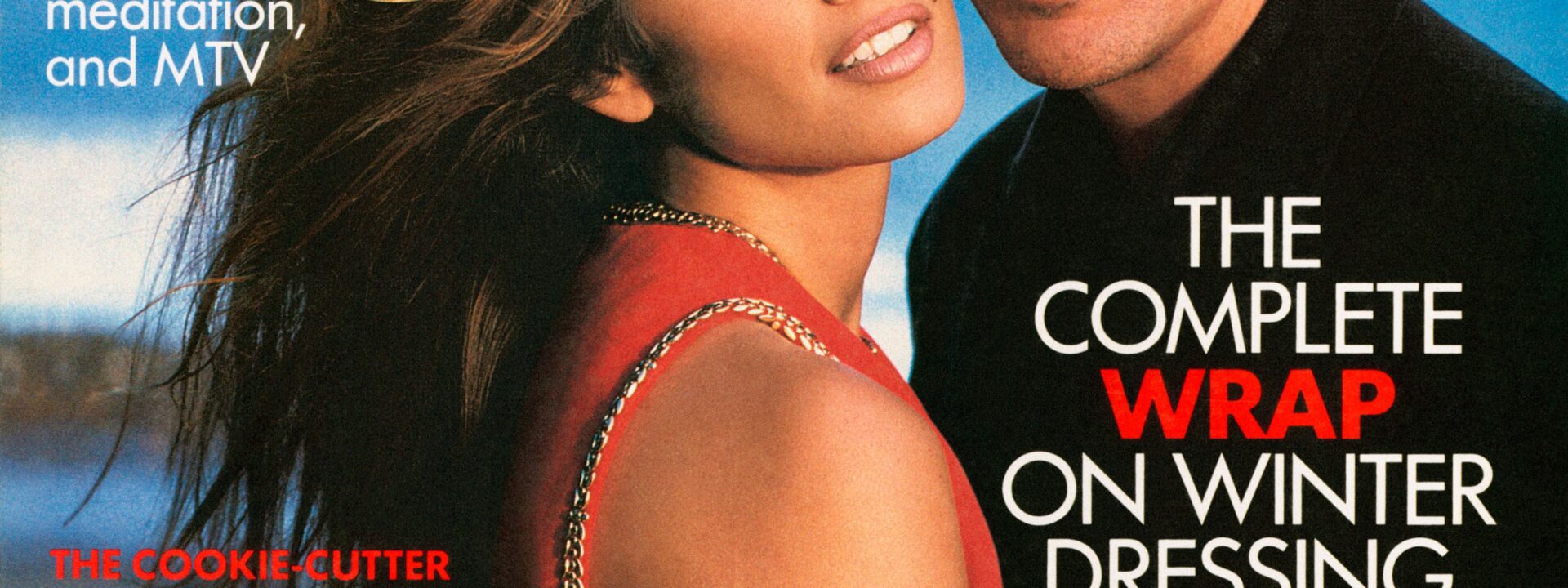
To celebrate Vogue’s September 2026 cover, which features Kaia Gerber and Homer Gere from The Shards, we’ve dug into our archives to bring back a very special cover story from 1992. Yes, we mean the one where Richard Gere and Cindy Crawford—then a year into their marriage—talked about life and work as two halves of a true ’90s power couple. And, needless to say, that joint profile is very much a product of its time. The (first) Bushes were still in office, though not for much longer; Crawford was hosting an MTV talk show; and Brooke Shields and Debra Winger are mentioned in the most dated ways imaginable. (There’s also a Magic Johnson cameo!)
Of course, Crawford has been married to Kaia’s father, Rande Gerber, since 1998, while Gere was married to Homer’s mother, Carey Lowell, from 2002 to 2016, before marrying his current wife, Alejandra Silva, nearly a decade ago. So, all’s well that ends well—but indulge us in a bit of ’90s nostalgia and revisit the full story below.
“The Model and the Movie Star,” by Julia Reed, was originally published in the November 1992 issue of Vogue.
For more of the best from Vogue’s archive, sign up for our Nostalgia newsletter here.
It’s Monday morning, Labor Day, in Los Angeles, and no one—certainly no one famous—is working, except for a small crowd crammed into a tiny room on the fourth floor of Maison Sofitel, where Cindy Crawford, supermodel, rising TV star, and wife of Richard Gere, is getting her makeup done. She’s being made up on Labor Day in Los Angeles because she’s about to tape a segment of MTV’s House of Style, a wildly successful, six-times-a-year, half-hour show that has made Cindy the network’s most popular personality, prompted MTV comedian Denis Leary to jokingly demand the creation of C (Cindy) TV, and motivated her to seriously consider giving up modeling for broadcasting. The segment is being rushed into production so it can air on Wednesday, the day of the MTV Awards, where Cindy will be a presenter and preshow commentator. Her producer, Alisa Bellettini, is very tense. Cindy’s blood sugar drops after five, Bellettini explains officiously—and “entre nous,” of course. There are lots of interviews to tape; we must all stick with the program. The topic is the paparazzi, and the interviews include one with the Los Angeles bureau chief of the National Enquirer, which has just published paparazzi shots (taken with a long lens from a boat) of Vogue’s own photo shoot of Cindy and Richard on the beach.
Cindy, who isn’t tense at all, is focused on choosing a look that will send the right message to the National Enquirer. She knows that even though she’s doing the interview, the tabloid will use the chance to put her on its cover. First, she’s handed a pinstriped Ralph Lauren suit, very businesslike. Then comes a ruffled purple chiffon Anna Sui blouse. “Brilliant!” shrieks the crowd in the hotel room. “Too Elvis,” Cindy says and takes it off. A lot of discussion about blouses follows: what about the Armani linen, does anyone have a plain white T-shirt? Finally, she goes with a very low-key Brooks Brothers blue-and-white stripe belonging to Bellettini, who also offers “some very fabulous YSL cuff links.” “No, thank you,” says Cindy, who rolls up her sleeves instead. “That’s more me.” The hair, too, announces Syd the Hairdresser, will get “the smooth professional look.” It’s pointed out that Brenda Starr always had glamorous hair. “Yeah,” says Cindy, “and look what that role did for Brooke Shields’s career.”
If there’s one thing Cindy Crawford is in absolute control of, it’s her career. At twenty-six, she’s made no Brooke Shields-like missteps, and she won’t. In addition to appearing in almost every major fashion magazine in the world and hosting her own MTV show, she has a five-year, $7 million contract with Revlon, a line of exercise videos, and a carefully managed public image that keeps her in the spotlight without the usual scandals. She’s a master at balancing her supermodel status with her growing TV presence, and she’s determined to keep it that way.She has a contract with Revlon, her own exercise video that she says “takes Jane Fonda further,” and a hugely successful pin-up calendar. Half of the proceeds from that calendar go to research and to helping families of leukemia patients—the disease that killed her brother when they were growing up in De Kalb, Illinois. She and her mother deliver the check together, and “Mom decides where to spend the money.” One year, they bought beds so parents could sleep in their children’s hospital rooms because “Mom remembered what it was like to sleep in a chair.” I tell her that’s wonderful, and she agrees: “That kind of calendar has totally broadened my audience.”
Broadening her audience has always been very important to Cindy. “None of the other models have my range. In the snobby fashion world, I know people have talked about me, but I have my own agenda. There was some thought behind everything, like doing the Playboy shoot [in which she posed for seminude pictures in the July 1988 issue]. It caused a sensation and made a statement.” Now, when she can earn as much as seven thousand dollars for a walk down a runway, at a time when models get more exposure than actresses, Cindy Crawford is getting out of modeling. Her agenda does not, for example, include this month’s New York fashion shows for the first time in her career. Her agenda includes becoming “the Barbara Walters of my generation.”
After three years on MTV, Cindy says she wants to do “more serious things. Alisa and I are like… we can’t only do what kind of shoes you should be wearing, but to do a piece on bulimia in three minutes [as she did in September] is really hard.” The Fox network, the only network besides MTV that Cindy thinks speaks to people her age, has asked Cindy to develop an idea for a talk show: “maybe one fifteen-minute interview, one issue-oriented thing, one trendy thing.” Cindy wants it to be like the Barbara Walters show, but again, she would “take it further—Maria Shriver and all those people, they do the same thing, it’s all the same format.”
Cindy would not, for example, sit with a guest “asking earnest questions. I never find it that interesting where someone’s from. It’s like when I went shopping with L.L. Cool J. Maybe you don’t find out how someone got started, but you find out what it’s like to be around them.” She also thinks younger people will listen to her talk about the importance of safer sex or the dangers of breast implants (“I can say, ‘Hey, you really don’t need this. You can wear padded bras or let it be'”) more than they would to an older, “serious newsperson.”
She says Fox is “very serious,” but that she won’t have time to deal with a new project at least until the spring. Although her “plate is full,” she is weeding things out, accepting only top magazine covers “because Revlon likes it. But I don’t want to model anymore. It’s not that interesting. I’d rather do all these other things that I helped plan instead of showing up and being told what to put on.”
Richard Gere’s career goals are not as concrete as his wife’s. Although he has just finished two movies (Sommersby with Jodie Foster and Mr. Jones, which reunites him with Internal Affairs director Mike Figgis), he says, “I don’t care about acting.” I ask him, then, if he would like to try directing. “I might, but I don’t have a thing about it.” What, then, does he have a thing about? “I’m trying to open my heart, that’s about it.” He laughs. “That’s a hard gig, man, harder than making a movie.”
If Cindy Crawford’s current passion is becoming a figure who delivers information to members of her generation, Richard Gere’s passion is the plight of the Tibetans, who are currently being massacred by the army of the People’s Republic of China. A practicHaving been a Buddhist since the age of twenty-four, Gere is close friends with the Dalai Lama. Five years ago, he founded Tibet House on the Dalai Lama’s behalf—an organization that raises money and awareness about what Gere calls “the genocide that has been going on for the last forty years.” Gere first met the Dalai Lama in Norway in 1989, when the Dalai Lama received the Nobel Peace Prize. He says he will do anything to remove a Bush administration that has such close ties to the Chinese “power elite.” However, “the Clinton campaign hasn’t approached me.”
Gere tells me about meeting the Dalai Lama, and even about meeting his close friend, photographer Herb Ritts—”one of the really, really pleasant people”—but he won’t tell me when he met Cindy. “Oh, I don’t want to talk about this, to tell you the truth.” I already know when he met Cindy—Herb Ritts’s mother introduced them at a 1988 barbecue for Elton John—but I want to know why he won’t tell me himself. “Because it’s not that interesting to me.” I ask if he’ll talk about their relationship at all. “No. We’re not a team, you know; we’re not a dog-and-pony act.”
Photo: Vinnie Zuffante/Getty Images
Now Cindy Crawford is the woman almost every man in the world would like to have. I know this because I was nearly mobbed on the plane back from L.A. when I mentioned to the man next to me that I had just seen her in person. And he’s right about those calendars—everyone’s got them. She could barely film a stand-up on the sidewalk outside the National Enquirer office because of all the commotion around her. Japanese tourists, guys in pick-ups, guys in Porsches—they all stopped: “Cindeeeee! Cindeeeee!” Aldo Coppola, an Italian hairdresser who worked with her at the Milan fashion shows, says, “her sexiness makes me want to hang myself.” Denis Leary says on air that he wants to watch her eat Eskimo Pies naked on the roof of the Empire State Building and warns: “I think you hear me knocking, Richard, and I think I’m coming in.” By the same token, Richard Gere is the man about whom every female in America has a post-Pretty Woman rescue fantasy. I know women who’ve been obsessed ever since he laid out all those Armani outfits in American Gigolo, not to mention since he was laid bare by Debra Winger, who complained about the unpleasantness of their love scene in An Officer and a Gentleman, thereby giving credence to the widespread view that she’s crazy. When Gere says, “Debra’s got her own problems” and that he actually enjoyed himself, you tend to believe him. Anyway, the point is that here they are, these two who have everybody in America in love with them, the perfect storybook—or at least the perfect Hollywood—couple. Yet they are extremely careful to keep their gigs, hard or otherwise, separate.
“Cindy called,” says Gere’s secretary when I’m in his office. “She wants to know what house you’re sleeping in tonight.”
“Tell her,” he says, “I’ll be at the beach.”
“Again, that’s like one of the things in my life,” Cindy tells me when I ask how she juggles a new marriage with so many career duties. “If anything’s a priority, [the marriage] would be it.”
She is, as usual, clear-eyed. “It’s not like there are any surprises. I’m not gonna tell him not to make movies, and he knows I was doing this before.” She says she managed to see Gere almost every other week when he filmed Sommersby in Virginia. It was while he was shooting Mr. Jones in California that they decided to elope to Las Vegas in December 1991 to get married. And they would never, she says, “be apart for a month.”
Last August they were together in India for a “teaching” by the Dalai Lama, where, like everybody else, they contemplated Emptiness with crossed legs and with red blindfolds covering their eyes, aAnd there, when given the choice between Emptiness and Cindy Crawford, most of the Western worshippers went for Cindy, scrambling for photo opportunities as soon as the blindfolds came off. I ask Richard if Cindy, who was raised as a Congregationalist, is interested in becoming a Buddhist. “Cindy is interested in exploring the positive aspects of the universe and herself. But I don’t think she’d ever call herself a Buddhist.” Cindy doesn’t think so either. “I’m interested in my own brand of spirituality, which is mostly at the information-gathering stage right now.” She’s reading about Judaism and other religions and “taking things from each, 10 percent here, 10 percent there. Then I’ll feel like I’ll have my own religion.”
Well, she sort of already does. At the MTV Awards, Mick Jagger slips past the crowds outside virtually unnoticed, Annie Lennox gets polite applause. Cindy walks by in a Versace S&M outfit, her hair piled high like Ann-Margret in Bye Bye Birdie, and the fans and media go wild. In a group of terribly dressed people with bad hair and skin that passes for rock royalty at the event, Cindy is the only real queen. She struts past the ropes, teases the fans by running toward them, mugs with Kris Kross, thrusts out a hip, and puts on attitude for the radio reporters who shove their mics in her face. “You too busy for an annoying little radio reporter?” She flashes a grin. “You’re not so little, but you’re annoying.” But she gives them all sound bites, signs calendars, poses for pictures. “Work it, baby,” her MTV camera crew yells. “Strike the pose.” And she does, clearly enjoying herself.
Perched on a makeshift outdoor stage for the preshow commentary, Cindy is handed a vase of a dozen red roses that Richard managed to get past the roadblocks, the thousands of fans, and the massive security. It’s a feat that could only be pulled off by a famous movie star or for Cindy Crawford. She reads the card: “I love you desperately. Have fun tonight. Richard.” Wow. “Oh, we always leave that message for each other at hotels,” she says, nonchalant, tossing the note aside. She’s far more excited by the arrival of Magic Johnson, the only star who gets close to the applause Cindy received. Climbing off the stage, she puts herself in his path. “Magic is soooo cool.” She introduces herself; they talk, they kiss, their red AIDS ribbons touching. She returns, thrilled, beaming like a child. “That was worth coming here tonight.” I ask her what she said to him. “I told him that the night he announced he was HIV-positive, I had a dream that he was the first to beat AIDS. I wanted to call him and tell him, but by the time I got his number and everything, too much time had passed, and I don’t know, it didn’t seem right. So I told him now.”
There is, in fact, a genuine naïveté about Cindy Crawford, despite her ironclad discipline and unwavering focus. To the National Enquirer editor, she asks such Journalism 101 questions as “What does the Enquirer offer people that they can’t get anywhere else?” while outside his door the staff is offering money to Syd the Hairdresser to expose “the sham marriage of Richard and Cindy.” Inside, she poses for the Enquirer photographer and throws another softball. “Has the concept of the National Enquirer changed over the years?” Bellettini is about to blow a blood vessel while the bureau chief insists that the Enquirer’s stories are “100 percent accurate.” At one point, when he tells Cindy that the tabloid gets much of its information from the stars’ staffs, Cindy gushes that “it’s just scary to me, as a sort of celebrity, that you have to worry about everyone around you.” But when he replies that “you don’t have to worry, Cindy, because you behave yourself,” and that the privacy of people like the Duchess of York deserves to be…He invaded because “she was blatantly misbehaving and she was still married,” Cindy’s Midwestern common sense finally lets her see through the man’s hypocrisy. “And what are you guys?” she fires back. “The moral majority?”
She hasn’t had much practice with interviews, after all—most of her pieces are indeed about shoes and stuff—but her instincts are solid, and she’s right to believe her freshness and youth work in her favor. About Bill Clinton, she says what only someone who went to a big public high school could: “He’s the guy who’d be Most Likely to Succeed, the guy everyone would like except the weirdos. He’s the guy you’d vote for as class president, but I don’t know about the real one. You know, he’d probably play up to the students and the teachers too. And I don’t know if that’s good.” It’s a take on Clinton’s famous fence-sitting that regular people can relate to, especially those after the baby boomers, and it’s one I’ve heard from a man with the sharpest mind I know. He didn’t think it was polished enough to repeat, but Cindy got it too, and she said it.
She might actually have it. “Do I look like Barbara Walters?” she asks, posing in mirrored shades on a balcony where she’d just finished an interview. “How about Diane Sawyer?” No, not really. She looks like Cindy Crawford, and she looks like she enjoys it. Cindy isn’t taking the usual path that ambitious models take toward acting, after all. Instead, she’s going for a new career where she can still be herself. “Cindy prefers the role of Cindy Crawford to anything a screenwriter could create for her,” says Larry Thompson, the owner of her former management company. Most people probably would. Anyway, says her husband, who should know, “Only a crazy person would want to be an actor.” And Cindy Crawford is not crazy.
Frequently Asked Questions
Here is a list of FAQs about the Cindy Crawford and Richard Gere 1992 Vanity Fair cover story written in a natural tone with clear direct answers
General Background
Q What exactly is this From the Archives story
A Its a look back at a famous magazine articlespecifically Vanity Fairs November 1992 cover story featuring the thenmarried power couple Cindy Crawford and Richard Gere The From the Archives feature republishes the original article and photos online for modern readers
Q Why is this particular cover so famous
A A few reasons It was one of the first major magazine covers to feature a top supermodel and a major movie star as a married couple The photos were also famously intimate and playful showing a side of the usually private Gere that the public had never seen before
Q Who took the photographs for the cover story
A The iconic photos were shot by the legendary fashion photographer Herb Ritts His signature blackandwhite style and his close friendship with the couple gave the images a relaxed candid feel
Q Were Cindy and Richard actually married at the time of the interview
A Yes They got married in December 1991 so they had been married for almost a year when the interview was conducted and the photos were taken They divorced in 1995
Q Is this the same as a throwback post on social media
A Yes its essentially the same concept but done in a highquality editorial format Its a formal way for a magazine to revisit its own history and give readers a piece of pop culture nostalgia
Content Details
Q What did they talk about in the interview
A The article covered a range of topics including how they met their very different personalities their careers and how they navigated the intense media scrutiny that came with being a highprofile couple
Q What was the big problem or tension in the story