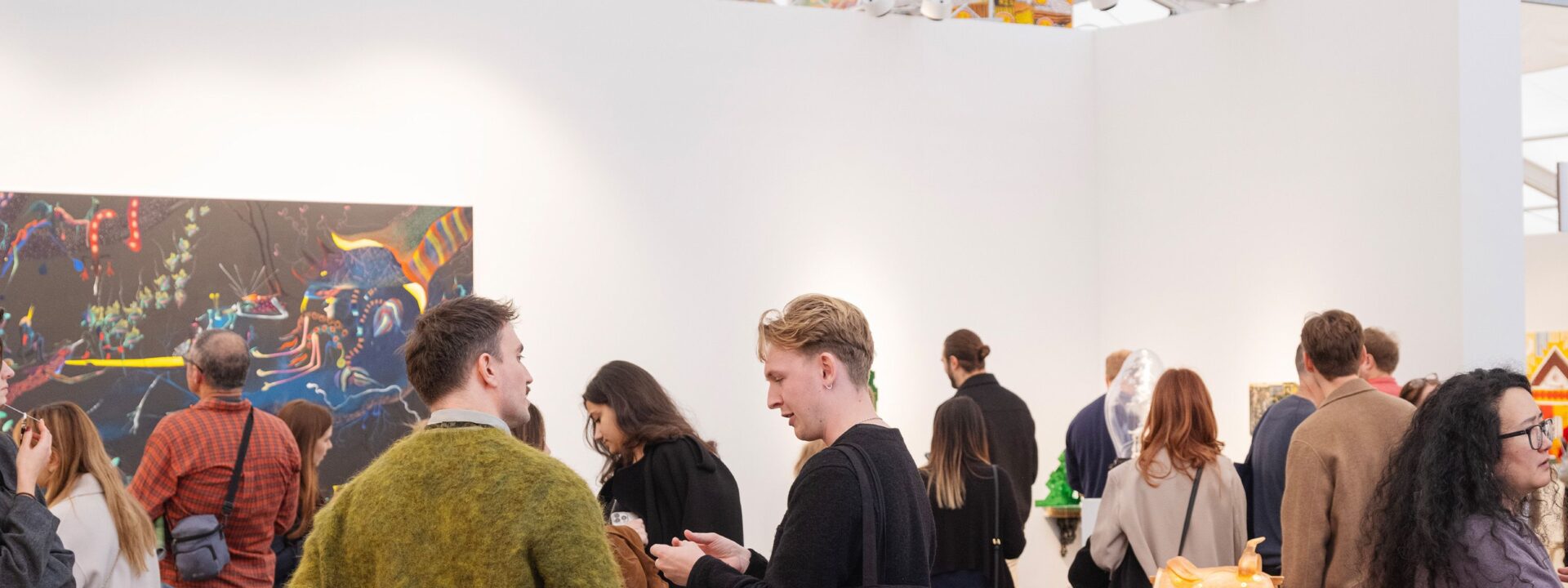
Just as fashion month ends, one of the busiest times in the commercial art world begins: a series of major art fairs across Europe, America, and the Middle East leading up to the holiday season. First is the London edition of Frieze, a long-standing highlight on the global art calendar that draws wealthy collectors, advisors, dealers, curators, institutional directors, and enthusiasts to the British capital every year. The week centers on two fairs on either side of Regent’s Park — Frieze London, focused on contemporary art, and Frieze Masters, which mainly shows historical works — and features major exhibition openings, brand events, parties, and star-studded gatherings. But how much is there to celebrate? Culturally, London’s artistic heritage — its status as home to some of the world’s most respected institutions and a source of cutting-edge talent — remains unchallenged (and well worth toasting). While recent headlines about the UK art market have usually been gloomy, on the ground there’s a noticeable buoyancy — or at least a make-do optimism. In a more localized art fair ecosystem — with a global run of events that even the most avid frequent flyer would struggle to keep up with — galleries seem to be innovating by making the most of what London offers: access to a diverse audience; the freedom to take bolder curatorial risks; and its uniquely interconnected network of creative industries, rather than trying to copy established formulas. Beyond the art world, players in the city’s broader luxury ecosystem are also committing, with ambitious activations across London’s fashion, retail, and hospitality institutions. Here’s everything you need to know about this year’s Frieze London, which runs from October 15 to 19. Is London back? The mood in the British art market hasn’t been the brightest in recent years. “The market has changed across the board, and I don’t think anyone should pretend otherwise,” says Eva Langret, Frieze’s director of EMEA (Europe, the Middle East, and Africa). “Collectors take more time. Galleries have had to make difficult choices when faced with challenges, and bringing a booth to a fair comes at a cost.” Chemould CoLab, Jayeeta Chatterjee, When a child itself a mother, 2024. Photo: Courtesy of the artist and Chemould CoLab “People are being more considered about buying,” says Freddie Powell, owner and director of Farringdon gallery Ginny on Frederick. For Powell, however, a more pressing threat to galleries’ bottom lines than a lull in demand is the surge in operational costs — many of which, given the globally networked nature of the art business, have spiked in the wake of ongoing geopolitical crises. “The pressure will always come from rising costs, from shipping to producing an exhibition; galleries have to work harder to make the same things happen.” This combination of buyers’ caution and increased overheads has prompted notable gallery closures and operational downsizings, with Mayfair veteran Stephen Friedman Gallery and Tiwani Contemporary, one of few London galleries specializing in contemporary art, among related shutterings. In June, Pace, one of the art world’s true mega-galleries, announced that it would be vacating its Mayfair location, and moving into a smaller, “less corporate” space — a move accompanied by a downsizing of both its artist roster and staff headcount. Still, a “London is back” optimism — green shoots of which were seen last year — has continued to flourish. “The mood in London feels revitalized,” notes Kabir Jhala, The Art Newspaper’s art market editor, highlighting “record-breaking evening sales of single-owner collections” at auctions worldwide, including in London, where Tottenham Hotspur owner Joe Lewis’s collection — including paintings by Amedeo Modigliani, Claude Monet and Lucien Freud — reached a hammer price of £249.3 million atSotheby’s in June. “There is a sense that the top end of the market is back in full swing.” Alice Neel, John Cheim, 1979.
Photo: Courtesy of the Estate of Alice Neel, David Zwirner and Victoria Miro. Still, market pessimism can be felt globally, not just in London. “To quote one young dealer who just moved here from Berlin [Pauline Seguin of Heidi], ‘Everyone expected London to fall off a cliff post-Brexit; but then everywhere else turned to shit, too,’” he recalls. “There’s a sense that dealers and artists still value having a presence in London this week. Maybe the Cool Britannia revival is having its intended effect.” While the cultural impact of a resurgence in British soft power may be hard to quantify, there’s clearly faith in what London can offer the artists who choose to stick it out there. “London gives us a head start,” Langret says. “Artists increasingly want to live and work here because of its depth, and galleries are expanding. When the people making the work choose a city, everything else tends to follow, and London’s diversity is a big part of that.” “I’m going into the week feeling optimistic,” echoes Powell. “We’re bringing new work we’re excited about, and the fair is full of artists I want to see. There is plenty to look forward to, and I’d like to leave some room for that in the conversation about the market over doom and gloom.” Inside the tents This year’s Frieze London and Frieze Masters will host 312 exhibitor presentations combined, spanning 48 countries and regions, with around 100 more participating galleries than Art Basel Paris — the competitor fair across the channel that opens directly after Frieze London. While it’s widely acknowledged “that Art Basel Paris has stolen some of the spotlight from Frieze — particularly those coveted, deep-pocketed American collectors who now favor the Paris fair,” Jhala observes, he cites Frieze London’s plenitude as a distinguishing factor. Selebe Yoon, Arébénor Basséne, Sirius 2, 2026.
Photo: Khalifa Husseinm, courtesy Selebe Yoon, Dakar. There’s a greater diversity of voices than in Paris, he adds, with the fair offering a truly global forum for dealers. This year’s fair welcomes galleries from São Paulo, Lima, Jeddah, Cairo, Mumbai and Kyiv, according to Langret, “showing alongside some of the most exciting young galleries and many of the world’s leading names from the US and Europe.” “Our job is very clear: to give galleries a reason to be here and help them build the relationships that last beyond the week,” she continues. “In a market where galleries are choosing carefully where to show, that tells you something. Frieze London is an important platform; it’s a place where a gallery from the other side of the world can put an artist in front of the international art world, often for the first time. That feeling is unmatched — and that’s what it’s all for.” Among the galleries debuting this year, Powell cites Linseed from Shanghai, Chemould CoLab from Mumbai, and Theta from New York. They can be found in the fair’s Focus section, an area dedicated to emerging artists and young international galleries, with support from Stone Island. The sector’s relocation to the front of the fair in 2024 marked a statement of intent: placing rising names at the forefront of Frieze London’s MO. It amplified the energy among its participants, Powell notes. “Ambition hasn’t gone anywhere,” he says, having joined the Frieze Focus selection committee this year. “Younger galleries are putting real resources into distinctive presentations. Galleries are still giving artists room to take risks. There is conviction in that.” Read More Serpentine’s Hans Ulrich Obrist: Creatives Must Help Shape AI By Amy O’Brien At Frieze Masters, this is the sophomore edition with Emanuela Tarizzo at the helm, who generated fresh buzz for her dynamic approach to the fair’s programming. Highlights of the forthcoming edition include Queering Modernism: A New Visual History, a curated section diving iinto gender, sexuality, and queer representation in 20th-century art; Spotlight, which aims to bring influential but overlooked 20th-century artists into the spotlight; and a 26th-Dynasty bronze of the ancient Egyptian creator god Ptah, once owned by William Randolph Hearst and believed to have inspired the original Oscar statuette.
The brand activations
Luxury brands are set to benefit as well. Their presence will be visible across sponsored fair sections, exhibitions, talk programs, and even the official opening dinner. At Frieze London, Tiffany & Co. remains one of the most prominent partners, sponsoring the Artist-to-Artist section for a second year and inviting seven established artists to nominate a rising talent they admire.
At Frieze Masters, De Beers returns with an immersive installation tracing the origins of natural diamonds, and Dunhill also comes back with a highly anticipated talks program featuring figures such as Es Devlin, Grayson Perry, Paul Pfeiffer, and Danh Vô. “With our partners, what matters to me is that they start with artists,” Langret explains, pointing to Stone Island’s four-year partnership on Frieze London’s Focus section as a particularly successful example of a brand-art fair relationship. “Every gallery in the section gets a bursary, and every year an artist from Focus designs the staff uniform.” This year’s uniform was created by Arébénor Basséne, a Senegalese artist presenting a solo booth in the sector with Dakar-based Selebe Yoon. The garment will also be sold at The Corner Shop at Selfridges during the week, extending the partnership beyond the fair itself.
While the benefits of partnerships are clear for fairs like Frieze — lowering barriers to entry for artists and galleries that could go on to shape the art world — the rewards for brands are more abstract and slower to produce a return on investment. Their motivations tend to center on positive alignment and nurturing the cultural environment a brand inhabits, rather than expecting immediate, measurable gains.
A spread from Six by Comme des Garçons, on show as part of a special installation at Dover Street Market.
Photo: Courtesy of Dover Street Market
“Stone Island has always been driven by research, experimentation, and a willingness to challenge convention. We recognized that same spirit in Focus and the emerging galleries and artists it brings together,” says Robert Triefus, Stone Island’s CEO. “Through the bursaries, we can make a tangible contribution to their participation. Contemporary art is also an important interest within our global community, so the partnership connects our own creative philosophy with a culture our community cares about.”
“Frieze London combines international reach with a strong sense of discovery, and Focus brings fresh perspectives into the heart of the fair, making it a compelling place to connect with artists, galleries, and collectors,” he continues, hinting at the possibility of more direct collaborations between brands and artists as partnerships develop. “We want the partnership to evolve in ways that create meaningful opportunities for artists and bring our community closer to their work.”
Beyond the tents
Step beyond the fairs and you’ll find an almost overwhelming spread of events. “Museums and institutions open their doors for celebrations, galleries host big dinners every night, and there’s the British Museum Ball on Saturday,” Langret says, with the museum’s second edition of its grand fundraising event chaired this year by hedge fund billionaire Igor Tulchinsky. “Dinners, collection and foundation visits, parties, exhibition openings… You can start the day with breakfast in a museum and end it at a young gallery’s party on the other side of London.”
On the exhibition front, a very abbreviated selection of standout shows opening alongside the fairs includes Tarek Atoui’s transformation of Tate Modern’s Turbine Hall into a gigantic sonic instrument; dual solo shows by Lorna Simpson and Cindy Sherman at Hauser & Wirth, the latter of whIt was produced with support from Chanel Patrimoine, the brand’s archive and heritage division; Salman Toor’s dreamlike emerald paintings at the Courtauld Gallery; and Justin Caguiat’s psychedelic graphic canvases at Serpentine South Gallery. Tarek Atoui’s installation for the Hyundai Commission at the Tate Modern’s Turbine Hall.
Photo: Courtesy of the Tate. There is also a long list of brand events happening across the city almost every night, including a takeover of a popular Marylebone pub by Prada-owned Church’s, a party hosted by JW Anderson and Ugg to celebrate their new collaboration; private dinners by Jimmy Choo and Chanel, the latter to mark the launch of the second edition of its Arts & Culture magazine; and even the unveiling of a new collaboration between Acne Studios and Hussein Chalayan at a private event on October 14. The city’s top luxury retail destinations are also full of activity, most notably Dover Street Market (DSM), which will use the occasion to present “an incredible installation designed by Rei Kawakubo, featuring iconic imagery from Six magazine, the legendary Comme des Garçons publication from the late 1980s and early 1990s,” explains Dickon Bowden, DSM’s global vice president. The store will also host its annual Open House, bringing together “a fantastic mix of projects and collaborations with Matières Fécales, Michèle Lamy, Susie Cave, Tim Walker, Solange Azagury-Partridge, Martine Rose, Ministry of Sound, Denim Tears, Hauser & Wirth and Stephen Jones, to name but a few,” he adds. “Frieze has been a hugely important time of year for us at DSM for many years, bringing together a diverse mix of creatives and collaborators alongside our friends and clients.” On Mount Street — in Mayfair, one of the city’s luxury shopping districts — there will be the third edition of the Mount Street Neighborhood Arts Festival, a calmer, more experience-driven counterpart to the buzz of the Frieze tents. “What happens around [the Frieze tents] gives the week its texture: a slower pace, a sense of place, and room for conversations. Mount Street has that naturally,” says Henry Hunter, Mayfair retail director at Grosvenor Group, which manages a significant portion of the street. “The clearest lesson from the first two editions was that people don’t just want to see art on Mount Street, they want to spend time here and take part,” with the program unfolding across art book publisher pop-ups, performances, and even a photo studio by esteemed photographer Miles Aldridge. Mount Street Neighbourhood Arts Festival features a pop-up studio by British photographer Miles Aldridge, where he’ll be shooting members of the public for his portrait series, 15 Minutes of Fame.
Photo: Courtesy of Mount Street Neighbourhood Arts Festival. More than an opportunity for community get-togethers and convivial hangouts, however, Frieze offers a windfall opportunity for the city’s luxury retail ecosystem. “Frieze draws a concentrated international audience of collectors and high-net-worth visitors,” Hunter says, noting that “in previous years, businesses on Mount Street have reported a double-digit lift in sales during Frieze week. But what we hear consistently is the impact on new client relationships — Frieze week is about introducing the right people to the neighborhood at a time when they’re open to discovery.” It’s a lifestyle. An intriguing development around this year’s Frieze is the swell in activations among London’s luxury lifestyle sector. That’s reflected in attempts to turn the Frieze tents into enticing “places to spend the whole day”, Langret says, highlighting pop-ups from some of the city’s buzziest restaurants — Jikoni, Maison François, Sessions Arts Club, and more. There’s also a new partnership between Frieze and luxury travel brand Mr & Mrs Smith, which will translate into an exhibition of commissioned photographs — including unseen images by Tina Barney and Martin Parr — at FriezHis permanent gallery is in Mayfair. There is also a surge of art programming across the city’s fleet of elite hotels. The Chancery Rosewood, one of Mayfair’s most lavish recent openings, will host a new boutique art fair, the London Invitational, while the original Rosewood in Holborn, The Peninsula, The Dorchester and 45 Park Lane are each hosting exhibitions, talks and art-centered events throughout the week. The Chancery Rosewood, location of the London Invitational art fair. Photo: Courtesy of the London Invitational. It’s a move that chimes with luxury’s widely attested shift toward the experiential, with contemporary art offering ready-made exclusivity and cachet — not to mention a draw for potential clients to be bowled over by plush properties. “We see luxury hospitality as being about more than the stay itself; it’s about creating a meaningful connection with the culture and community around us,” says Sandia Scott, head of rooms at The Newman, a new luxury hotel in Fitzrovia that will host independent art fair Minor Attractions over the course of Frieze. “London’s relationship between art and hospitality is evolving. Hotels are increasingly becoming cultural destinations in their own right, offering a platform for creative exchange and experiences that extend beyond the traditional gallery setting.” While there’s cause to acknowledge the market uncertainty among which Frieze London is taking place, what’s notable about this edition is a prevailing sense of good faith in what makes the fair distinct. “Frieze London brings together people from art, fashion, film and music in a city where those worlds already overlap like nowhere else. That lethal mix gives the fair a magic personality of its own,” Powell says. “It’s a week that now reaches well beyond the art world,” Langret adds. “Designers, musicians, chefs and filmmakers come to see what artists are doing, and many of them end up collecting. I love that, because art is at its best when it’s shared — and Frieze Week is London at its most open.” Minor Attractions transforms The Newman Hotel with contemporary art across 16 bedrooms on its first floor. Photo: Courtesy of Minor Attractions.
Frequently Asked Questions
Here is a list of FAQs about the Frieze London 2026 Cheat Sheet designed to help both firsttimers and seasoned art fair visitors navigate the event
General Beginner Questions
What exactly is the Frieze London 2026 Cheat Sheet
It is a quickreference guide designed to help you navigate the fair It usually includes a map of the booths a list of mustsee galleries the schedule of talks and tips on where to eat or relax
When and where is Frieze London 2026 taking place
Frieze London 2026 will take place in October 2026 It is held in The Regents Park London inside a custombuilt tent structure
Do I need a separate ticket for Frieze Masters
Yes Frieze London and Frieze Masters are separate fairs that happen simultaneously next to each other You need a specific ticket for each or a combined ticket if you want to see both
What is the Focus section
Focus is a section of the fair dedicated to galleries that have been open for 12 years or less It is a great place to discover emerging artists and younger galleries often with more affordable price points
Is there a dress code
No there is no official dress code However the vibe is generally smart casual Wear comfortable shoes because you will be walking and standing on concrete floors for hours
Can I buy art at the fair
Absolutely Every gallery is there to sell If you see something you like you can ask the gallery staff for a price list Dont be shythey expect people to ask
Practical Tips Logistics
What is the best day to visit
VIPPreview Days Best for serious collectors and seeing the art before it sells out It is crowded with industry people
Public Days Better for general viewing Friday is usually quieter than the weekend
Sunday Often the most relaxed day but some galleries may have sold their best pieces by then
How do I avoid the crowds
Go early The doors usually open at 1100 AM Arrive right at opening or go