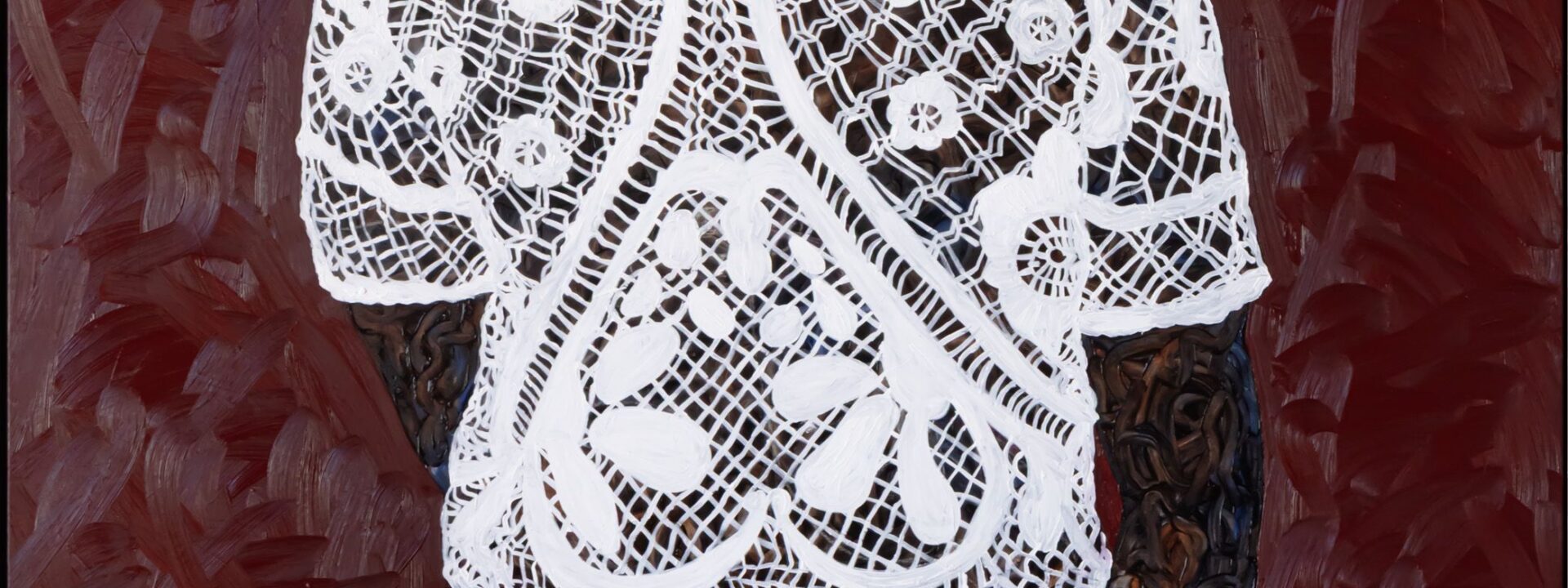
Presenting his first solo show in Italy was not something Amoako Boafo took lightly. It’s “meaningful because of the weight of [Italy’s] art historical legacy, especially in a place like Venice,” the Ghanaian artist, known for his finger-painted portraits of stylish Black subjects, tells Vogue. “But for me, it was never about entering that history as an outsider looking in. It was about creating a conversation with it.”
The artist
Photo: Nii Odzenma
Produced by Gagosian, “Amoako Boafo: It doesn’t have to always make sense” opened this May at the Museo di Palazzo Grimani during the 61st Venice Biennale and is on view through November 22. As a state museum just minutes from San Marco, Palazzo Grimani is a beloved gem of Renaissance art. Its immersive Tribuna—known as a “Chamber of Antiquities”—is filled with ancient sculptures. Elsewhere in the space, visitors will find a series of large-scale abstract works by Georg Baselitz, created for the Sala del Portego’s 18th-century stucco-framed panels, where portraits of the Grimani family hung until the end of the 19th century.
Boafo was a perfect fit for the museum’s historic galleries. “I tried to work with the space respectfully, honoring the building’s legacy while also bringing my own history into it,” he says. He adds that visiting Venice as a student and returning as an exhibiting artist has been a “full-circle” moment.
In recent years, Boafo’s exhibitions have become more immersive and personal. Last year, for a show at Gagosian’s London location, he worked with architect and designer Glenn DeRoche of DeRoche Projects to recreate the courtyard of the artist’s childhood home in Ghana (where he remembers learning to paint) inside the gallery. “We have a shared understanding of how space can shape both experience and community,” says Boafo, who previously worked with DeRoche on Dot Ateliers Ogbojo, the writers’ and curators’ residency program Boafo founded in Ogbojo, Ghana, in 2024.
Amoako Boafo, Parrots, 2026. Oil on canvas. 74 7/8 × 56 3/4 inches (190 × 144 cm).
Photo: Leonardo Cestari. Courtesy the artist and Gagosian
The central role of community in Boafo’s work comes through vividly in the exhibition, starting with a video that shows the artist at home, in the studio, on the tennis court (he played semi-professionally), and beyond. There are also works by Boafo’s friends and collaborators. A realistic resin-and-plaster-cast sculpture of a woman in an ivy-leaf-printed bra, made with his friend Stephen Allotey, is placed next to Boafo’s 2023 portrait of a woman sticking out her tongue. (Both the painting and the sculpture use a paper-transfer technique to add floral patterns to the figures’ clothing.) On several walls, poems by Ghanaian poet Raphael Worlasi Langani, written for the exhibition, are featured. In one of the final rooms, a poem titled Darkness is paired with Boafo’s All Black painting (2026), his first black-on-black portrait. “There’s a strong connection between visual language and poetry for me… My studio isn’t an isolated space—it’s full of conversations, exchange, and community,” Boafo says.
Amoako Boafo, All Black, 2026. Oil on canvas.
Photo: Leonardo Cestari. Courtesy the artist and Gagosian
Amoako Boafo, Striped Blouse, 2023. Oil on canvas. 35 1/2 × 31 1/2 inches (90 × 80 cm).
Photo: Leonardo Cestari. Courtesy the artist and Gagosian
That sense of community is also reflected in the portraits themselves, especially in a gallery with what Boafo calls the “heroine wall,” made up of 11 mostly bust-length portraits of women against a marigold-colored background. Representing friends, family, and people he admires, the portraits include Koyo Kouoh, the late executive director and chief curator of the Zeitz Museum of Contemporary Art Africa in Cape Town, who was also the 2026 Venice Biennale curator.The artistic director of the Biennale. The Cameroonian-Swiss curator made history as the first African woman chosen to curate the Biennale before she passed away last year.
The “heroine wall” in “It doesn’t have to always make sense” at the Museo di Palazzo Grimani.
Photo: Leonardo Cestari. Courtesy of the artist, Gagosian, and the National Archaeological Museums of Venice and the Lagoon.
This wall marks another first for Boafo: he has never used embroidery techniques in his paintings before. In White Swimsuit (2026), a stunning display of texture, the figure with wispy eyelashes looks back, and the threads of her halter-top almost blend into the background. Later in the exhibition, Boafo’s embroidery appears again—more simply this time—in Two Faces (2021–25), where a painted figure holds a child that is almost entirely embroidered. Boafo is known for finger-painting his subjects’ skin while using looser brushstrokes for their backgrounds and clothes, but here he depicts the younger figure’s skin tone with a patchwork of brown threads. “I wanted certain elements to have a stronger physical presence, not just to be seen visually, but to carry their own materiality,” he explains. “Textiles already play a big role in how I think about identity, presence, and character, so adding embroidery to the work felt like a natural step.”
Boafo calls Venetian lace another “major influence” on the show, both in the artworks and the exhibition design. “Back home, if someone is celebrating an occasion with a touch of luxury, you think of lace,” he says. “It carries a certain presence and respect, whether it’s expensive or simple.” The show opens with Mozzarella White Lace Top (2026), which is over six feet tall. Its deep maroon background is echoed in the gallery’s wallpaper, which features a damask pattern. The introductory text describes this pattern as “historically used for church and home furnishings, as well as for the fancy clothes of Venetian nobility.” Later in the exhibition, two elegant portraits of women in off-the-shoulder dresses—one in turquoise lace and one in red lace—hang side by side.
The exhibition’s pacing—one or two paintings per room, except for the heroine wall—allows for intimate moments with Boafo’s striking portraits and the palazzo’s historic architecture. Set against terrazzo floors and wooden ceilings, the works feel like a modern addition that fits right in. “Venetian portraiture has long shaped ideas of prestige, beauty, status, and power. What interested me is what happens when my subjects enter that tradition, and they aren’t intimidated by it. They aren’t just visitors; they are asserting their own identities,” Boafo says. “Placing Black portraiture in a place like Palazzo Grimani is a way to connect classical tradition with contemporary Black experience. For me, painting is really about documenting and celebrating Blackness. I want the figures in my paintings to be strong and unapologetic.”
Frequently Asked Questions
Here is a list of FAQs about Amoako Boafos first solo exhibition in Italy inspired by Venices artistic history
Beginner Questions
1 Who is Amoako Boafo
Amoako Boafo is a contemporary Ghanaian artist known for his vibrant expressive portraits He often paints Black figures with bold colors and textured brushstrokes usually focusing on hands and fingers
2 Where was this exhibition held
It was held in Venice Italy at the Museo di Palazzo Grimani a historic Renaissance palace
3 Why did Boafo choose Venice for his first Italian solo show
Boafo was inspired by Venices rich artistic history especially the works of Renaissance painters like Titian and Tintoretto who also used dramatic color and emotional expression He wanted to connect his modern portraits with that tradition
4 What was the exhibition called
The exhibition was titled Amoako Boafo I See You
5 How is this exhibition different from his previous shows
This show was sitespecific meaning the art was created to dialogue with the palaces architecture and its historical paintings Its not just a gallery hang the rooms themselves become part of the artwork
Advanced Questions
6 How exactly did Venetian Renaissance art influence Boafos paintings in this show
Boafo borrowed the Renaissance use of chiaroscuro and the intense saturated colors found in Titians works He also referenced the way Venetian artists posed figures in intimate threequarter views but he replaced their religious or mythological subjects with contemporary Black sitters
7 Did Boafo directly copy any Renaissance paintings
No he didnt copy them Instead he recontextualized them For example he used the same dramatic lighting and deep reds of a Titian portrait but painted a young Black man in modern streetwear Its a conversation not a copy
8 What role did the Palazzo Grimani building itself play in the exhibition
The building was a costar The paintings were hung in specific roomslike the Tribune which has a famous frescoed ceilingso that Boafos figures seemed to be looking at or interacting with the Renaissance decor It