When a major new Helmut Lang exhibition opens in Vienna on December 10, it will have been 7,625 days since the designer announced his departure from his own brand. The MAK’s exhibition, “Helmut Lang Séance De Travail 1986–2005,” shows how Lang—now working as an artist—continues to influence how we experience fashion. This influence extends beyond the runway to include brand identity, expressed internally, through retail, and via external communication.
The museum is uniquely positioned to explore this, as it houses the largest Helmut Lang archive. Thanks partly to a donation from the designer in 2011, the archive contains 10,000 items. Some are garments, but most are materials—lookbooks, ad campaigns, Polaroids, proofs, tear sheets, backstage passes—that document the unseen work behind building the iconic label.
One goal of the exhibition is to fulfill Lang’s wish that the MAK’s holdings serve as a “living archive.” In a statement, Lang said, “I hope it inspires others to have the courage to find their own voice. The past is never easier than the present; the present is always the opportunity.”
Over two years, MAK’s General Director Lilli Hollein has creatively engaged with Lang’s complete legacy. The Vienna show acts as a bookend to last year’s “Helmut Lang: What Remains Behind,” an exhibition of Lang’s sculptures at the MAK Center’s Schindler House in Los Angeles. However, Hollein rejects categorizing one show as solely about art and the other solely about fashion.
Curator Marlies Wirth notes that Lang approached fashion “the same way that artists would approach their work. So my claim is he was always an artist. He just did not call himself an artist.” Hollein adds, “Helmut Lang Séance De Travail 1986–2005 is more than a fashion exhibition. Simply showing garments on mannequins would not be the right approach. Architecture, collaborations with artists—especially female artists—advertising, and dramaturgy are all key to understanding his enormously visionary approach. What we are showing is immersive in a special way. We take you backstage, to the stores and the atelier. You will intuitively understand the essence of his work and why this brand was such an epitome of coolness and continues to influence so many designers today.” (Evidence of this is abundant in the Spring 2026 collections.)
Organized into five parts, the exhibition traces Lang’s entire fashion career. It opens with his groundbreaking Fall 1998 show, which was presented on CD-ROM. Reflecting on this innovation in 2016, Lang explained, “This was when I moved my company from Europe to the United States. I felt it was a new beginning for me and for how to communicate my work. I sensed the internet would grow into something much bigger than imaginable, so I thought it was the right moment to challenge the norm and present the collection online. It was a shock to the system, but the beginning of a new normal. That season, we also made the entire collection available on a public platform, giving consumers an unfiltered view of my work for the first time.” Like many of Lang’s pioneering moves, his embrace of technology is something we now take for granted.Greet, New York (2004).
The visitor moves from LED screens to see an actual example of the brand’s rule-breaking taxi-top advertisement, a partial recreation of the Greene Street store, and photographic documentation of it. New York’s importance as a place is clear in Lang’s work. More significantly, the city influenced Lang’s way of being—or rather, his way of being was perfectly in sync with New York at the time. “We all know it’s a city that never sleeps… You don’t just walk when the light turns green; you anticipate walking,” says Wirth. That restlessness and unpredictability helped shape Lang’s philosophy of dress: “You live your life, you should be ready for living your life, and the clothes should adapt to you; you should not adapt to the clothes,” she notes.
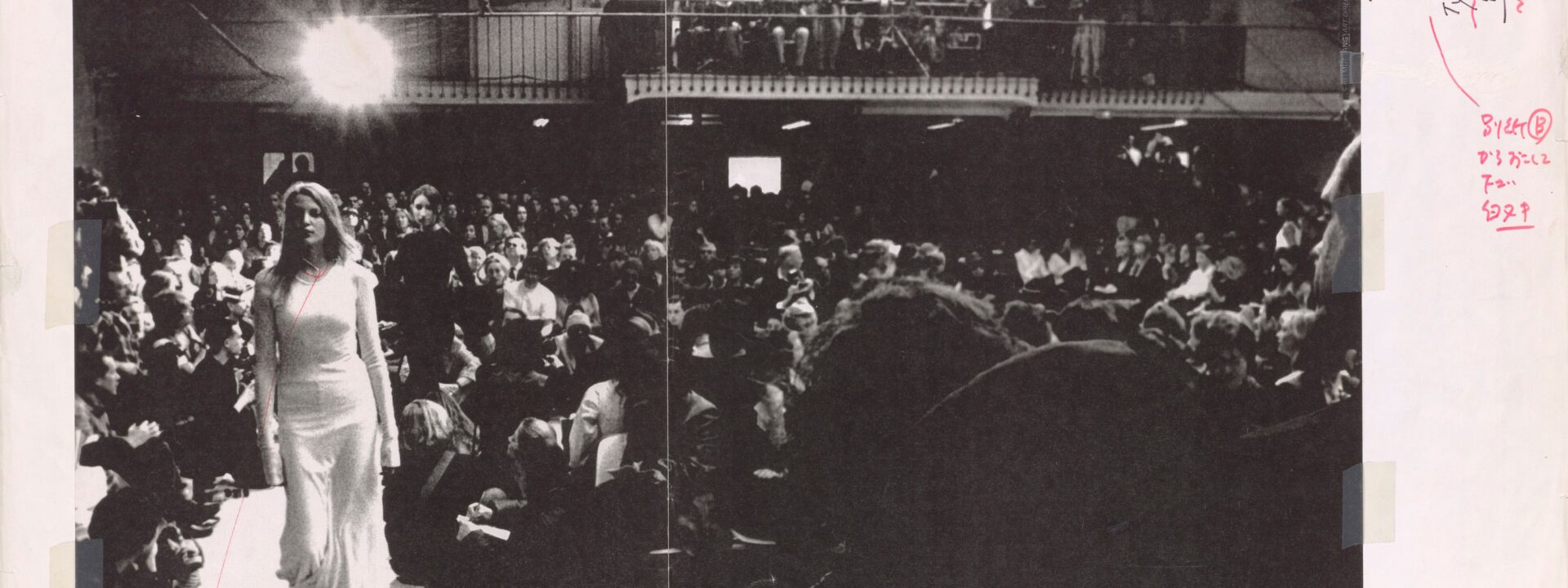
The centerpiece of the immersive Séance De Travail section is a large seating plan printed onto the floor. Lang chose art galleries as venues, where guests were sometimes seated neatly in rows and at other times crowded close to the models. This section also features show invitations and 3,000 digitized lookbook images on touch screens, allowing visitors to customize their experience.
Materials in the Made to Measure and Perfumery sections focus largely on advertising, including Lang’s famous “I Smell You on My Skin” project with Jenny Holzer. Notable here is the designer’s use of white space in ads, his infrequent use of models showing actual products or garments, and his collaborations with the Robert Mapplethorpe Estate and a group of living photographers, each bringing a distinct view to the brand.
Near the finished advertisements are layouts with handwritten notes. Wirth explains that the idea was to let visitors “learn about the process. That’s the main concept of the show: get into the mindset of Helmut Lang; maybe try to understand the analog media history of how things worked when you didn’t just click a button in InDesign but had to send layouts back and forth by messenger and test things.”
From there, the visitor proceeds to the Backstage section. On view are Polaroids of the design process and collection fittings that, the curator says, “show all the intricate hidden labor and collective work that goes into the whole thing.” Her aim, she explains, is “to highlight that backstage is more than just access with a little wristband. It is a whole world of relationships, stress, exact timing, preparation, and detail that happens collectively before you enter the runway with the finished look.”
When it comes to the actual garments, Wirth wanted to emphasize how Lang transformed tailoring from something traditional, almost outdated, into something dynamic. She highlights texture (like the lace embedded in latex on ‘the 1994 dress of the year’ and stingray bags) and the concept of adaptability (which extended from garments to fragrances). Speaking of one of Lang’s signature jackets with built-in shoulder straps, she says, “it’s not only worn; it can be deployed.”
A subsection within this section…The brand’s focus on media and cultural presence is dedicated to artist collaborations, which include everything from in-store installations to the selection of photographers.
The “Helmut Lang Séance De Travail 1986–2005” exhibition is more than just a fashion show, and Lang was more than just a minimalist. As Wirth explains, “Lang grew up in the Austrian countryside, and his grandfather was a shoemaker. We use the term ‘essentialism’ rather than minimalism to describe his approach, because it’s about stripping things down to their core essence. He looked at workwear or a well-made shoe from the perspective that it must be durable, high-quality, and made from good materials, but also that it must serve a purpose—to protect or to enable you to do a certain job. He then translated that into his visual language.” In other words, it was design for living.
Wirth argues that one of Lang’s greatest legacies is this “cultural insertion”—focusing not on product consumption or the brand itself, but on the idea that we exist as individuals within a larger social construct. The notion that we are part of something bigger, connected to community rather than just commerce, is especially important in this era of societal division. Lang’s work remains relevant because it consistently and uncompromisingly united aesthetics with purpose and progress.
“Helmut Lang Séance De Travail 1986–2005: Excerpts From The MAK Helmut Lang Archive” will be on view at the MAK from December 10, 2025, to May 3, 2026.
Frequently Asked Questions
Of course Here is a list of FAQs about the new Helmut Lang exhibition in Vienna designed to be helpful for both newcomers and fashion enthusiasts
General Information
Q What is this exhibition about
A Its a major exhibition exploring the work and influence of Austrian fashion designer Helmut Lang It goes beyond clothing to showcase his artistic vision collaborations and impact on contemporary culture
Q Where and when is the exhibition taking place
A The exhibition is at the MAK Museum of Applied Arts in Vienna You should check the MAK website for the exact dates as exhibitions often have specific run times
Q Who is Helmut Lang
A Helmut Lang is an Austrian fashion designer who became globally famous in the 1990s and early 2000s He is known for a minimalist avantgarde and often industrial aesthetic that redefined modern luxury and streetwear
Visiting the Exhibition
Q Do I need to buy tickets in advance
A Its highly recommended especially for weekends or peak times You can usually purchase timedentry tickets online through the MAK museums official website
Q What can I expect to see there
A You can expect to see a mix of iconic garments archival materials photography artistic installations and collaborative works that illustrate Langs creative process and his connections to art and architecture
Q Is the exhibition suitable for people who arent into fashion
A Absolutely While fashion is the core the exhibition frames Lang as a cultural figure It explores themes of art design advertising and the spirit of the 1990s making it engaging for anyone interested in contemporary culture
Q How long does it take to go through the exhibition
A Most visitors spend between 1 to 15 hours but you could easily spend longer if you want to engage deeply with the materials and multimedia displays
Deeper Dive Context
Q Why is Helmut Lang considered so influential
A Lang pioneered minimalist chic using unconventional materials like rubber metal and synthetic fabrics He blurred the lines between high fashion and utilitarian workwear and his advertising campaigns were groundbreaking artistic statements
Q Ive heard about his archive What does that refer to
A In 2005 Lang famously