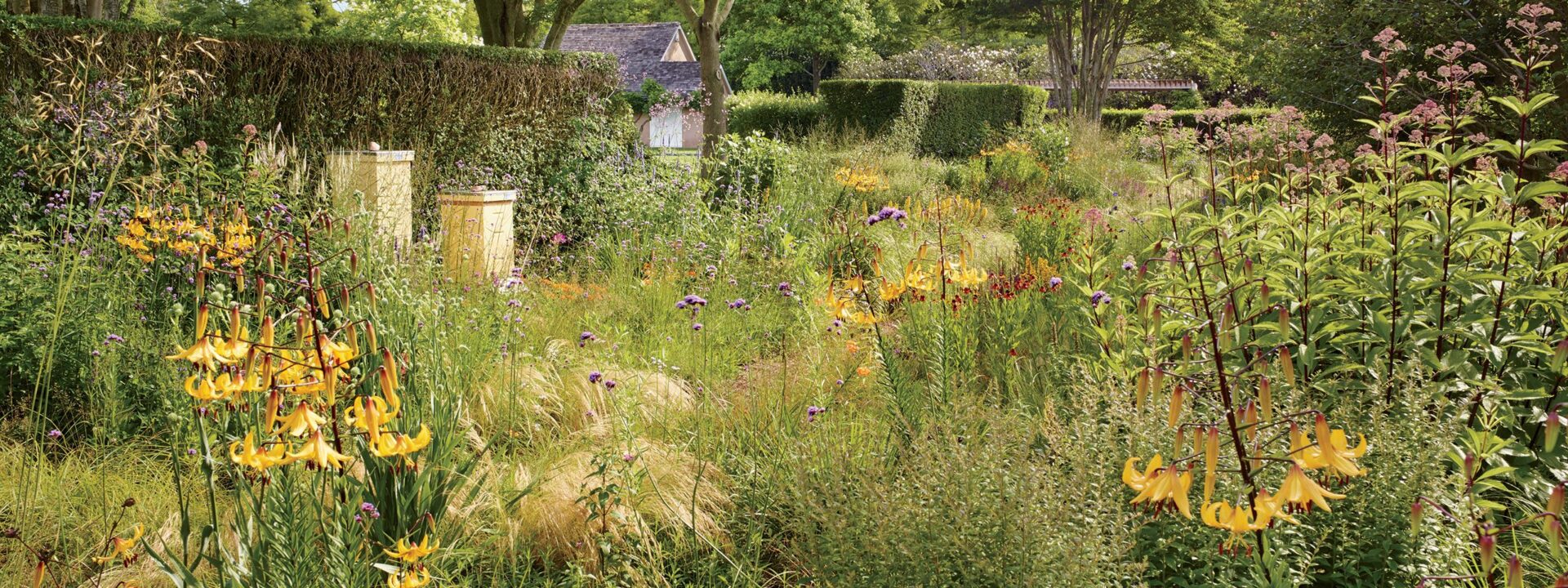
Lately, my phone has been showing me videos of time-lapse flower beds: simple patches of dirt, squeezed between a house’s siding and a stretch of lawn, quickly turning into a burst of color and a sea of swaying blooms. This is called “chaos gardening”—a trend fueled by social media that’s catching on with a certain type of gardener who wants to stage a small rebellion against the rules of traditional gardening. No planning, plotting, skill, or experience needed. You don’t even have to go to a nursery; a dusty seed packet from the hardware store will do.
Chaos gardening is a step away from the free-spirited, wild English garden style that might seem like its inspiration. It’s not really like the modern meadow movement either, which focuses on native plants and ecological restoration and usually involves carefully choosing specific species. Instead, chaos gardening relies on chance, whim, and inspiration. It welcomes surprises and celebrates mistakes. In one TikTok video (with 4.6 million views and counting), a gardener called The Chaos Gardener tells the story of her four-year-old daughter, who took a packet of sunflower seeds and secretly planted them in her sandbox—resulting in the tallest, strongest sunflower stalk she’d ever seen. “Here’s the trick,” says popular TikTok gardener Farm Boy James, while tossing handfuls of dried lentils and black-eyed peas over his shoulder, “there isn’t a trick.”
My own backyard projects have been less chaotic: trips to the garden store with a budget and a color scheme in mind, sketches and lists that account for staggered bloom times. But every book I’ve read or class I’ve taken has made me feel both encouraged and intimidated by how much I still don’t know. Some parts of gardening feel instinctive (water when it’s dry), while others feel almost contradictory. It took a firm rose expert at the Brooklyn Botanic Garden to convince me to cut my rose vines down to thin, knee-high sticks, stripped of all tangled branches. “Trust me,” she said, “they’re going to love it.”
So there was something really appealing about just letting go. A neighbor has a field of echinacea flowers in her front yard that by mid-summer looks like hundreds of emojis have popped up around her stoop, with tipsy bumblebees buzzing between them. She told me she had read all the Piet Oudolf books, but when it came time to plant, she just tossed handfuls of seeds in the air. Could I transform a bare little corner of my backyard with the same carefree spirit?
At the garden store, I bought packets of blackberry lily, cardinal climber, lobelia, aster, echinacea, lavender, and thyme seeds. At the last minute, I added a packet of outhouse hollyhock—a plant so named because it can grow tall and thick enough to hide an outdoor toilet. I don’t have an outhouse in my backyard, but the bulky plastic compost bin could use some cover. How did this selection measure up to my usual standards? Were these plants native? Not really, I found out when I looked them up later. Invasive? Oops, maybe a little, in some cases. I had planned to divide the plot—one half planted randomly, the other with more careful spacing—but my own four-year-old daughter seemed to sense that approach wasn’t in the spirit of the project and started scattering seeds everywhere. At the last minute, I remembered that Ffern, the lovely organic fragrance company, had sent me a packet of cornflower, lady’s bedstraw, and red campion with their newest seasonal scent, so I threw that in too. About 27 seconds later, we were done. We gently stepped on the soil, gave it a spray of water, and walked away.
Of course, there are complications you’ll run into pretty quickly with this trend. For starters, there’s the issue of density—a lot of the videos show seeds packed in so thickly that it’s hard to imagine how they’ll all grow.You fling handfuls of seeds the way an enthusiastic chef salts a pot of pasta water—more is more! Then you read the fine print on a packet of thyme seeds, each one smaller than a poppy seed, and discover it’s meant to cover up to 233 square feet. If these plants sprout, you’re supposed to thin them—a nice way of saying “kill your darlings”—if they’re closer than a few inches apart. “It feels like infanticide,” says noted gardener Jo Thompson, author of The New Romantic Garden (2025), when I call her for advice. Thompson’s style has always been a bit like chaos gardening—a little unruly, a little messy, and more welcoming because of it. “I liked the idea that it wasn’t all about me,” she says. “I wanted to guide the garden and invite a sense of spontaneity.” She likes plants that “look after themselves,” she adds, letting nature take its course with minimal interference.
A stairway at Gravetye Manor in England, a century-old garden seen as a forerunner to a modern, naturalistic style.
Photo: Claire Takacs / Courtesy of Rizzoli
There’s ancient wisdom in growing a mix of plants—the “three sisters” (corn, beans, and squash) have long been planted together to boost yields. In fact, the term “chaos garden” can be traced back to farmer and writer Gabe Brown, author of Dirt to Soil (2018). He describes a regenerative experiment that started almost as a dare: He took 70 species (including cover crops like cowpeas and soybeans, plus vegetables and flowers) and spread them over a 30-acre field. Even though conditions weren’t ideal that year, it created a thriving kitchen garden for him and his wife. “Shelly would send me to pick a vegetable for supper, and whatever I tripped over was what I’d bring home,” Brown writes. Thompson, in her own garden, grows salvia near her roses—a method that uses salvia leaves’ natural fungicidal properties.
We know that plant diversity creates not just a more productive environment, but also a more stable one that’s friendly to pollinators. A variety of plants can help prevent weeds and offer some natural pest protection. This is important even for the most amateur backyard gardener: Recent research shows that diversity-boosting efforts in smaller gardens have a bigger impact than in larger ones. “I don’t like the term chaos gardening,” ecologist Douglas Tallamy tells me—he thinks it suggests messiness. But he stresses the responsibility that anyone with even a tiny plot of land should feel. “If people have a little garden that’s a few square feet and the rest is a giant lawn,” he says, “they’re not doing anything with it.” He points out that there are about 40 million acres of lawn in America—roughly the size of Washington State. If chaos gardening gets people used to the idea of doing more than just handing their property over to a landscaping company, the benefits could go beyond a feel-good social media trend.
Within a week, my daughter came running to tell me a shoot had appeared on my bare patch of Brooklyn dirt. It was too soon for any of the seeds we’d planted to sprout, but something had apparently drifted over and gotten a head start. I pulled out my plant identification app, but the leaves were tiny—it was too early to tell what had taken root. The first resident of our chaos garden was a surprise, it seemed—what a delight indeed.
Frequently Asked Questions
Here is a list of FAQs about a chaos garden written in a natural tone with clear answers
BeginnerLevel Questions
1 What exactly is a chaos garden
Its a garden where you let plants grow however they wantno strict rows no weeding out volunteers and no rigid design You just plant seeds or let existing plants spread and nature takes the lead
2 Is a chaos garden just a messy neglected yard
Not exactly Its deliberately lowmaintenance but you still choose what to plant and might occasionally thin things out The goal is a wild selfsustaining look not a dead or overgrown wasteland
3 Do I need to weed a chaos garden
Generally no The idea is that all plantsincluding weedsare part of the system But if a super aggressive weed takes over you can remove it Its about balance not total neglect
4 What are the benefits of having a chaos garden
Its great for wildlife requires less work and can be more resilient to pests and drought Plus you get surprising beautiful combinations youd never plan yourself
5 Can I still grow vegetables in a chaos garden
Yes but youll get smaller less predictable harvests Many people mix veggies with flowers and herbs letting them selfseed Its more about the experience than a perfect crop
AdvancedLevel Questions
6 How do I start a chaos garden from scratch
Choose a sunny spot clear any really invasive weeds then scatter a mix of native wildflowers hardy perennials and selfseeding annuals Dont plant in rowsjust toss seeds loosely Water lightly then let it go
7 What plants work best for a chaos garden
Native plants are ideal because theyre adapted to your climate and support local insects Good choices include coneflowers blackeyed Susans yarrow cosmos poppies and milkweed Avoid highly invasive nonnatives like English ivy
8 How do I prevent one plant from taking over completely
If a plant dominates you can pull out extra clumps in spring