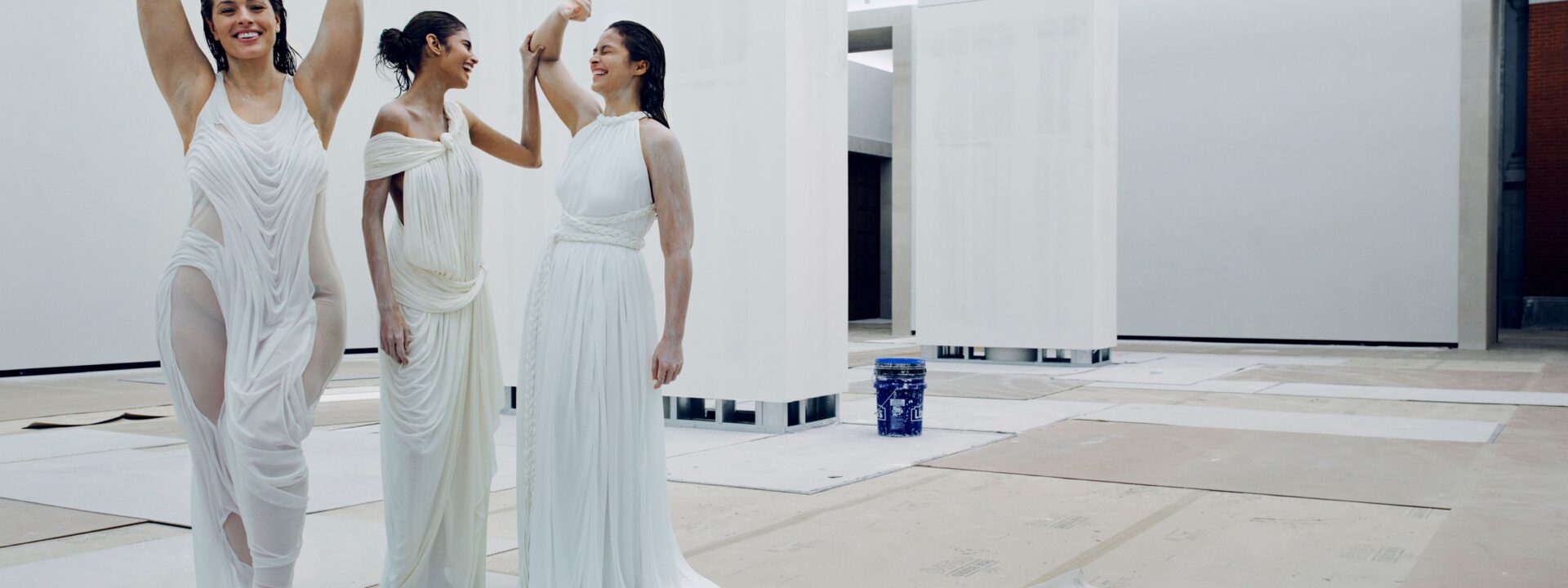
“Fashion is more art than art is,” Andy Warhol once said, and 39 years after his death, he may have the final word. Is fashion art? Is art fashion? This May, those persistent questions may finally be settled when The Metropolitan Museum of Art’s Costume Institute moves from its longtime basement location to a prime spot upstairs, right next to the museum’s Great Hall. “In a way, fashion is beyond art,” says Andrew Bolton, the curator in charge of the Costume Institute. “It embodies our lived experience. It’s the only art form that does that.”
Fashion will now take center stage in what was once The Met’s sprawling gift shop, situated between the Egyptian galleries to the north and the Greek and Roman galleries to the south. Here, in its new home, the Costume Institute’s Condé M. Nast Galleries—named for the publisher and bon vivant who turned Vogue, Vanity Fair, and other magazines into cultural icons—will host “Costume Art,” an exhibition exploring and celebrating the dressed body, featuring clothing and artworks from most of the museum’s 19 collecting areas.
Max Hollein, The Met’s CEO and director, calls the new galleries “a powerful continuation” of what the museum has long done. “The Costume Institute is part of our identity. The new galleries don’t represent a revolution.”
But they have been a long time coming, and in the meantime, the audience for fashion has grown dramatically. “The relationship between fashion and art has become less defensive,” says artist Maurizio Cattelan, one of several artists and curators I spoke with while writing this story. “Fashion no longer asks for permission from art, and art no longer pretends to ignore fashion. They’ve understood they share the same obsession: the body, power, desire, status.” He adds, “At The Met, fashion has moved from being displayed as craft to being framed as narrative. The exhibitions feel less like wardrobes and more like arguments. That shift, from object to idea, is where fashion becomes interesting.”
“The impact of the Costume Institute and its exhibitions has grown enormously over the last 30 years,” says designer Michael Kors, who lists artists like Mark Rothko, John Singer Sargent, and Georgia O’Keeffe as influences on his work. “It’s opened people’s eyes to the connection between fashion and everything—from pop culture to politics to art. It has shown the public that fashion is about more than just the clothes you put on every day.”
Designer Tory Burch adds that these new galleries “will recognize fashion as an essential part of our shared history. The Met has always understood that fashion is a vital form of creative expression, one that shapes and reflects our culture.”
Even so, the Costume Institute’s spring exhibition lacked a permanent home for years. The new space came about after a long campaign—led in large part by this magazine’s global editorial director—and presented a daunting task for an architecture firm. The commission went to the Brooklyn-based firm Peterson Rich Office, whose principals, Nathan Rich and Miriam Peterson—a husband-and-wife team who had their first date at The Met—immersed themselves in the museum’s history and its 21 separate buildings. “It’s more of a city than a building,” says Peterson. They studied the Great Hall and considered how it could lead into the galleries, as well as how light filters through the space. Their goal was to create a new urban pathway, and they worked closely with Bolton. “It was wonderful having conversations with him,” says Peterson. “We felt a deep resonance between architecture as a field and costume as an art form.” Bolton needed a flexible space where lighting could beThe space was adjusted and power was provided, but he wanted it to reflect something of the stature of the Greek and Roman galleries. “It had to be a rotating exhibition space,” says Rich. “It needed to constantly change. At the same time, it had to feel as if it had always been there.” The new galleries, nearly 12,000 square feet, are divided into five interconnected spaces and incorporate limestone thresholds that echo the limestone arches in the Great Hall. Luminescent gray-and-white stone floors, beamed ceilings, and Venetian plaster walls flood the space with an aura of permanence.
“Fashion at The Met has grown from celebrating beauty and craftsmanship to exploring culture, politics, and history,” says Dasha Zhukova, an art collector, businesswoman, and museum trustee. “It’s not just about what we wear, but what clothing tells us about who we are. So I wouldn’t call it controversial that the Costume Institute has taken center stage at The Met. The new galleries are about perspective, not hierarchy.”
Zhukova also notes that the Costume Institute has helped attract a younger and more diverse audience—one especially uninterested in rigid boundaries. The painter Anna Weyant, who is 31, firmly states that costume should be regarded as art and as one of art’s most “political forms.”
Tschabalala Self (whose work Evening appears on page 146) says, “To me, the separation between fashion and art is a false dichotomy. They’re both means of expression—modalities, really—that allow artists to express the concerns and desires of our time. … I’m really excited to see the new exhibition. As a figurative painter, the body is central in my practice. It’s something we all share, and when we dress we all make a statement.”
“The term ‘art’ comes from the ancient Greek word arete, which translates as ‘excellence,’” says artist Paul Chan. “So it seems to me that there can be excellence in costumes as much as in any painting or sculpture.”
Is there any dissent about The Met’s grand move? “I regard fashion as an art but not as Art,” comments Massimiliano Gioni, artistic director of the New Museum in Lower Manhattan. Yet Gioni is quick to point out that museums and curators—himself included—have broadened their vision. “It doesn’t even matter whether fashion is art or not: certainly it is a discipline, a practice that can tell us a lot about what we desire and value. As such, it is a language worth listening to and engaging with if we want to learn more about ourselves.”
“The difference between art and fashion is time,” says artist Rachel Feinstein. “Fashion is about the present, about now. Next year, what you’re seeing on the runway will look dated, whereas a painting or sculpture made today will not. Art has longevity—it’s meant to last.”
Boundaries vanish in the new exhibition curated by Bolton. Titled “Costume Art,” it is inclusive and collaborative, unified by the theme of the human body and how it has been depicted—dressed, undressed, decorated, honored, injured, and mourned. Through a series of revelatory, often surprising, and sometimes jarring juxtapositions, the exhibition pairs objects and images with clothing: a 460 BCE Greek vessel with a 1920s Fortuny gown; Albrecht Dürer’s Man of Sorrows with Arms Outstretched with Vivienne Westwood’s Martyr to Love jacket; an 1883 walking dress that seems to have stepped out of Seurat’s study for A Sunday on La Grande Jatte; curvilinear sculptures by Jean Arp and Henry Moore paired with ensembles by Rei Kawakubo for Comme des Garçons. The exhibition reveals the long and symbiotic relationship between art and fashion—making the case that they are deeply connected.“I wanted to present fashion as a lens through which to view art,” Bolton explains. “I wanted the pairings to be sometimes formal, sometimes conceptual, sometimes political, sometimes humorous, sometimes deeply profound, and sometimes lighthearted. When you place a garment next to an artwork, a new meaning emerges. Something else happens. I want to focus on that. It’s as if one plus one equals three… Hopefully, the show will empower people to make those connections beyond the museum’s walls.”
“I’ve been struck by how The Met’s presentation of fashion has shifted from something archival to something more immersive, almost cinematic,” says artist Laurie Simmons. “The exhibitions have taken on narrative, mood, psychology—more of a sense of performance… The museum is acknowledging that the body—dressed, styled, staged—is as rich and loaded as any ancient relic. It’s also an ongoing story that’s constantly being rewritten in real time. Its placement near the Egyptian galleries and across from the Greek and Roman galleries feels less like a disruption and more like a correction. It acknowledges that what we wear is also civilization’s artifact.”
“I like the idea that some of the glamour of fashion is rubbing off on painting and artists,” artist John Currin tells me. “I care about painting even more than sculpture or architecture or photography; still, I think these things coexist wonderfully, especially fashion, because it’s been so beneficial for the museum.” Institutions like The Met need change, he argues; nothing should be regarded as sacred. “They should have a celebrity zoo at The Met,” he says. “People naked in cages. They can work out in front of everybody… I’ll give up the bookstore if that’s what it takes.” (The Met has not given up its store—only relocated it.)
Finally, I asked my husband, Calvin Tomkins, who wrote the history of The Metropolitan Museum of Art (Merchants and Masterpieces), the question I’d been asking everyone: “Can costume be art and art be fashion?” He answered with a resounding “Yes!” and added, “In fact, the two are so close that they can’t help being each other.”
In this story: hair by Jimmy Paul; makeup by Kabuki; manicurist, Jin Soon Choi; tailor, Carol Ai.
Produced by Special Production Agency. Set Design: Studio Wagner.
All artwork images courtesy of The Metropolitan Museum of Art.
Frequently Asked Questions
Of course Here is a list of FAQs about the Costume Institutes exhibition at The Metropolitan Museum of Art written in a natural conversational tone
General Information
Q What is Costume Art at the Met
A Its the popular name for the annual fashion exhibition presented by The Mets Costume Institute Each year its a major themed showcase that explores fashion as an art form through historical garments and contemporary designs
Q Is it a permanent exhibit
A No Its a special temporary exhibition that opens each spring and runs for about four to five months The theme title and designer focus change every year
Q Where in the Met is it located
A Its housed in the Iris and B Gerald Cantor Exhibition Hall on the museums first floor Youll usually see a dedicated entrance and line for it
Q Do I need a separate ticket
A Yes While general admission to The Met is paywhatyouwish for New York residents and students the Costume Institute exhibition requires a timedentry ticket with an additional special exhibition fee Its highly recommended to book these in advance online
Visiting Experience
Q Why is it always so crowded
A Its one of The Mets most popular annual events especially after the Met Gala brings massive media attention It draws fashion enthusiasts art lovers and tourists alike Weekdays early mornings or later in the exhibitions run are typically less busy
Q How long does it take to see the exhibition
A Most visitors spend between 45 minutes to 15 hours depending on the size of that years show and how closely you look at the details
Q Can I take photos or videos
A Nonflash photography for personal use is usually allowed but its always best to check the specific guidelines posted at the entrance each year as rules can change Tripods and selfie sticks are typically prohibited
Q Is the exhibition good for kids
A It can be especially for kids interested in design or storytelling However it involves a lot of slow walking and looking at delicate objects behind glass so it depends on