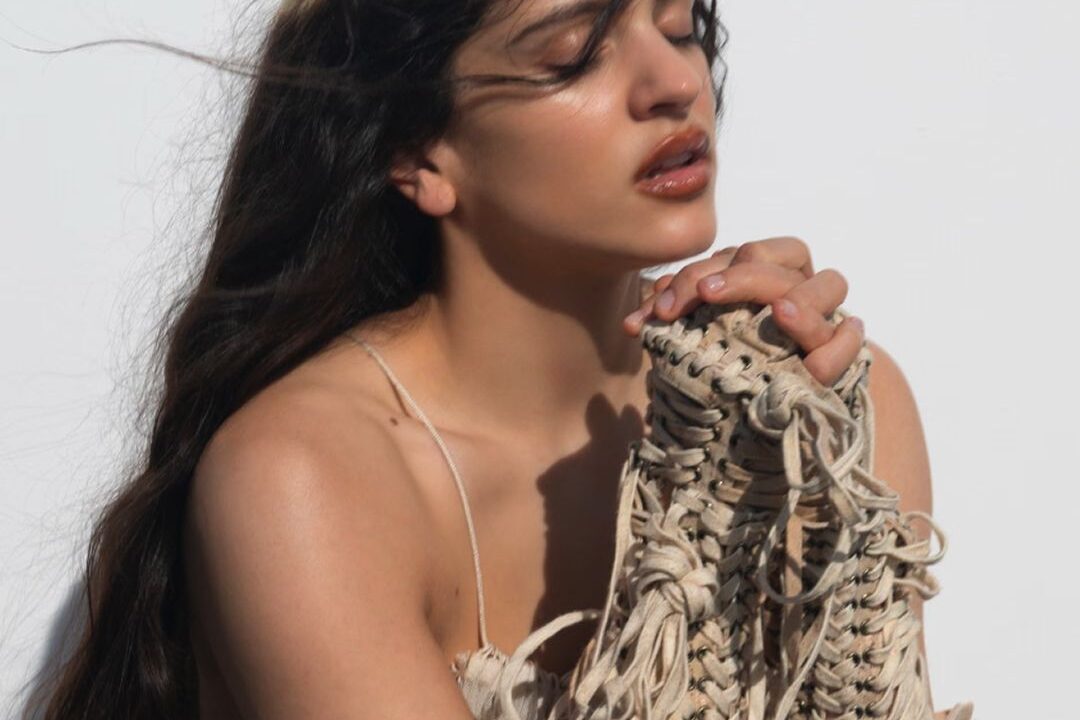
Hosanna, Lux! Rosalía’s fourth studio album is as commanding as it is demanding. It represents a giant leap from her 2022 LP Motomami and its glitchy blend of hip-hop, reggaeton, and flamenco. On Lux, she sings in 13 languages, often accompanied by the London Symphony Orchestra. The album is a challenge to algorithm-driven music trends that homogenize taste and produce generic pop. Listeners are invited to submit to her beatification through transcendent beats, where pop and religion intertwine to create something heavenly.
The fashion surrounding Lux—from its rollout and music videos to the months that followed—moves to the same sacred rhythm. During last fashion week, Rosalía stayed true to a celestial white color scheme in custom, floaty Dior and feathery Schiaparelli. The album cover, styled by Chloe and Chenelle, features Rosalía in a nun’s veil and a constricting top from Alainpaul’s spring 2025 collection, as if she’s on the verge of religious ecstasy. For the album visuals, she wore a singular white leather feather piece from Ann Demeulemeester by Ludovic de Saint Sernin.
While promoting the album, Rosalía performed at the LOS40 Music Awards in Valencia, Spain, in a sheer, sinewy gown from Dilara Findikoglu’s fall 2024 collection. The dress combined cream tulle panels with a black overskirt, blending angelic and underworld aesthetics. “I wanted to express divine feminine power somewhere beyond time, beyond reality, and beyond what is happening,” Findikoglu told Vogue at the time—a vision that orbits Rosalía’s own for Lux.
On the red carpet at the LOS40 Music Awards, she embodied a fallen angel in custom Balenciaga spring 2026, featuring a feathered black cape and otherworldly crystal sunglasses. Another promotional image captures her in a state of intense prayer, wearing Jean Paul Gaultier spring 2004 corset gloves—a twisted, ascetic look.
The video for the goth-pop, avant-orchestral track “Berghain,” styled by Jose Carayol, revels in archival runway pieces. It includes a clinging black dress and jacket from Alexander McQueen’s fall/winter 2002 collection, sourced from London’s West Archive. “I wanted it to be romantic, beautiful,” McQueen told Vogue at the time. “Power to the women!” The designs blended milkmaid necklines with Helmut Newton-esque details like leather bodices and tight pencil skirts—a pleasurable yet painful dichotomy that has long fascinated the Catalan star.
The video also features rosary-bead strapped sandals with cross charms from McQueen’s spring 2003 collection, and a bloom-pink pleated silk dress from Nicolas Ghesquière-era Balenciaga spring 2004. The latter, as Ghesquière described, “gives power to femininity” through the contrast of structure and fluid textiles. Both pieces were sourced from Barcelona’s Algo Bazaar. Another scene shows Rosalía in a gray fringed scarf-top and low-rise pleated skirt from McQueen-era Givenchy spring 1997, paired with a button-adorned tank top from McQueen spring 2003.
Both Ghesquière’s mythological goddesses and McQueen’s witches have enchanted the pop star—fitting for an artist whose album draws inspiration from medieval mystic Hildegard of Bingen and the poet and saint Vimala, a former sex worker. When Madonna embarked on her own spiritual journey in the late ’90s, culminating in Ray of Light, she turned to designer Olivier Theyskens for clerical-like gowns and enveloping corsets in shiny leathers, playing…Rosalía explores the contrast between sensuality and modesty. She delved into the Theyskens archive and, styled by Chloe and Chenelle, wore a vintage Olivier Theyskens leather set—a high-necked top with ruffled shorts—embracing those same opposing ideas.
Beyond vintage, she has also worn a Vivienne Westwood by Andreas Kronthaler Spring 2026 dress, a bridal boudoir gown featuring a lock pendant reminiscent of the Sacred Heart. There was a serene, voluminous Thom Browne Spring 2026 skirt, where she used her album cover to hide her upper body—proving there’s still room for joy and playfulness in this celestial aesthetic. At a Barcelona listening party for her album Lux, the singer chose a celestial, sheer cream gown from Colleen Allen’s Fall 2025 collection. While the New York designer’s work may appear austere at first glance, it shows a deep respect for the female form.
In the months following Lux, she has continued to dress like a hardened angel: a ruffled Chanel Spring 2026 skirt paired with sharp patent black Chanel pumps to avoid any primness, and a floaty dress matched with Margiela tabi knee-high leather boots. She’s also allowed for some humor, sporting a “God Complex” graphic tee in sky blue and neon pink.
As shown, Rosalía isn’t finished with her divine style streak.
Frequently Asked Questions
Of course Here is a list of FAQs about Rosalías Lux era framed as questions a fan or curious observer might ask
General Beginner Questions
1 What is the Lux era
Its the name given to the current artistic and fashion phase of Spanish singer Rosalía which began around 2024 Lux means light in Latin and the era is characterized by a celestial elevated and minimalist aesthetic a stark contrast to her previous Motomami era
2 Why is it called a heavenly rise in fashion
Because her style has shifted dramatically towards looks inspired by angels saints and religious iconography She frequently wears elegant flowing white gowns intricate veils and delicate jewelry creating an ethereal and heavenly visual theme
3 What music is part of the Lux era
While a full album hasnt been released yet the era was introduced with the singles Tuya and Despechá RMX The music often blends her signature flamenco roots with more atmospheric romantic and sometimes orchestral production
4 How is Lux different from her Motomami era
Motomami was bold chaotic streetinspired and deconstructed Lux is serene elegant unified and draws from high fashion and religious imagery
Advanced Cultural Impact Questions
5 What designers is she wearing in the Lux era
She has heavily featured pieces from major luxury houses especially Balenciaga and Rick Owens Her looks often involve custom creations that blend avantgarde tailoring with her celestial theme
6 Is the Lux era a commentary on fame or spirituality
Many critics and fans interpret it as both It explores themes of light purity and transcendence which can be seen as a metaphor for her rise to global fame a personal transformation or a critique of the idolization of celebrities
7 How has she incorporated Spanish culture into this era
Deeply The