Nestled within Kering’s headquarters in Milan, the Material Innovation Lab (MIL) holds a collection of over 8,000 sustainable material samples sourced from more than 600 manufacturers and innovators. Director Christian Tubito and his team have spent 13 years carefully building this archive, scouting, testing, and piloting each material to identify which ones have the potential to scale.
However, winning over designers has always been difficult. The fashion calendar leaves only narrow windows when designers are open to new ideas, and matching the handfeel or drape of new, more sustainable materials to their expectations can take years. Some materials have broken through, but most have remained stuck in pilot projects or capsule collections. Kering MIL isn’t alone in facing this challenge: in the past year, several well-known, well-funded material innovation startups have stumbled or shut down entirely, unable to secure the brand adoption needed to bring their innovations into the mainstream.
At Milan Fashion Week in September, Kering MIL and talent incubation platform S Style will present Wardrobe Edition — their third collaboration and Tubito’s latest effort to show luxury designers what his network of innovators can offer. Developed over the past year, Wardrobe Edition features 10 full looks, each created by a different emerging designer. Unlike some other incubation programs, the designers were paid for their work and received marketing and business guidance from the program’s mentors throughout the process.
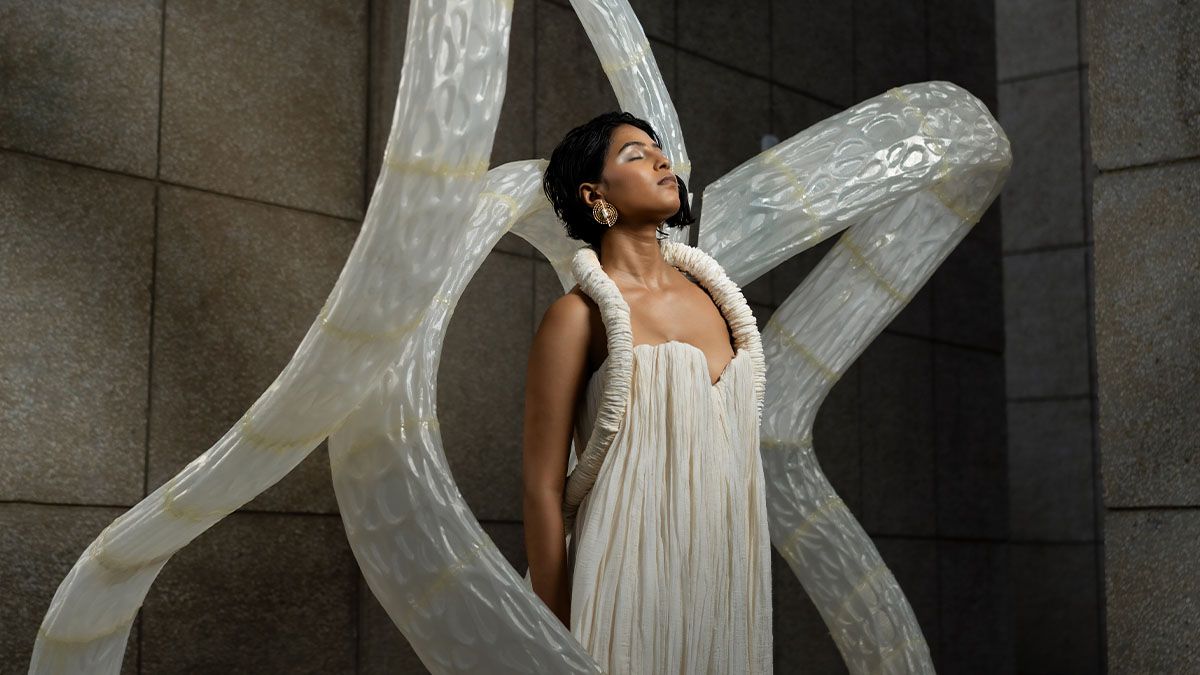
Palestine’s Ayham Hassan reimagined traditional crafts using Lunaform by Gozen and plant-based iridescent pigments from Sparxell. Tbilisi-based footwear brand Invasive Modification ventured into apparel for the first time, using a fur-effect fabric made from wool by Lanificio Becagli. India’s Srushti Patil experimented with Spiber brewed protein and Taroni silk, cultivated using organic sericulture practices. “It’s a way to dress the innovations,” says Tubito, “to give them a shape beyond the samples we have in our archive.”
While established houses often have formal workflows and design teams divided into separate departments (fabrics, finishes, product development, sourcing), emerging designers have the freedom to experiment and the flexibility to incorporate innovation more easily, he explains.
To push the designers beyond their comfort zones and shift them from inherited ways of working into a more playful mindset, apparel designers were asked to create accessories and vice versa. Tubito says it worked wonders, flipping the design process on its head and leading to unexpected results. “Most of them didn’t start with a sketch,” he says. Instead, “they started with a lot of questions” — about how the materials worked, how to optimize them for fashion, or how to collaborate with the innovators.
The featured innovations ranged from regenerative natural fibers to recycled fibers and bio-based nanocellulosics (nanoscale structures derived from plant pulp, wood, and agricultural residues), but this year there was a particular focus on leather alternatives, in line with Kering’s new strategic goal to cut its use of virgin animal leather by 30% before 2028.
Several of the featured innovations are direct alternatives to animal leather. French knitwear brand Matho worked with Ephea, a mycelium-based alternative from Italian biomaterials startup Sqim, which Kering-owned Bottega Veneta is already selling in the form of wallets, card holders, and key chains. Meanwhile, Milan-based designer Giuseppe Buccinnà combined Planeta by Pasubio, a hybrid material made from recycled polyamide derived from end-of-life tyres mixed with natural proteins and biopolymers, with Innovera by Modern Meadow, a bio-based component.This material can be processed to create nappa-style suede or embossed finishes.
Omôl designer Nathalie Chebou-Moth drew on her brand’s signature Totem line to create footwear using Taroni silk (silk produced through organic sericulture) and Elevate, a protein- and plant-based leather alternative from Uncaged Innovations.
Photo: Courtesy of Omôl
“The process was largely similar to working with standard materials, though it needed more attention to seam strength and material thickness,” says Buccinnà. Since the material was designed to behave like traditional leather, he notes that his requests were much like those he would make to a conventional tannery. He chose two different weights—one for the bag and one for the garment—and tested various adhesives to achieve the desired drape. “We were also able to create a custom color outside the standard range, which was key to capturing the garment’s conceptual vision.”
Innovation requires iteration, and that was a recurring theme. Bhumi, founded by Dutch designer Emma Van Engelen, is known for its 3D-printed bags, worn by celebrities like Julia Fox and Bridgerton’s Nicola Coughlan. For Wardrobe Edition, Van Engelen teamed up with BioCirflex3D, a bio-based, fully compostable, and recyclable alternative to standard 3D-printing filaments, developed by Israeli startup Balena.
For Wardrobe Edition, Bhumi designer Emma Van Engelen refined her signature 3D-printed bags (shown left) using BioCirflex3D, a bio-based, fully compostable, and recyclable filament (sketch on the right).
Photos: Courtesy of Bhumi
It was a rough start, says Van Engelen. While conventional filaments have been widely tested by various makers, and common issues come with known fixes, BioCirflex3D required a lot of trial and error. “As soon as I realized I could physically stretch the filament between my hands, I knew this would be a very different challenge,” she says. For weeks, every print failed as the material stretched around the gears and clogged the machine. With no peers to turn to for advice, it took Van Engelen several months to get it working. “The focus on experimentation, creativity, and quality over quantity made this one of my favorite projects I’ve been part of.”
On the other end of the textile spectrum, London-based designer Maximilian Raynor worked with Made for a Woman, a Madagascar-based accessories brand, to create ready-to-wear pieces from their signature raffia material. They soon realized the artisans couldn’t produce the full garment—it was too complex and outside their expertise—so they shifted to making panels, which Raynor’s team could cut and sew in London. “Creating such an intricate textile is extremely time-consuming, and together with the artisans from Made for a Woman, we found a balance between bold, unique design and what was realistically achievable,” Raynor says. “I’m proud to work with a material that people aren’t used to seeing in such an extreme, high-fashion context.”
London-based designer Maximilian Raynor collaborated with Madagascar-based accessories brand Made for a Woman to develop ready-to-wear from their signature raffia material.
Photo: Courtesy of Maximilian Raynor
Elsewhere, corset specialist Lorenzo Seghezzi worked with Lunaform by Gozen, a 100% bio-based nanocellulose material made through the controlled fermentation of microorganisms. It was a “stimulating challenge,” says Seghezzi, who wanted to back the raw material so it would be strong enough for one of his signature corsets. The raw Lunaform was thin but sturdy, but the standard backing made it too thick, and it buckled under the pressure a corset requires. Next, he tried pairing it with a fine-weave cotton coutil—similar to how he might use silk taffeta or satin—but that meant it wasn’t as smooth or seamless.
Eventually, Seghezzi settled on bonding the materials usingUsing a double-sided fusible web, he says, “It was a fascinating experience that pushed us out of our comfort zone and challenged us to come up with innovative technical solutions.”
Getting designers on board
With regulatory rollbacks, political backlash, and shifting priorities, it’s clear that sustainability has been facing something of a downturn. Getting designers involved is more crucial than ever, and sustainability metrics alone won’t win them over—the materials also need to perform well.
Still, working with new and unfamiliar materials can feel intimidating for designers, says Giorgia Cantarini, founder of S Style. For the Wardrobe Edition, some designers asked for large amounts of the material they were using, so they’d have plenty of room to make mistakes. Part of Cantarini’s role was boosting their confidence and encouraging them to treat it like any other garment. “My job is to guide the designers, so they don’t get scared and give up on their creativity or over-ask,” she explains. “I try to tell them that a new material isn’t a limitation. They can use their knowledge to achieve whatever they have in mind.”
ArrowArrow
Tubito and his team at MIL served as the technical experts, helping designers work with innovators, refine the more sustainable materials, and adapt them to their needs. This was a learning curve for everyone involved—when Kering MIL works with Kering brands, it usually partners with research and development, fabric development, or product development teams, not designers. “We needed to figure out how to translate things into their cultural language,” says Tubito. “Industrial designers or pure product designers are used to working with constraints, but fashion designers are taught to start with pure vision, without considering constraints. So we couldn’t use the word ‘constraints’ at all; instead, we talked about experimentation and the potential of the materials—challenges they could overcome.”
Most fashion designers coming out of fashion schools are taught to design with vision first and supply chain second. Starting with a fiber or fabric and then creating a garment within the limits of the material and its production processes was a new experience. But that’s the essence of sustainability—working with finite resources rather than encouraging excess. The designers found it a welcome challenge. “I needed to think much more comprehensively from the very beginning about how the material would behave during the later stages of development and construction,” notes Kuai Li, designer at Quine Li, who worked with silk alternative AMSilk, recycled cellulosic Circulose, and brewed protein fiber Spiber. “I found it to be a very positive and productive collaboration.”
India’s Srushti Patil experimented with Spiber brewed protein and Taroni silk, grown using organic sericulture practices. Photo: Courtesy of Srushti Patil
Tubito hopes that when the project debuts next month, it will draw attention to the innovations Kering MIL has been developing and encourage both Kering-owned and other brands to try them in more commercial settings. Even when Kering combines material demand across its brands to create larger volumes, Tubito says broader industry support is needed to scale these innovations, especially since many require industrial infrastructure.
“Kering alone can’t scale an innovation; we don’t move large enough volumes,” says Tubito. “To truly bring the next generation of materials and technologies to market, we need to share not just demand, but also the effort, risk, and commitment needed to build the industrial capacity behind them. So we hope these creative interpretations serve as a starting point for the innovators, where other brands and manufacturers help them take the next steps to scale.”
Frequently Asked Questions
Here is a list of FAQs about Kerings initiative with the 10 designers written in a natural and accessible tone
General Background
1 What exactly is Kering doing with these 10 designers
Kering has invited 10 designers from different fields to rethink how we use materials The goal is to challenge the designers to create new innovative ways to make fabrics and products that are more sustainable than what we use today rather than just tweaking existing ones
2 Why is a luxury giant like Kering doing this
Luxury fashion relies on highquality rare materials but the industry is a huge polluter Kering knows that to stay relevant and responsible they need to find new clean ways to source and create materials Its about futureproofing their business and meeting the growing demand for ecoconscious luxury
3 Who are these 10 designers
They are a mix of established and upandcoming talents from around the world spanning fashion product design and materials science Kering hasnt released a single static list as they often rotate or add designers but the initiative focuses on bringing fresh eyes from outside the traditional luxury bubble to solve material problems
4 Is this just a marketing stunt
No While it does generate good PR Kering has a history of investing in sustainability This initiative is a practical RD project The designers are given access to Kerings labs and supply chain to actually test and prototype their ideas not just draw pretty pictures
The Design Materials Process
5 What kind of sustainable materials are they working on
They are looking at everything from biofabricated leathers to new ways of recycling textile waste into premium fibers They are also exploring plantbased alternatives to silk and wool that require less water and land
6 How is this different from just using recycled polyester
Recycled polyester is a good start but it still relies on plastic Kering is pushing for regenerative and circular materials This means materials that either break down completely at the end of their life or