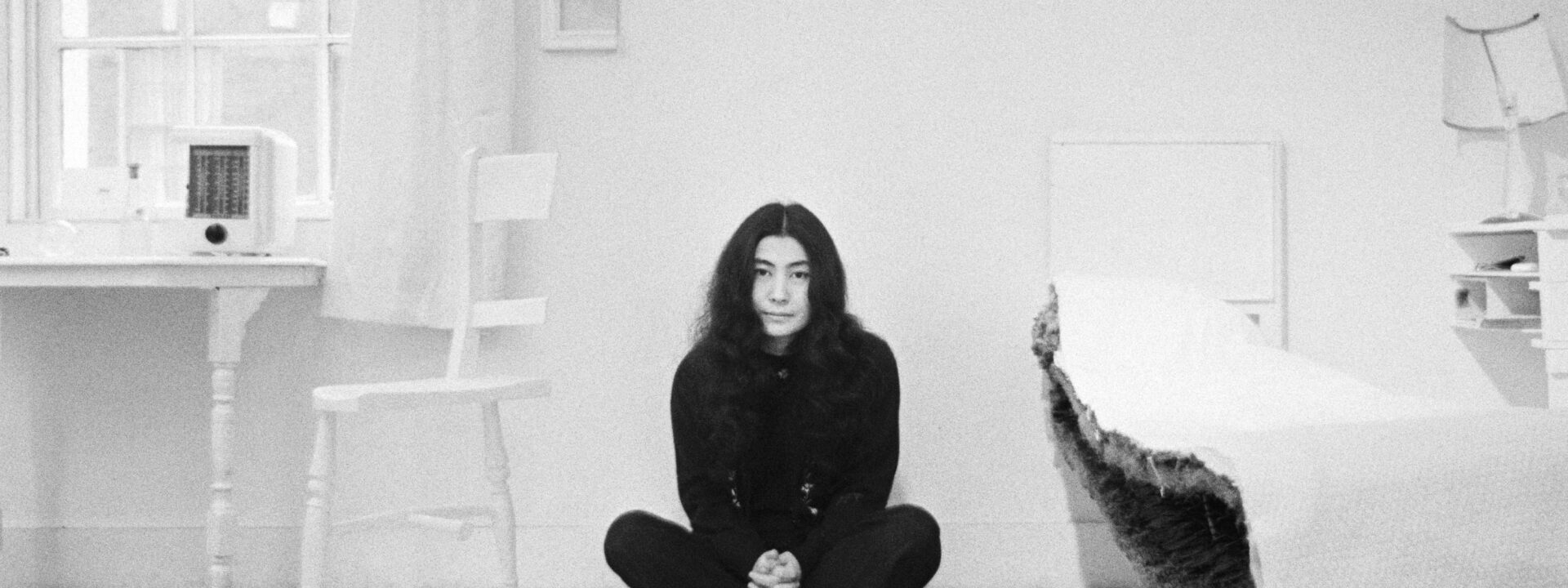
In 1971, Yoko Ono placed ads in local newspapers announcing a one-woman show at New York’s Museum of Modern Art. But when visitors showed up for the exhibit, they found a small sign outside the entrance. It explained that Ono had released flies onto the museum grounds and invited people to follow them around the city. In the end, there was no official exhibition inside. Instead, Ono had cameramen stationed around the building to ask visitors what they thought of the show.
Their reactions became the artwork itself. Some people raved about the nonexistent exhibition, while others immediately tried to figure out what it all meant. Many dismissed Ono outright, with one person calling her “bonkers.” But in the grainy footage of the event, one viewer responds with pure joy: a child. When the interviewer asks what he would think if the exhibition existed only in his imagination, the boy breaks into a grin. “Then you have a very good museum there,” he says. “That’s real neato.”
That clip now plays inside “Yoko Ono: Music of the Mind” at The Broad in Los Angeles, where it feels less like old footage and more like a key to understanding Ono’s entire body of work. Running through October 11, “Music of the Mind” is the artist, musician, and activist’s first solo museum exhibition in Southern California. It covers much of Ono’s early work, including conceptual art, music, film, installation, instruction pieces, and activism.
“Yoko has a very large universe of work that’s not represented in the show, and couldn’t be,” says Connor Monahan, her studio director for nearly two decades. “There’s no one show that could really cover all of Yoko’s work.”
The exhibition at The Broad comes as Ono’s legacy is being reexamined. Long dismissed by the public as either an absurd avant-garde provocateur or simply “the woman who broke up The Beatles,” Ono is now widely recognized as one of the founding figures of conceptual and performance art. “Music of the Mind” highlights this, presenting Ono not as a cultural footnote or oddity, but as one of the defining artistic visionaries of the last century.
“There’s a relentless optimism with Yoko,” says Monahan. “Many people, if they received that kind of public criticism, wouldn’t continue to make more work. But she was never broken by that.” He points to one of Ono’s longtime philosophies: “Believe in yourself and you’ll change the world.”
“Imagination is not secondary to the work; it is the work,” Monahan adds—an idea that the child outside MoMA instinctively understood.
Ono’s view of imagination as nourishment started early. At age 12, after being evacuated from Tokyo during World War II, she and her family took refuge in the Japanese countryside. Food was scarce, so Ono and her younger brother Keisuke would lie on their backs, looking up at the sky and exchanging “menus in the air”—imagining elaborate meals together. Sarah Loyer, curator and exhibitions manager at The Broad, describes those moments as “a belief in one’s imagination as a mode of survival.” Ono later considered these imagined feasts among her first works of art.
After returning to Tokyo, Ono enrolled at Gakushuin University in 1952, becoming the school’s first female philosophy student. She then moved to the United States in 1953 and attended Sarah Lawrence College, where she studied poetry and musical composition.
By the early 1960s, Ono was deeply involved in New York’s downtown avant-garde scene. She staged experimental performances and instruction-based works out of her Chambers Street loft, catching the interest of figures like Marcel Duchamp, Peggy Guggenheim, Isamu Noguchi, and Robert Rauschenberg.
Installation view of “Yoko Ono: Music of the Mind” at The BroadLos Angeles, May 23–October 11, 2026.
Courtesy of The Broad. Photo by Joshua White/JWPictures.com. © Yoko Ono
“Music of the Mind” begins with three versions of Lighting Piece (1955), which gives a simple instruction: “Light a match and watch till it goes out.” Nearby are photos of Ono performing the piece, along with a black-and-white film of her striking a match in hypnotic slow motion. Elsewhere in the galleries, you’ll find original typed pages from Grapefruit, Ono’s groundbreaking 1964 book of instruction works. These pages invite audiences to “Listen to the sound of the earth turning,” “Draw a map to get lost,” and simply “Fly.” When asked in a 1971 interview why she wrote the book, Ono replied, “You see, we live and we die. In between that we eat and sleep and walk around—but that’s not enough for us. We have to act out our madness in order to be sane.”
A few rooms into the show, there’s a large white canvas covered with nails. Some have single strands of human hair tied around them. The instruction reads:
“Hammer a nail into the surface every morning.
Pick up a single hair that falls out when combing in the morning.
Tie that hair around the hammered nail.”
Each time a participant hammers another nail into the canvas, the strike sends a deep, echoing boom through the gallery, startling nearby visitors before drawing them in to try it themselves.
Installation view of Painting to Hammer a Nail in “Yoko Ono: Music of the Mind,” Gropius Bau, Berlin, Germany, 2025.
© Gropius Bau, photo: Luca Girardini. Artwork © Yoko Ono
These engaging, interactive elements are found throughout the show. Even before entering the museum, visitors are asked to write wishes on tiny slips of paper and tie them onto the olive trees already growing on the museum plaza. Inside, in one particularly joyful activity, visitors are invited to put on large black fabric sacks and move around on a white platform, their slow, blurry shapes looking like living Rorschach inkblots. Elsewhere, for Helmets (Pieces of Sky) (2001), viewers search through suspended World War II-era German army helmets, taking sky-patterned jigsaw puzzle pieces from inside them to bring home. “Take a piece of sky,” Ono tells viewers. “Know that we are all part of each other.”
“The work challenges what we think it means to be an audience member at a museum,” says Loyer. Visitors who hesitate at the edges of these participatory works slowly gather the courage to join in after watching someone else go first, and each interaction sparks conversations.
Visitors explore Yoko Ono’s Add Colour (Refugee Boat) (1960/2016) installed in “Yoko Ono: Music of the Mind,” Tate Modern, London, 2024.
© Yoko Ono. Photo © Oliver Cowling, courtesy of Tate.
Works first created decades ago also take on new meanings as the world changes around them. Add Color (Refugee Boat), an ongoing participatory installation that invites viewers to leave messages and drawings on a white boat at the center of an all-white room, has transformed many times over the years: first reflecting the Syrian refugee crisis, then Ukraine, and now Gaza. During my visit, viewers scrawled calls to abolish ICE across the walls, drew waves beneath the boat in different shades of blue, and wrote messages for peace in multiple languages.
“All of her work is unfinished and constantly changing and evolving over time,” says Monahan. Come back to “Music of the Mind” two weeks later, and it will literally be different: new wishes hanging from trees, new messages covering walls, new strangers completing the work in ways Ono herself could never fully predict. As long as war, displacement, misogyny, racism, nationalism, and state violence continue, Ono’s work still feels strikingly relevant.
A video of one of Ono’s most famous works, Cut Piece, first performed in Kyoto in 1964, is also on display. During the performance, the artYoko Ono sat silently onstage as audience members came up and cut pieces of her clothing off with scissors. Since then, the piece has been interpreted in many ways: postwar trauma, objectification, consent, race, vulnerability, and the role of the audience. “It really puts the responsibility on the viewer,” Loyer explains.
Cut Piece, 1964, performed in New Works of Yoko Ono, Carnegie Recital Hall, New York, filmed by David and Albert Maysles, 16mm film, black and white, stereo sound, 8 minutes 27 seconds.
© Yoko Ono
While the exhibition naturally touches on John Lennon’s influence, it doesn’t put him at the center. Ono met Lennon in 1966, the night before her show opened at London’s Indica Gallery. Lennon wandered in, climbed a ladder as part of one piece, and through a magnifying glass saw a tiny word printed on the ceiling: “YES.” Ono later recalled handing him a card that said “Breathe,” which made him lean in so close she could hear him inhale. Then he walked over to a pedestal holding an apple—itself an artwork—and took a bite. “I turned pale,” Ono remembered. “I thought, how dare this guy do that to my work.”
Together, Lennon and Ono turned celebrity into a tool for anti-war activism through bed-ins, billboard campaigns, conceptual performances, and media actions against the Vietnam War. But celebrity also deeply distorted how the public saw Ono herself.
Bed-In at the Amsterdam Hilton Hotel, Netherlands, 1969.
© Yoko Ono. Photo: Henry Pessar.
Throughout the 1970s, Ono released a series of politically charged, experimental albums that were often mocked at the time but are now seen as remarkably influential—foreshadowing punk, riot grrrl, no wave, and experimental pop decades before those styles became mainstream. In her 1973 spoken-word song “I Learned to Stutter,” Ono says, “I was living as an artist and had relative freedom as a woman and was considered the bitch in the society / Since I met John, I was upgraded into a witch and I think that that’s very flattering.” The line is funny, sharp, and knowingly theatrical. But beneath the humor was something much more painful. “The society suddenly treated me as a woman who belonged to a man who is one of the most powerful people in our generation,” she continues. “The whole society wished me dead / I started accumulating a tremendous amount of guilt complex and in result of that I started to stutter.”
Since then, Ono’s voice has found new meaning. During the run of “Music of the Mind,” her work will extend beyond the museum itself: seven billboards across Los Angeles will display phrases like THINK PEACE, ACT PEACE, IMAGINE PEACE, and PEACE is POWER. Across the street from The Broad, REDCAT—the performance space inside the Walt Disney Concert Hall complex—will host performances of Cut Piece and Sky Piece to Jesus Christ. And in August, musicians including Yo La Tengo, Tune-Yards, Sleater-Kinney, Rufus Wainwright, and Yuka Honda will reinterpret Ono’s music during a major concert at The Broad.
“Yoko sees art as something that’s never been limited to a gallery or a museum,” says Monahan. “[She sees] art as an action or activity, a provocation or shift in perception for the audience.” One of Ono’s favorite sayings, he explains, is: “The job of the artist is not to destroy but to change the value of things.”
A black sack becomes a tool for collective play. A tree becomes a living record of longing, grief, and hope. A nail becomes an act of connection. Ono’s art is ultimately about the fragile, radical belief that another way of seeing—and therefore another way of living—might still be possible. Imagine.
Frequently Asked Questions
Here is a list of FAQs about visiting the Yoko Ono exhibition at The Broad written in a natural tone with clear direct answers
General Planning
Q What is the Yoko Ono exhibition at The Broad all about
A Its a major survey of Yoko Onos work spanning from the 1960s to today It focuses on her interactive art instructions and peace activismmuch of which invites you to participate
Q How long does it take to see the whole exhibition
A Most people spend about 1 to 15 hours If you plan to do every interactive piece budget closer to 2 hours
Q Do I need a separate ticket for the Yoko Ono show
A Yes The Broads general collection is free with a timed ticket but the Yoko Ono exhibition requires a separate paid ticket Book it online in advance
Q Is the exhibition good for kids
A Absolutely Many pieces are handsonlike hammering a nail into a canvas or writing wishes Its very engaging for children but keep an eye on them near the more fragile installations
Q Can I take photos inside the exhibition
A Yes nonflash photography is allowed in most areas Some very fragile or lightsensitive pieces may have restrictions but signs will tell you
The Art Experience
Q What does instruction art mean
A Yoko Ono often gives you a written instruction rather than a finished object The art is completed when you imagine or physically follow the instruction
Q Which piece should I definitely try to interact with
A Definitely try Wish Tree You write a wish on a paper tag and tie it to a tree Also Painting to Hammer a Nail is a classicyou literally hammer a nail into a white panel
Q Is the Cut Piece performance part of the exhibition
A The original performance isnt happening live but the show includes documentation of Yoko Ono performing Cut Piece in the 1960s Its powerful to watch