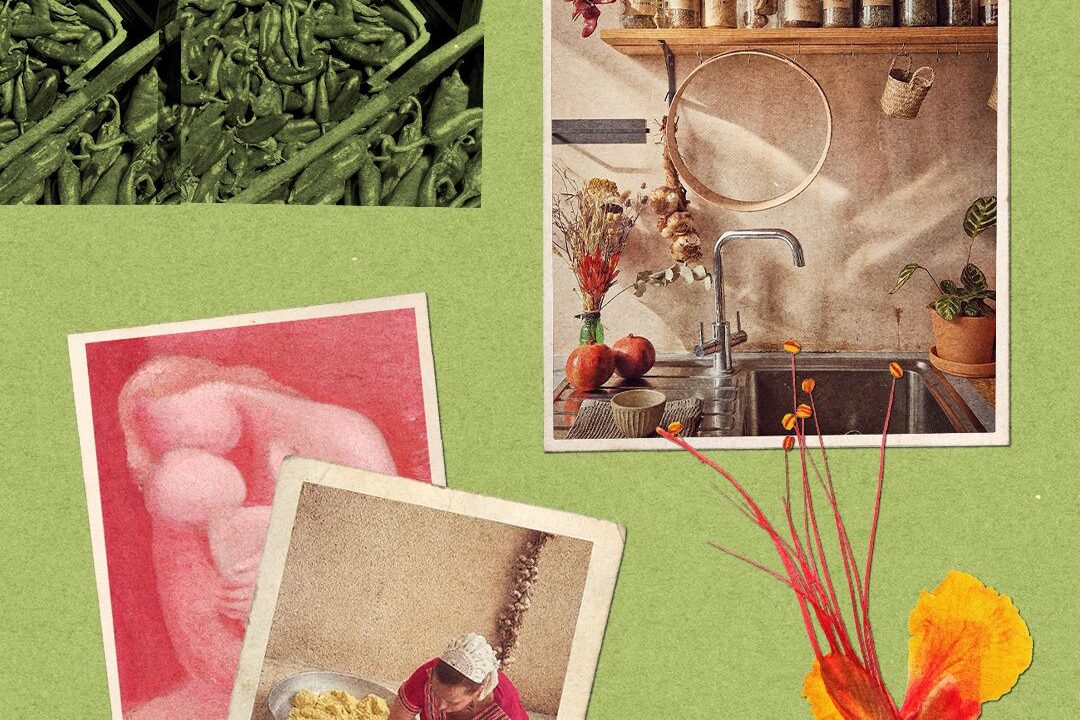
I grew up in a village on the Cap Bon peninsula in Tunisia, the birthplace of harissa, nestled between the Mediterranean Sea and fields of tomatoes and peppers. My playground was the beach, my family’s farm, and my grandparents’ houch—a central courtyard at the heart of traditional homes. Every year, at the peak of the season, my mother, aunts, cousins, and I would gather there. We’d arrive the night before and sleep side by side, waking early while it was still cool.
By morning, the house was full. My mother’s cousins and neighbors joined us; trays, coffee, and bundles of cloth—used to spread couscous grains out to dry in the sun—were passed from hand to hand. Crates of freshly picked tomatoes lined the walls, and big bags of semolina and flour were stacked nearby. Everyone knew what to grab—even the children. My cousins and I filled basins with water to soak the garlic, knowing it would make peeling easier.
By the time the first joyful zaghrouta (ululation) echoed through the house, the work had already begun. It always started with tkesksiss—making couscous from scratch. Large metal trays and sieves were set out, and the oldest women, their faces marked with Amazigh tattoos, took their places around them, sleeves rolled up, hands already dusted with semolina. Water, flour, a repeated motion—rolling, sieving, gathering, then starting again. Years later, a French friend watched a tkesksiss and called it la danse des mains—the dance of the hands. There’s only one way to learn that dance: you watch, you repeat, you try again. Slowly, it settles deep inside you, until you don’t have to think about it anymore.
Around us, the courtyard filled with other tasks: tomatoes split open and laid out to dry, baklouti peppers—the local variety used for harissa—strung into long garlands, figs opened to the sun.
This is the oula—never just a way to preserve food, but a way of living in tune with the seasons: fermenting, drying, distilling, transforming. Even after we moved to France when I was eight, we returned to Tunisia every summer to take part in the oula. This matriarchal tradition defines Tunisia’s food culture. As poetic as I find it, it was born out of necessity centuries ago—a way to stock up for the year ahead, when winter brought scarcity. Without refrigerators, fermenting, sun-drying, and preserving in salt were the only ways to keep food from spoiling. The practice didn’t fade with modern times; women across generations have kept it alive.
My mother and I were in charge of mixing and roasting the ingredients for bsissa, a nourishing powder made from roasted barley and pulses, over the clay oven. Making bsissa—a tradition passed down through generations—is an art, yet nothing is measured or written down. When I was younger, the ingredients didn’t make sense to me—the combinations felt unlikely, even wrong. I would question my mother, and she would patiently explain why each one mattered.
Back then, I was a wild child, later a rebellious teenager—sneaking out, pushing back against anything that felt assigned to me just because I was a girl. I felt that girls were being prepared to be good cooks, then good mothers, while boys roamed freely—at the beach, without those expectations. My mother had conservative ideas of what a “good girl” should be: pretty dresses and good behavior. I was skateboarding with Wu-Tang Clan blasting through my Walkman. Later came cigarettes. It created constant tension between us.
What made it more complicated was that my mother had raised me to be independent. She pushed for good grades, a career, financial independence. “Never depend on a man,” she would say. And yet, she was also aware of the persistent social pressures in the village, where girls were expected to be modest and know their place. She wanted both for me: freedom and conformity. I fought the latter with particular force.
And yet, participating in the oula…The oula felt different. Those moments, standing side by side, were the only times we didn’t argue. It was in that courtyard that my cooking education began—though my love for food came much later. The oula was precise and limited, and that’s what drew me in. The gestures stayed with me, even when I tried to avoid them. My mother made sure of that.
When I was a student and my family lived in France, I stopped spending much time in the village—I had internships and other things to do. I remember joking to my mother that she was better off without me there, and that casual comment led to a more open conversation than we’d ever had. She told me how hard diaspora life had been for her, and that she wanted to share the traditions she loved—the things that kept her close to her family—so I could inherit them and carry them on after she was gone.
In France, a country where differences are often expected to fade, the oula was how we held our ground. It showed up in small, everyday ways, like when a sleepover mom asked what I ate for breakfast and I said “bread and olive oil”—an answer that puzzled everyone. I remember the reaction, but I never saw our way of eating as something to hide. If anything, it made me more determined to hold on to what we did at home. Our kitchen followed a different logic. Peppers hung from the balcony, homemade merguez sausages dried in the open air, trays of caraway seeds were left in the sun to toast. My parents have spent more time in Tunisia since retiring, but the way they prepare and store their food has always stayed the same.
photo: Boutheina Ben Salem
I live in London now, but I still follow the same traditions and habits. In markets, I look for produce that still carries the season, for spices that haven’t faded. Everything starts there—the rest comes by instinct. When I cook for friends and family, I don’t measure. In Tunisia, we say: Your eyes are your scale. That carries through in how I gather people around my table. I often invite guests to look into my cupboards and smell the ingredients I use.
I’ve turned one of the cupboards into an “oula room.” The products of oula—spices, couscous, preserved vegetables and fruits—move through my cooking not as relics, but as living ingredients, carrying the memory of the people who made them.
Hand Me Downs is a series, with a new essay appearing each day through Mother’s Day, celebrating the gifts—tangible and intangible—that our mothers give us.
Frequently Asked Questions
Here is a list of FAQs based on the topic When my mother and I were preparing the Oula we found something we could agree on
This appears to refer to a specific personal story or a metaphor about finding common ground during a traditional or cultural preparation The FAQs are written to clarify the concept and its potential meaning
BeginnerLevel Questions
1 What is the Oula
The Oula is a traditional Finnish sauna ritual often involving steam birch whisks and a focused time for relaxation or purification It can also refer to a specific ceremony or gathering like a prewedding or postchildbirth sauna
2 Why would a mother and daughter prepare the Oula together
Preparing the Oula is often a family or community activity Mothers and daughters might do it to bond share wisdom or prepare for a life event Its a time for connection across generations
3 What does we found something we could agree on mean in this context
It means that despite their usual differences or disagreements the act of preparing the Oula created a shared moment of harmony The task itself became a bridge
4 Is this a common saying or a specific story
It sounds like a specific personal story or a metaphor Its not a common idiom but it reflects a universal experience finding unity in a shared meaningful activity
Intermediate Advanced Questions
5 What are the typical steps in preparing a traditional Oula
First you heat the sauna stove Then you soak birch branches in warm water to soften them You also prepare water for steam set out towels and sometimes prepare a cooldown area The atmosphere is quiet and respectful
6 What deeper meaning does preparing the Oula have in Finnish culture
Its not just about physical preparation Its a ritual of cleansing reflection and hospitality The act of preparing together symbolizes cooperation respect for tradition and creating a safe space for vulnerability
7 How could this story relate to conflict resolution or family dynamics
The Oula preparation forced the mother and daughter to focus on a