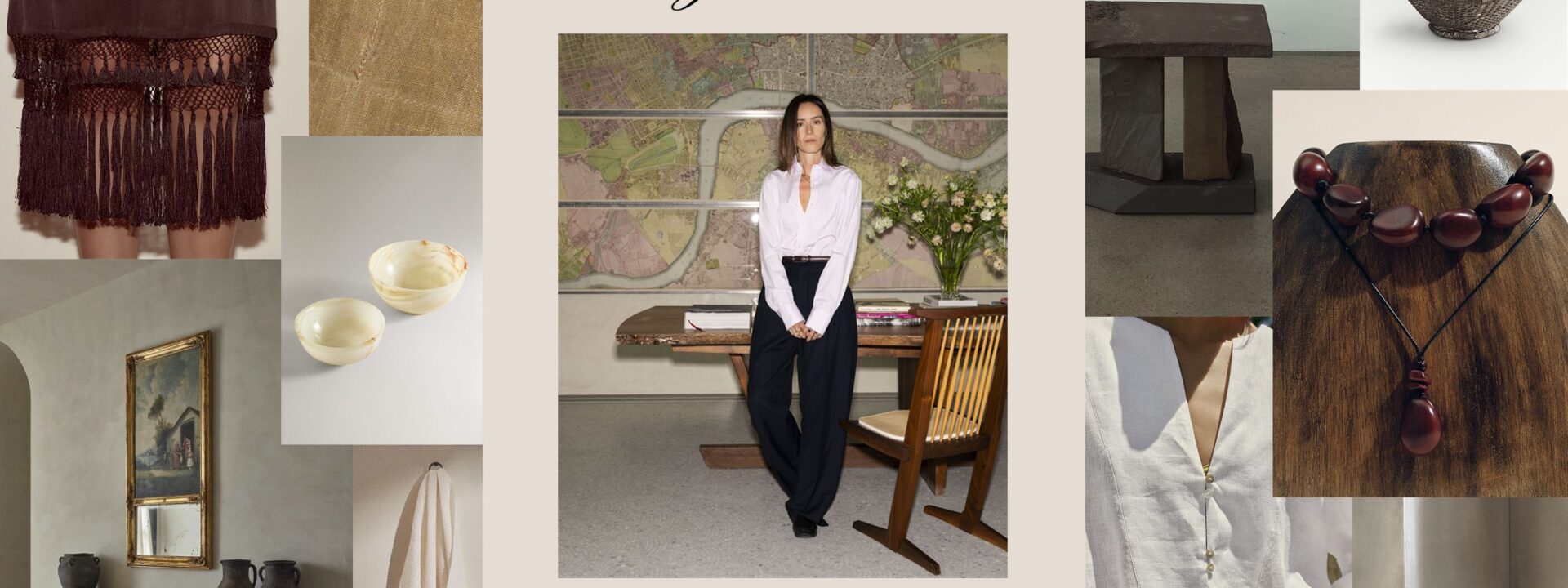
Eagle Eye exists to bridge the gaps—between how we dress and how we live; between the spaces that draw you in and the coat you keep grabbing. Each month, London-based designer and creative director Alex Eagle will bring in her network of friends and experts to explore the “why” behind a certain theme—why we’re drawn to certain things, and how those instincts quietly build up over years without us even noticing. This column is rooted in interior design, with many offshoots (and, of course, a curated selection of shoppable products).
Lately, I’ve found myself buying peonies just as their petals start to fall, reaching for vintage shirts softened by years of washing, and choosing materials I know will look better in ten years than they do now—all things that show the marks of time. There’s a Japanese philosophy for this feeling: wabi-sabi.
Rooted in Zen Buddhism, it has quietly shaped aesthetics for a long time. It emerged in the 15th century as a reaction against the ornate and excessive, finding its fullest early expression in the tea ceremony, where rough bowls and uneven surfaces were considered more beautiful than polished perfection. Wabi, roughly translated, speaks to the beauty of simplicity and solitude. Sabi refers to the grace that comes with age and wear. Together, they describe something Western taste has historically struggled to name: the appeal of the imperfect, the incomplete, and the impermanent.
The most stylish women I know aren’t constantly updating their wardrobes; they repeat themselves. Not because they lack imagination, but because the object has moved beyond fashion and become part of their identity. Ryota Iwai, founder of Auralee, sees the same quality in the things he reaches for himself. “I’m drawn to things that aren’t overly engineered or perfectly controlled,” says Iwai. “Things that feel a little worn, slightly imperfect, lived-in.” This way of thinking goes beyond fashion. For Imogen Kwok, a chef working at the intersection of food and art, it’s her Japanese carbon steel knives, broken-in and aged, that best capture wabi-sabi: “The moment you accept that food is a living, changing medium,” she says, “you realize that perfection can only exist for a moment—if at all.”
As a designer, I find myself asking not how something will look when it’s finished, but how it will look in ten years. Will the brass darken beautifully? Will the timber become richer? “You spend months obsessing over every detail,” says New York-based stylist and designer Colin King, “only to realize that time is going to become your collaborator.” Seen that way, wabi-sabi can also be thought of as the decision not to interfere. You see it in stone floors left unpolished, plaster walls that show their age, and brass handles worn bright exactly where a hand reaches every day. At Hôtel du Couvent, a restored 16th-century Provençal convent, this is very much the design principle. When the team behind the redesign found a monastery table at a flea market in northern Italy, worn smooth by decades of meals, they placed it in the restaurant as the centerpiece, just as it was.
“That table is the room. Not despite the patina; because of it,” explains Vanina Kovarski, head of brand for the hotel. “You can’t manufacture that. You can only have the good sense not to sand it down.”
At its core, wabi-sabi is about remembering that the objects we love most tend to share a quality with the people we love most: They become more themselves over time.
Imperfection
“True wabi-sabi is about discovering and embracing a flaw, or finding a quiet beauty within imperfection,” says Kwok. It’s a visible stitch, a glaze that settles differently on every piece in a set, a weave with slight irregularity. These aren’t flaws to be fixed—they’re the whole point.
Look for handmade and handwoven pieces; anything that looks untouched by a machine. Colin King’s tiny onyx bowl for Zara Home is a good place to start; each piece is shaped byThe stone itself. From there, Bode’s fringed Worcester dress or The House of Lyria’s linen napkins are both strong contenders.
Save to wishlist
Save to wishlist
Zara
Small onyx bowl
$149 ZARA
Save to wishlist
Save to wishlist
Christen
Helix 75 sandals
$1,750 NET-A-PORTER
Save to wishlist
Save to wishlist
The Row
Cadia scarf
$650 NET-A-PORTER
Save to wishlist
Save to wishlist
Studio Mantel
Wood ear clips
$331 STUDIO MANTEL
Save to wishlist
Save to wishlist
Bode
Fringed embroidered midi dress
$1,600 NET-A-PORTER
Save to wishlist
Save to wishlist
The House of Lyria
Lume linen napkins
$305 ABASK
Save to wishlist
Save to wishlist
Carsten in der Elst
Graywacke Offcut side table #4
$3,378 MAX RADFORD GALLERY
Save to wishlist
Save to wishlist
Dosa
Patched square pillow
$868 MOUKI MOU
Beauty of Aging
Aging is a natural part of everything, including your clothes and home decor. Think of a navy sweater worn so often it hangs just right, vegetable-tanned leather, or unlacquered brass.
Iwai builds wear into his original designs: “I prefer it when knitwear or t-shirts get pilled, when the neckline stretches out—I also like it when the hems of pants get worn down and frayed.” For denim, look to the brand’s Selvedge jeans, hand-finished on a shuttle loom. Elsewhere, Hunting Season’s tagua and leather pendant necklace, which darkens and softens with wear, and Art Brugi’s hand-carved chestnut serving board are both pieces that will look completely different in ten years—and completely right.
Save to wishlist
Save to wishlist
Hunting Season
The Pendant necklace
$275 NET-A-PORTER
Save to wishlist
Save to wishlist
Zara
Loveseat 01
$4,500 ZARA
Save to wishlist
Save to wishlist
Niwaki
Carbon knife range
$196 NIWAKI
Save to wishlist
Save to wishlist
Auralee
Distressed wide-leg jeans
$635 NET-A-PORTER
Save to wishlist
Save to wishlist
Art Brugi
Hand-carved serving board
$835 ABASK
Save to wishlist
Save to wishlist
Kalinko
Irrawaddy brass bowl
$77 KALINKO
Save to wishlist
Save to wishlist
The Row
India small tote
$3,400 NET-A-PORTER
Save to wishlist
Save to wishlist
Netherton Foundry
Copper prospector pan
$425 ABASK
Natural State
Wabi-sabi finds its most natural expression in the natural world, through materials that breathe, shift, and settle over time. There is beauty in things that come without artifice: undyed wool, raw linen, unglazed clay. There are many creative ways to approach this. For example, Colin King’s woven metal basket turns steel into something that feels organic. Textiles like cotton and mohair are great for layering. To really highlight an item’s natural state, look at vases and vessels in their most unfinished form. A clay pitcher from Button Atelier’s collaboration with Co. House Designs, or a wood-fired urn from Japanese ceramicist Akiko Hirai—both roughly textured—are good examples.
Save to wishlist
Save to wishlist
Matteau
Fisherman pants
$545 NET-A-PORTER
Save to wishlist
Save to wishlist
JW Anderson
x Akiko Hirai short tea caddy
$1,095 JW ANDERSON
Save to wishlist
Save to wishlist
Thalia-Maria Georgoulis
Espresso spoon 9
$271 MOUKI MOU
Save to wishlist
Save to wishlist
Co. House Designs
x Button Atelier Rialto terracotta pitcher
$128 LULU AND GEORGIA
Save to wishlist
Save to wishlist
Raeso
Golden Nectar Mānuka Honey Enzyme Cleanser
$85 RAESO
Save to wishlist
Save to wishlist
Leset
Kyoto wide-leg pants
$280 NET-A-PORTER
Save to wishlist
Save to wishlist
Brun de Vian-Tiran
Cirrus handwoven mohair throw
$510 ABASK
Save to wishlist
Save to wishlist
Zara
Tall woven brass basket
$389 ZARA
Simplicity
Wabi-sabi is not minimalism, but they share a quietness. Where minimalism often seeks perfection through reduction, wabi-sabi is more layered. Instead of polished uniformity, it welcomes texture and irregularity. It’s pared-back, not sterile. Noguchi’s Akari lamp, for example, is made with washi paper and casts a warm, soft glow. A linen set in crisp white is fluid, designed to soften over time. The simplest things, chosen carefully and lived with for years, tend to build character naturally.
Save to wishlist
Save to wishlist
Zara
Kimono shirt
$60 ZARA
Save to wishlist
Save to wishlist
Zara
LineStraight-leg pants — $50, ZARA. Save to wishlist.
Noguchi Akari light sculpture — $950, NOGUCHI. Save to wishlist.
Alex Eagle — The Hanover jumper — $558, ALEX EAGLE. Save to wishlist.
Zara mini hammered wood stool — $60, ZARA. Save to wishlist.
CVC Stones — Radiant necklace — $4,400, CVC STONES. Save to wishlist.
Cou Cou Intimates — The Iris slip dress — $140, COU COU INTIMATES. Save to wishlist.
Shizu Designs — M wrapped stone — $96, ALEX EAGLE.
Frequently Asked Questions
Here is a list of FAQs about WabiSabi in the home based on Alex Eagles approach
BeginnerLevel Questions
1 What exactly is WabiSabi in simple terms
WabiSabi is a Japanese philosophy that finds beauty in imperfection impermanence and incompleteness Think of a cracked ceramic bowl repaired with gold or a worn wooden table that tells a story Its about appreciating the natural cycle of growth and decay
2 Does WabiSabi mean my house has to look messy or broken
Not at all Its not about neglect Its about intentional imperfection You choose items that have natural textures slight asymmetry or visible age but the space should still feel clean calm and cared for
3 Whats the difference between WabiSabi and minimalism
Minimalism often focuses on reducing clutter to achieve a clean modern look WabiSabi is more about accepting and highlighting the character of objects You can have fewer things but those things have soullike a chipped mug you love rather than a perfect massproduced one
4 How do I start bringing WabiSabi into my home without spending money
Start by looking at what you already own Choose one chipped bowl or a faded linen shirt and place it where you can see it Notice its texture and history Then remove one perfect decorative item that feels fake or plastic The shift is in your mindset not your wallet
Advanced Practical Questions
5 Alex Eagle mentions honoring the material What does that mean for furniture
It means choosing materials that age gracefully like solid wood stone clay and natural linen Avoid veneers plastic or highgloss finishes that hide wear When a wooden table gets a scratch you dont cover ityou let it become part of the tables story
6 How do I balance WabiSabi with having a clean functional home
WabiSabi doesnt mean clutter The key is conscious curation Keep surfaces clear of daily mess but leave one imperfect object as a focal point Function is beautifula wellworn wooden spoon is more wabisabi than a shiny new silicone