Dua Lipa’s wedding in Sicily was one of the most star-studded and stylish events of the year. But here at Vogue, we were just as curious about her honeymoon destination as we were about her dress. After all, no one knows how to travel in style quite like Lipa.
Today, she shared a carousel of photos on Instagram, revealing that she and her new husband, Callum Turner, took a road trip across Italy. They stopped in eastern Sicily, the Amalfi Coast, and the often-overlooked southern region of Basilicata. In Basilicata, they stayed at Palazzo Margherita in Bernalda—a charming hotel that also serves as a family retreat for its founders, the Coppola family. It turns out Lipa and Turner honeymooned in the same suite I stayed in during my visit: the Sofia, co-designed by Sofia Coppola herself alongside the legendary Jacques Grange.
Here, we revisit our story on the region from summer 2025, highlighting it as a fast-growing hotspot for travelers who want to go off the beaten path. It’s the perfect alternative to the often overcrowded shores of Puglia and the Amalfi Coast. Now that Lipa and Turner have confirmed the buzz around Basilicata, you’ll want to book your hotels quickly before the crowds catch on.
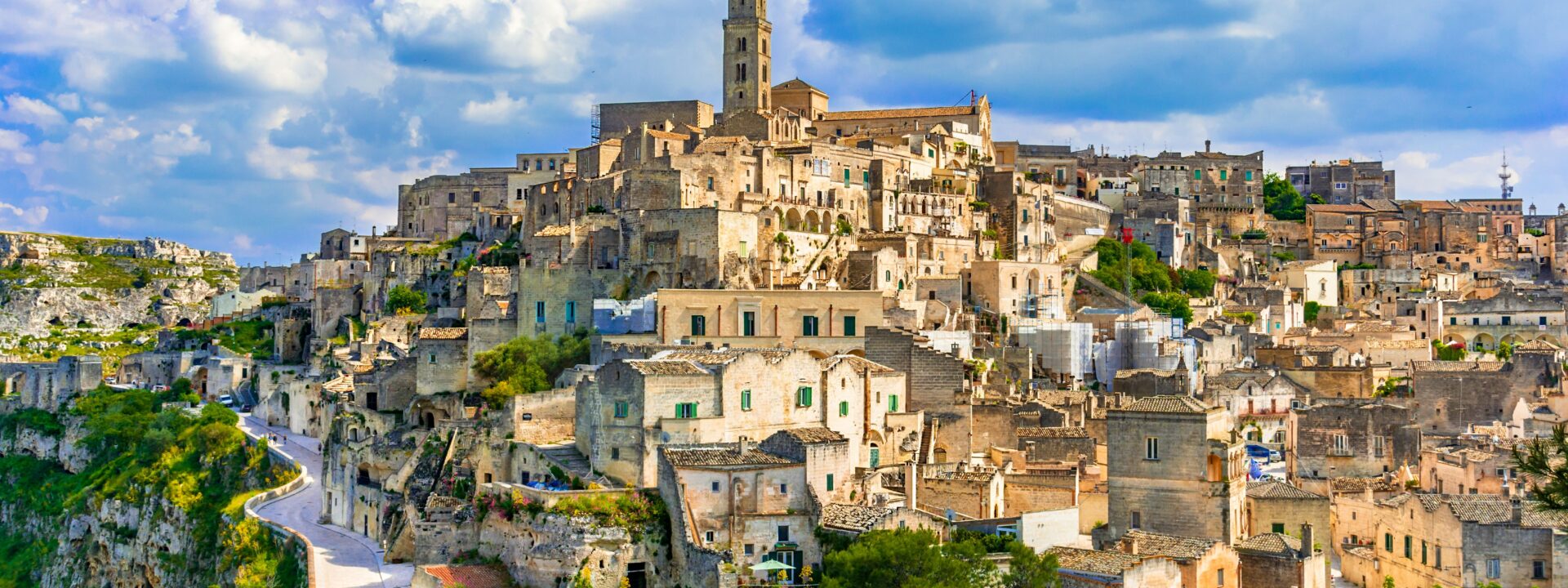
On my first morning in Matera, I was jolted awake by a thunderous burst of fireworks. I had accidentally arrived on the day of this ancient city’s most important religious festival, the Festa della Bruna—and here, the party starts early. Around 5 a.m., as I tried to get back to sleep, the Procession of the Shepherds began at the 13th-century cathedral of Maria Santissima della Bruna, then wound its way down to the modern city center. As the day went on and I ventured out to see it for myself, crowds of locals and students sipped Aperol spritzes from plastic cups and ate packed paninis for lunch. They had staked out spots along the sidewalks to get the best view of the evening’s main event.
By 9 p.m., the streets were packed. Lit up by glittering arches of colorful lights, horses pulled a papier-mâché statue of the Madonna back up the hill and into the cathedral. Then another burst of fireworks erupted over the far side of the valley, and the crowd began weaving through the maze of steps and alleyways that make up the city’s Sassi cave districts. More fireworks exploded from the canyon, and locals gathered on terraces to play music, sip prosecco, and cheer. As the cheers echoed off the craggy limestone walls, lit by flashes of pink and purple light, it felt like stepping back in time—or onto a movie set. That feeling stayed with me throughout my week in Basilicata. It’s the kind of Italy you can’t quite believe still exists, which explains why it’s quickly becoming a hotspot for adventurous travelers looking to avoid the country’s more tourist-packed spots.
If you picture southern Italy as a boot—Puglia as the heel, Calabria as the toe, and Sicily as the misshapen football being kicked into the Mediterranean—then Basilicata, the region that includes Matera, sits in the less glamorous instep. But that also means it has a bit of everything: dramatic mountain ranges, lush national parks, charming beach towns, and ancient cities. And when I say Matera is ancient, I mean ancient.
Getting to Sextantio Le Grotte Della Civita, the hotel where I stayed in the heart of those Sassi districts, took some planning. If you’re feeling very brave, you can drive your car to the bottom of its steps. But the smarter choice is to leave your vehicle at a parking lot on the outskirts.You leave town and hop on a shuttle bus. As you reach the edge of the city, you’re greeted by the truly stunning sight of the Sassi districts—crumbling buildings stacked diagonally down the hill, like a collapsing wedding cake. A porter will take your luggage to one of the hotel’s 18 rooms, each set inside its own ancient cave. You’re invited to sit on the terrace with a glass of local wine and a platter of cold cuts, then head into a cave to pick up your key. After that, you walk up through the hotel’s little town-within-a-town to find your room.
Photo: Courtesy of Sextantio Le Grotte della Civita
My room was tucked away in a courtyard made of honey-colored stone, with vines creeping over the doorway. Once inside, the thick cave walls made the temperature drop instantly from the hot late-summer afternoon—nature’s own air conditioner, really. The style was artfully rustic: candles lit up the pockmarked ceilings, and the bathroom was hidden in another adjoining cave. Still, it felt genuinely luxurious, thanks to the natural linens on the bed and the bowl of fresh fruit left out for me.
Stepping outside, I heard birds singing and saw sweeping views across the valley. It felt like I was both in the heart of this ancient city and in a completely peaceful place. You could easily spend an afternoon, like I did, just sitting on your terrace, watching clouds cast shadows over the nearby buildings. It’s no wonder this city has inspired filmmakers for decades: Pier Paolo Pasolini once used it as a stand-in for ancient Jerusalem, and its winding alleys recently appeared in a thrilling car chase in the latest Bond film. See what I mean about it being cinematic?
Photo: Getty Images
After recovering from a late night of festivities (religious ones, at least in theory), I headed 40 minutes south to the medieval town of Bernalda. It’s best known as the ancestral home of Francis Ford Coppola, and it’s also where the Godfather director set up a quiet paradise, Palazzo Margherita, back in 2012. Arriving at its modest entrance on a sleepy weekday afternoon, with locals walking by carrying grocery bags, you’d think you were pulling up to someone’s family home.
Photo: Gundolf Pfotenhauer
Stepping through the sage-colored doors into a leafy courtyard, that feeling only grew. We were quickly invited to sit under one of the terracotta red umbrellas and sip an espresso while checking in. After that, we took a quick tour through the vine-covered gardens and fragrant greenery beyond. There’s also a Cinecittà-themed bar at the front of the property, open to the street, serving excellent wood-fired pizzas. At the far end of the garden, there’s a lovely pool surrounded by lush greenery, with its own private bar.
Photo: Gundolf Pfotenhauer
Photo: Gundolf Pfotenhauer
The hotel is the result of a long restoration process with legendary interior designer Jacques Grange. Its suites are named after members of the Coppola family (including daughter Sofia, who had her wedding here in 2011) and are mostly decorated in lavish southern Baroque style.
We stayed in the whimsical Sofia suite—full of elaborate murals and wicker furniture—which Sofia co-designed herself. The en suite had an enormous clawfoot tub and bath products also made by Sofia, plus a large outdoor terrace where I could listen to birds chirping while sipping an iced coffee brought up to my room.
The Sofia suite at Palazzo Margherita.
Photo: Gundolf Pfotenhauer
Besides exploring Bernalda itself (be sure to ask the hotel concierge to arrange a morning visit to the cheese shop), there’s plenty to enjoy right here.A few blocks away, there’s a shop where you can watch mozzarella and burrata being made by hand—and then eat it for breakfast. After that, you’ll want to explore the local area. There are plenty of amazing historical sights nearby—I headed straight for the remains of the sixth-century BC Temple of Hera, just a 15-minute walk down the road—but it’s also worth spending an afternoon wandering through the forested natural parks along the seafront. Conveniently, the hotel has a partnership with a local beach club, where you can stop for gelato and relax on a sun lounger for a few hours after your walk, with the sound of Italian chatter (you won’t hear much English around here) drifting on the breeze.
Photo: Gundolf Pfotenhauer
Finally, after a long day visiting the ruins of an ancient Greek temple or taking a cooking class to make the freshest tomato sauce you’ve ever tasted, there’s a cinema room where you can watch one of 300 Italian movies handpicked by Coppola after sunset. We chose to watch Fellini’s 8½ with cocktails in hand, after enjoying a three-course meal cooked by local chefs: crispy fried artichokes, eggplant parmigiana, and a perfectly cooked, locally sourced steak with a generous pile of puntarelle.
As a friendly porter pressed the button to retract the chandelier and the projector lights flickered on, I felt for a moment like I was a true Coppola myself. If they gave out Oscars in Basilicata, I’d give Palazzo Margherita the award for best hotel in a leading role.
Photo: Gundolf Pfotenhauer
After soaking up the region’s mix of old and new cultural wonders for a few days, you’ll eventually want to wind down with some downtime. In the town of Maratea, which sits on the small stretch of coastline where Basilicata meets the Mediterranean, you’ll find a mountainous seaside paradise just as stunning as the Amalfi Coast—but without the crowds. Here, head straight to Hotel Santavenere, an impressive five-star hotel perched high above the sea. It once hosted stars like Sophia Loren and Anita Ekberg, but has recently been refreshed by the family behind the cult-favorite Puglian destination hotel Borgo Egnazia. Set on a steep hill with sweeping, panoramic views, it’s a study in restrained Italian elegance: whitewashed walls and taupe linens, generous platters of fresh fruit and local cheeses at breakfast, and antiques, maritime prints, and objects scattered around each room to remind you of the region’s rich seafaring history. (You can also see the sparkling blue Tyrrhenian Sea from nearly every corner of the property, framed by bright pink bougainvillea.)
Photo: Alessandro Amodio
It’s the kind of place where you could happily spend an entire weekend without leaving the estate, largely thanks to the private beach club on-site. You can be whisked down by golf buggy in no time to find a truly stunning pebbled haven. Right next door, the sprawling beach bar and restaurant Il Carrubo serves seafood linguine for lunch and spritzes as the afternoon goes on. (There are also buzzers next to every sun lounger if you want drinks brought to you while sunbathing.) The food is charming and authentic—a highlight was the perfectly charred wood-fired pizzas with iced tea on the terrace of Gli Ulivi. Every Friday night, they put on a buffet of impressive spreads featuring local produce and an outdoor barbecue back at Il Carrubo, with live music to recreate the atmosphere of an Italian summer town square festival.
Photo: Courtesy of Hotel Santavenere
Then there’s the newly refurbished and impressively well-equipped spa, which can easily keep you busy for most of an afternoon, whether you choose a sea salt scrub and olive oil massage, or just want to try out the sauna, Himalayan pink salt room, and other facilities.There are also various hot and cold pools. (Oh, and there’s a stunning gym pavilion with glass walls overlooking the sea, in case you want to get some steps in before heading for a massage.)
Photo: Courtesy of Hotel Santavenere
Photo: Cosimo Rubino
But while I’m saying you could easily spend an entire weekend on the grounds of Santavenere, that doesn’t mean you should. Like everywhere I stayed in Basilicata, there was a strong sense of local pride and a real desire to show off the beauty and history of the region. We were happy spending the morning at the beach, but we were also encouraged to join a guide for a hike up and down Monte St. Biagio—the towering peak that looms over the town and, below it, Santavenere itself. (Make sure to also take a walk through the center of Maratea, which is pretty much the perfect example of a charming southern Italian town.) Another afternoon, we were taken along the coast in a traditional gozzo Sorrentino boat to learn about the fascinating history of this hotly contested stretch of coastline—during the Middle Ages, it was conquered by everyone from the Normans to the Angevins—and to splash through the glowing turquoise waters of the grotta azzurra caves.
The port of Maratea.
Photo: Getty Images
On my last night at Santavenere, the hotel staff invited me down to the nearby port for another religious festival. (Clearly, there are still plenty of those around here.) Hundreds of locals piled into boats and sped out of the harbor at the sound of a starting pistol, with bunting flapping in the wind, as offerings were thrown onto the shores of a tiny, uninhabited island. Then it was back to the hotel for wood-fired pizza, watching the coastline fade into a deep blue as the lights of nearby towns twinkled through the haze. It’s exactly the kind of place you just won’t find along the more crowded stretches of the Italian coast: la dolce vita, but with just the right amount of edge.
Photo: Mario Ferrara
Frequently Asked Questions
Here is a list of FAQs about following Dua Lipas honeymoon travel style to southern Italy written in a natural tone with clear direct answers
BeginnerLevel Questions
1 Where exactly in southern Italy did Dua Lipa go for her honeymoon
She spent time in the Puglia region specifically in the picturesque town of Polignano a Mare and the surrounding coastline along the Adriatic Sea
2 What is Puglia known for
Puglia is famous for its stunning whitewashed towns dramatic limestone cliffs crystalclear turquoise water and incredible food like fresh seafood olive oil and orecchiette pasta
3 Is this a good spot for a summer vacation
Absolutely Puglia has beautiful beaches charming villages and a lively summer atmosphere Its perfect for swimming sunbathing and enjoying long warm evenings
4 Do I need to speak Italian to visit
Not at all In popular tourist spots like Polignano a Mare many people speak English However learning a few basic phrases like Buongiorno and Grazie is always appreciated
5 Whats the best way to get around Puglia
Renting a car is the most flexible way to explore the smaller towns and hidden beaches For getting between major cities trains are a good option
Advanced Practical Questions
6 What specific town did Dua Lipa stay in and whats so special about it
She stayed in Polignano a Mare Its famous for its historic old town perched on a high cliff and its iconic Lama Monachile beacha small pebbly cove carved into the rock thats perfect for a dramatic swim
7 I want to follow her exact itinerary What are the mustdo activities
Focus on three things
1 Beach day at Lama Monachile or a nearby private lido
2 Sunset aperitivo at a cliffside bar in the old town
3 Boat tour along the coast to see sea caves and hidden coves like the famous Grotta Palazzese