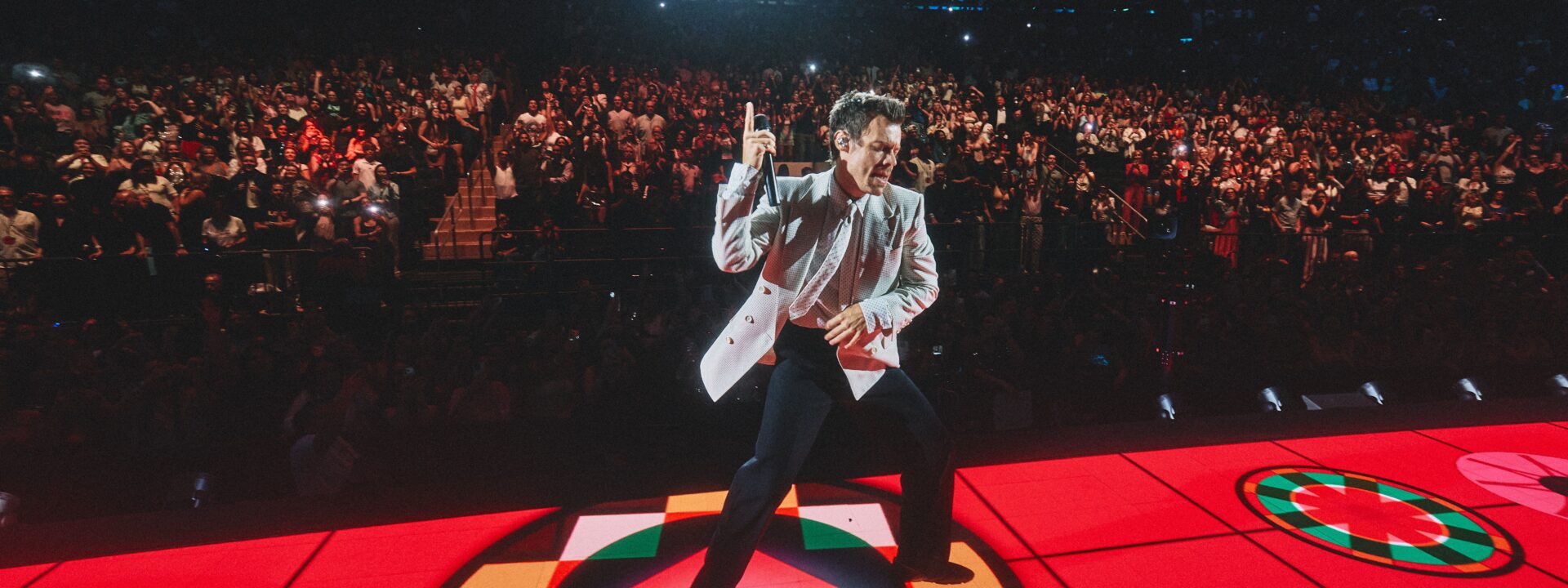
Harry Styles first played Madison Square Garden at 18, as a heartthrob in a little pop group called One Direction. Back in 2012, he had just come off Britain’s The X Factor, and not long before that, he was working the counter at W Mandeville Bakery in his hometown of Holmes Chapel. He had a name—and a cheeky smile—made for stardom, plus a love for skinny jeans. When he arrived at the venue, he kissed the floor and said in awe, “I made it to Madison Square Garden.”
On Wednesday night, Styles kicked off a sold-out 30-night residency at MSG, doubling the 15-show run from his Love on Tour that earned him a rare-for-musicians banner in 2022 (putting him in the same league as just Billy Joel and Phish). This residency is the only U.S. stop on his global Together, Together tour, supporting his fourth album, Kiss All the Time. Disco, Occasionally., which is full of pulsing dance beats. Fourteen years after geeking out over his MSG debut, Styles—now 32—took over the legendary arena with fresh confidence, electric energy, and dazzling production that topped any of the six shows of his I’ve seen before. He traded his early-2000s ankle-biter jeans for custom Tom Ford suiting with tiny white dots (“Ties have replaced boas,” Liz Brown, a photographer shooting Together, Together street style, told me. “The sanitation workers are probably thrilled”), but he still pulled off something more golden than any Grammy: holding onto his boyish sense of wonder.
These days, “I wouldn’t be caught dead kissing the floor with my pathetic immune system,” Styles told the crowd. “However, it is not lost on me what it means to play here.”
Of course, Harry (because we’re parasocially on a first-name basis) isn’t just playing MSG. He’s owning the arena, on and off, through “Harryween” (his campy Halloween show) and drawing American girls in sequins and Sambas from all over the country, their skin stamped with kiss marks. For his own look, Styles has moved from Love on Tour’s sparkles to suits by Chanel and Celine that blend American Psycho, David Byrne, and Dick Tracy. After Wednesday night, I see Styles’s private-equity-chic as an extension of his musical growth. Some shamelessly thirsty fans think Styles is too covered up (“he needs to remove some garments,” an obsessed friend texted last night, and sure enough, squeals erupted when he took off his blazer), but Styles is all grown up and dressing for the job he wants: less bare-chested sex symbol, more mature electropop presence. Gone were the playful audience chats from past shows (except for quickly congratulating a fan who painted her pregnant belly as a disco ball), replaced by intense sessions at the synth board.
His sonically adventurous new album, nicknamed “Kissco,” dominates the setlist and crackles live. One surprise is a reworked “Kiwi” from Styles’s self-titled debut, funkified with the house beats of LCD Soundsystem’s “Daft Punk Is Playing at My House.” With white lights strobing, Styles artfully muffling his voice on a handheld mic like a techno Elvis, bandleader Pauli Lovejoy high-kicking, and backup dancers bouncing like pogo sticks, the stage-in-the-round turned into a kinetic, infectious dance party and timeless, larger-than-life theater: a rapturous rave, the club before closing time, and Styles’s signature disco all blending together, together.
Photo: Anthony Pham
The tour started in May at Amsterdam’s Johan Cruyff Arena, a stadium that holds up to 72,000 people, but Styles—a forcefield of charm—still made it feel intimate when three close friends and I spent Memorial Day weekend in the pit. Like all British royalty, Styles has to be seen to be believed. He showed off marathon-runner stamina, circling the stadium stage with arched bridges vaguely like a Hot Wheels track (after complaints about blocked views at Amsterdam’s first shows, the design was tweaked). At MSG, the show shrank in size but gThe show has grown in intensity. Adapted for the 20,000-seat Garden, Styles’ stage is a simpler semi-circle that still reaches out to the crowd, with a touch of flair. Flashing rainbow lights in syncopated patterns make it feel like a giant game of Simon.
In an era of massive productions like the Eras Tour and Beyoncé’s halftime show, Harry’s performances are stripped-back and pure. No fireworks, no backup dancers, no surprise guests. He held the Dutch arena spellbound just by strumming his guitar through the heartbreaking beauty of “Fine Line,” a song I missed at the residency’s opening night. “He is the show,” Candela Gonzalez, a 26-year-old au pair from Buenos Aires, told me (though I prefer her native Spanish flourish, calling him “el espectáculo”). It’s his natural charisma—that sweet, non-toxic masculinity and the adoration of his female fans that fill his songs and create a bond among his followers. Brown, the street style photographer, said that shooting Love on Tour and Together, Together—”seeing this welcoming feminine energy”—has “healed internalized misogyny I didn’t even know I had.” Honestly, no one is more eager than a Harrie to snap 25 photos of you outside the venue (with retakes if needed) before gushing over your hair glitter. “No one’s drunk here,” Julie, a Harrie from Long Island wearing matching blue KATTDO tees and red boas (they’re not extinct yet!) with her best friend from Cornell, told me. “Everyone’s just happy.”
I still believe Styles doesn’t need extra polish, but the upgraded production on night one in New York enhanced him without overwhelming him. From a grand halo of light that echoes MSG’s dome and casts a deep, moody red glow during “Are You Listening Yet?” to a bass that vibrates in your chest and neon graphics on the big screen that reminded me pleasantly of the vintage MTV logo, Styles used the full power of the arena he’ll call home for 29 more nights.
After Dolly Parton’s passing, Styles didn’t try to cover one of the few artists worthy of the icon title. He let Parton’s voice speak for itself, playing a recording of “I Will Always Love You” as fans swayed with their phone lights. Was it a coincidence that the track faded right after Parton—whose legacy is proving to be as much about her generous spirit as her hit songs—sang, “I hope life treats you kind”? At the landmark show of an artist whose motto is “treat people with kindness”? I don’t think so. Like Parton, Styles has been chasing rainbows since he first stepped onto the MSG stage as a teenager.
He’s spoken about the deep connection he felt with the audience at a Radiohead concert in Berlin in 2025 and his wish to create that same feeling for his fans with “Kissco.” “I had a very clear moment of: ‘This is why I get on stage,'” Styles told Apple Music’s Zane Lowe. On Wednesday night, he lived up to that purpose. It was a show worth getting only five hours of sleep before my kids’ first day of school; worth even my $50 double “Madison Mule” cocktail. I could have kissed the ground myself.
Frequently Asked Questions
Here is a list of FAQs about how Harry Styless Madison Square Garden show grows covering everything from the setlist to the fan experience
General Concept
Q What does it mean that Harry Styless MSG show grows
A It means the concert isnt static It evolves over the course of the night in terms of energy stage presence and spectacle It starts with highenergy hits builds anticipation and climaxes with emotional ballads and a massive celebratory finale Think of it as a story with a beginning middle and end
Q Is the show different every night or is it the same growth pattern
A The overall arc is the sameit always builds to a peak But the details change He rotates songs in and out changes his speeches and reacts to the specific crowd so the journey feels unique each night
Q Is growing just a fancy way of saying the show gets better
A Not exactly Better is subjective Growing means it intensifies The production the crowds energy and the emotional weight of the performance all scale up as the show progresses
The Performance Setlist
Q How does the setlist help the show grow
A The setlist is structured like a wave It opens with upbeat danceable tracks to get the energy up Then it dips into deeper cuts and slower songs to create intimacy Finally it surges back with his biggest hits for the finale creating a sense of release and euphoria
Q What part of the show is the peak or the climax
A The climax is usually the final stretch of the main set leading into the encore Songs like As It Was and Kiwi are often saved for this moment to create a massive chaotic and joyful peak
Q Does the stage production change during the show
A Yes The lighting visuals and even the stage layout are used to build the atmosphere It often starts with bright colorful and chaotic lighting and gradually shifts to more intimate singlespotlight moments before exploding into a fullscale light show for the finale
Q How does Harrys own energy change