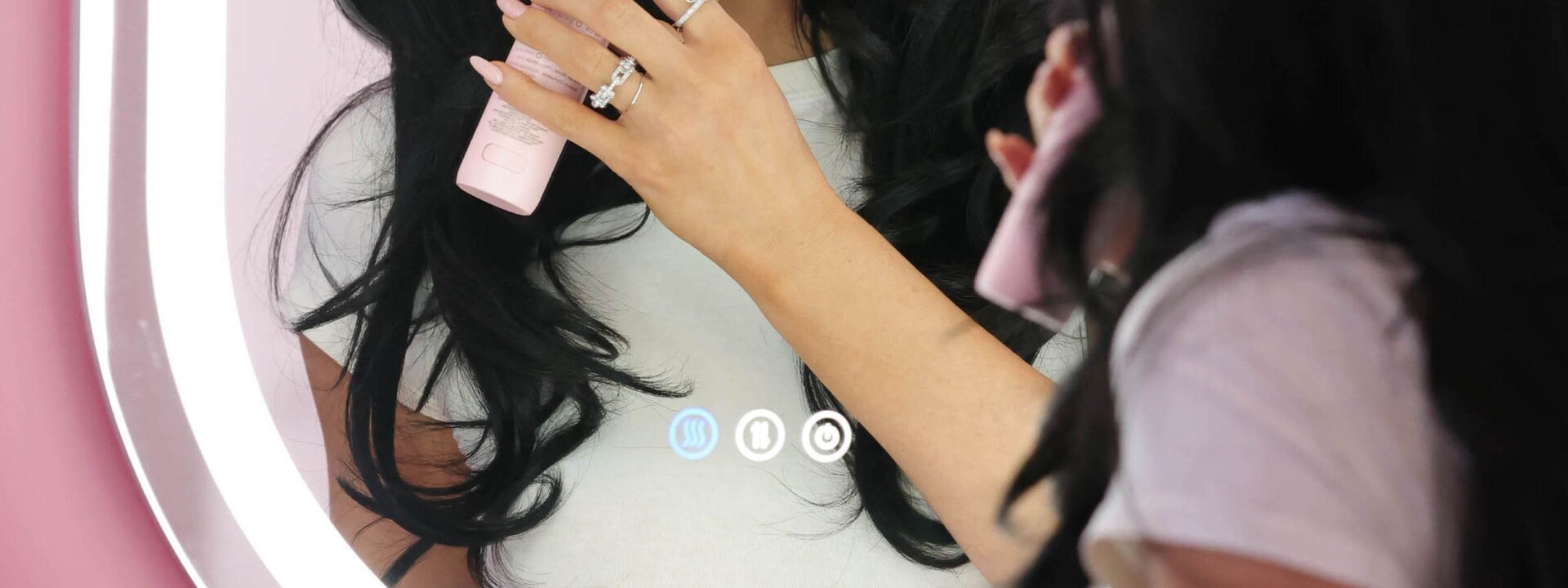
Last April, beauty mogul Kylie Jenner posted a TikTok featuring her favorite products from the K-beauty brand Medicube, after visiting the brand’s LA Glowland pop-up. “I’m now obsessed with the Booster Pro,” she told her 59.7 million followers in a video that has since received over 1.6 million likes. Following her visit, the pop-up attracted 5,000 visitors in a single week.
Jenner’s post is just one of 670,000 under the #Medicube hashtag on TikTok, where creators and other celebrities—like Hailey Bieber, Alix Earle, and Molly-Mae Hague—showcase before-and-after results using the brand’s viral products, such as the Zero Pore Pads and Age-R devices. This has helped place Medicube at the forefront of K-beauty’s recent resurgence.
During last year’s Amazon Prime Day alone, Medicube drove $22 million in sales; on Black Friday, it generated over $9 million across Amazon, TikTok Shop, and its own website. In October, it ranked first in Ulta Beauty’s online skincare category and third overall across online and in-store sales, following its expansion into more than 1,400 Ulta Beauty stores across the U.S.
“Many products in the UK and U.S. markets focus on general skin concerns like moisturizing or anti-aging. Our products, however, target very specific skincare needs and ingredients,” says Medicube’s parent company APR founder and CEO Kim Byung-hoon, speaking to Vogue Business from Seoul. “Because of this targeted ingredient pairing, we felt the products really resonated with consumers.”
Medicube was founded in Seoul in 2017 under APR Corp—a beauty-tech group established in 2014 that also houses brands like AprilSkin, Forment, and Glam.D. It started as a dermatology-led skincare label before evolving into a hybrid device-and-skincare brand. The brand gained international popularity around 2022, as TikTok’s interest in at-home beauty tech grew and creators began documenting visible, real-time results from its cult products.
In the fourth quarter of 2025, APR reported consolidated revenues of about $440 million, up 124% year-on-year. Overseas revenue rose 203% to roughly $362 million, increasing its share of total sales from 58% to 87%. For the full year, APR reported total revenues of approximately $1.2 billion, with Medicube accounting for about $1.1 billion—making the brand the overwhelming majority of the group’s business and its primary growth engine.
K-beauty—which first surged a decade ago before reaching market saturation—has enjoyed a revival over the last two years, with new players like Medicube entering the scene. Suddenly, K-beauty brands are flooding social feeds and retail shelves, as Western legacy conglomerates and indie startups race to compete. Using similar active ingredients, Medicube has managed to stand out by anchoring itself in problem-solution alignment—first with its Red line for acne-prone skin, and later with its tech-driven Age-R devices, which shifted focus from topical treatments to beauty hardware. Rather than just riding viral waves, the brand has focused on creating them, pairing clinical positioning with high-ticket beauty tech and an aggressive digital distribution strategy designed to turn attention into lasting scale.
But as K-beauty’s resurgence grows and competitors increasingly move into devices and clinical claims, Medicube will need to maintain its innovation and premium positioning in a market where trends—and customer loyalties—move at the speed of an algorithm.
Dermatology first, trend second
While much of K-beauty’s second wave in the West has been driven by dewy “glass skin” aesthetics and slugging, Medicube has carved its own path. Instead of chasing every viral trend, the brand has built momentum around highly specific, problem-solution products—most notably its ZeroMedicube’s Zero Pore Pads are a dual-sided, textured exfoliating pad pre-soaked with pore-refining ingredients. Their Collagen Night Wrapping Mask is designed to seal in ingredients overnight for a firming effect. The brand’s focus is not on chasing trends, but on delivering targeted results: addressing specific concerns with measurable outcomes and creating simple, shareable routines.
Medicube has gained traction with its highly specific, problem-solving products, especially the Zero Pore Pads. “Medicube sets itself apart in K-beauty through its dermatology-led, clinical development model,” says Billie Faricy-Hyett, chief buying officer at Lookfantastic, which began stocking the brand in July 2025. “Unlike many trend-driven brands, Medicube formulates products around well-researched, clinically proven ingredients with a clear basis in cosmetic dermatology.”
This approach has quickly led to strong sales. Medicube entered Lookfantastic’s top 30 skincare brands within months and climbed into the top 10 by revenue by early 2026—an “unprecedented achievement given their limited product range and the fierce competition,” notes Faricy-Hyett. “The Zero Pore Pads 2.0 are the bestselling product, with over 300 units sold in just the past two days, showing both strong adoption and repeat purchases.”
Growth is driven by a focused core range—including the Zero Pore Pads 2.0, Collagen Night Wrapping Mask, and a mild version of the pads—highlighting a strategy built on hero products rather than constant new releases.
“We pair these products with our Booster Pro facial device because, while the skincare is effective on its own, the device amplifies the results,” says Byung-hoon. “When used together, the difference is tangible. This synergy between device and formulation often turns first-time users into long-term advocates.”
The Power of Devices
While red light masks and vibration plates are now common on TikTok, the at-home device category was largely unproven when Medicube entered it in 2021 with its Age-R line. The Age-R device uses microcurrent, electroporation, and LED technology to firm, lift, and enhance product absorption for tighter, smoother-looking skin over time.
“In Korea, skincare clinics are widely accessible and affordable due to high competition,” says Byung-hoon. This inspired Medicube’s goal: if clinic-level treatments were accessible in Korea, why not deliver similar results at home? “Creams and serums can only do so much. We believe devices bridge that gap.” As the brand expanded globally, the opportunity grew clearer. “In many overseas markets, clinic access isn’t as widespread or affordable. Our goal was to bring advanced technology into the home and make it accessible worldwide.”
That early investment paid off. Global sales for Medicube’s Age-R category, led by the Booster Pro and including Mini and Ultra-Tune models, have surpassed six million units. This proves that consumers will invest in higher-priced at-home beauty tech when the results are credible and clearly communicated.
“We work closely with doctors and clinical advisors, and we own our factories,” says Byung-hoon. “We don’t outsource production, which allows us to control quality at every step. Safety and results—you can’t compromise on either.”To achieve visible results, it’s often necessary to boost power output, especially in heat- or energy-based devices. But this comes with risks, making engineering crucial. “With our Ultra-Tune device, which uses heat technology, we integrated multiple sensors,” he explains. “These prevent overheating or underheating, allowing us to enhance performance while ensuring safety.”
The next step is clinical applications, developing devices for salon use. “We’re also expanding into medical-grade devices designed for clinical settings rather than home use. These will launch toward the end of the year, starting in Korea,” he says. “From there, we believe it’s only a matter of time before we introduce these medical-grade clinical devices overseas.”
From TikTok to 1,400 Stores
Much of K-beauty’s recent growth has been driven not by department stores but by TikTok. Medicube recognized this early. Instead of treating TikTok merely as a channel for raising awareness, the company saw it as essential infrastructure—a place for community validation, affiliate commerce, and real-time product testing to happen simultaneously.
“Once we spent time on the platform, we realized there was deep peer-to-peer reviewing happening,” says Byung-hoon. “It wasn’t just influencers. Regular consumers were analyzing features, comparing devices, and explaining results.”
This behavior naturally aligned with the brand’s device strategy, as hardware requires demonstration and trust. TikTok’s culture of live testing and interactive comments provided both. Equally important was the immediacy. “We could see feedback in real time,” Byung-hoon says. “People told us what they loved and what they wanted improved. That direct loop made us invest more heavily.”
Medicube also embraced TikTok Shop early, moving decisively into live commerce and affiliate-driven distribution while many beauty brands remained hesitant. In March 2025, it became the first K-beauty brand to host a TikTok Shop Super Brand Day in the U.S., featuring creator Michelle Phan and celebrity makeup artist Sir John, who was simultaneously announced as the brand’s creative director. The decision paid off commercially. According to Charm.io, Medicube’s TikTok Shop revenue grew by 1,143% from 2024 to 2025. To date, the brand has surpassed $102.9 million in TikTok Shop revenue, selling one million units across 101 products.
Crucially, much of this growth has been driven by affiliate infrastructure rather than isolated big events, with nearly 34,000 creators signed up as affiliate partners. TikTok’s commission-based creator economy enabled mid-tier and micro-creators to participate in device education at scale, creating a distributed network of explainers rather than relying on a small group of brand ambassadors. Paid partnerships accelerated this momentum, involving everyone from Jenner and Jeffree Star to Earle and Tati Westbrook, whose “Better Than Botox” YouTube video showcasing Medicube’s devices reportedly generated a more than tenfold return on ad spend. Collaborations with creators like Mikayla Nogueira and Phan also contributed.
Leadership visibility further strengthened this approach. Byung-hoon appears regularly on TikTok under the nickname “CEOppa”—a blend of CEO and oppa, the Korean term used by younger women for an older brother or familiar male—answering questions and explaining device technology directly to consumers. In an era where employee-generated content builds trust, this hands-on, founder-led communication carries weight, especially given how rare it is for executives of major K-beauty brands to engage so openly and accessibly on platforms like TikTok.
Digital success has since translated into physical expansion. After building demand through TikTok Shop and affiliate commerce, Medicube securedIn 2024, Medicube entered a nationwide retail partnership with Ulta Beauty, marking a decisive shift from a digital disruptor to a mainstream player in the US market. The rollout accelerated steadily, and by August 2025, the brand was available in 1,400 Ulta Beauty stores across America.
This expansion highlights a broader strategic journey. TikTok generated initial buzz and validated the concept; an affiliate network then drove large-scale sales; and finally, retail distribution established a lasting presence. What Medicube has built is more than just a viral moment—it’s a vertically integrated growth engine that smoothly moves customers from discovery online to purchase in-store.
Frequently Asked Questions
Of course Here is a list of FAQs about Medicubes global success designed with clear natural questions and direct answers
Beginner Foundational Questions
1 What is Medicube and what do they do
Medicube is a South Korean skincare brand that specializes in athome medicalgrade beauty devices They are best known for their Booster machines which use technologies like EMS and IPL to target concerns like wrinkles acne and sagging skin
2 How did Medicube become so popular globally
Their success is a mix of effective products smart marketing and perfect timing They created easytouse hightech devices at a more accessible price than professional clinic treatments Their popularity exploded through social media especially TikTok and YouTube where users shared dramatic beforeandafter results
3 Whats the main benefit of using a Medicube device
The main benefit is getting clinicallevel skincare results at home Instead of paying for frequent expensive dermatologist visits you can maintain and enhance your skins appearance with a onetime device purchase
4 Are Medicube devices safe for home use
Yes when used as directed Medicube designs its devices to be safe for consumer use with builtin safety features and clear intensity levels However its always important to read the manual do a patch test and avoid using them on active infections or certain skin conditions
5 Which Medicube device should a beginner start with
Most people start with the AgeR Booster or Ussera Deep Shot The AgeR focuses on antiaging and firming with EMS while the Ussera Deep Shot uses a stamping technology for deep product absorption and fine lines They are considered great entry points to the brands technology
Advanced Strategic Questions
6 What was Medicubes key marketing strategy
Their strategy was heavily influencer and usergenerated content driven Instead of just traditional ads they seeded products to skincare enthusiasts and dermatologists on YouTube and TikTok Real people sharing genuine visible results created massive organic buzz and trust
7 How does Medicubes technology differ from other athome devices
Medicube often uses a