Former model Chris Royer explains that the best way to understand what it was like to work with Duane Michals is through the Hungarian word “kinscvadászat,” which basically means a “treasure hunt.” For Royer, a project with Michals was exactly that: “You were going on a trip, you knew you were going to discover things, it was a creative treasure hunt.”
Michals passed away on June 9 at age 94. He was born on February 18, 1932, in McKeesport, Pennsylvania. As a young boy, he showed an interest in art, and by age 14, he was taking watercolor classes at the Carnegie Institute in Pittsburgh. He earned a B.A. from the University of Denver in 1953, and after two years in the army, he began studying at the Parsons School of Design, hoping to become a graphic designer.
A trip to the U.S.S.R. in 1958 changed everything. The photos he took while on vacation sparked a passion for photography. Michals gave up the idea of becoming an art director and instead focused on working behind the camera. The pictures from that trip became his first exhibition at the Underground Gallery in New York in 1963.
As he developed his work as a fine arts photographer in the late 1960s, Michals started working for Condé Nast magazines. One of his earliest assignments was a portrait of musician Johnny Cash for the November 1969 issue of Mademoiselle. Unlike most portraits, which simply show the subject, Michals photographed Cash through a window, using his own reflection as a key part of the image, with the star sitting quietly in his hotel room.
Johnny Cash. Photographed by Duane Michals, Mademoiselle, November 1, 1969
Letting himself become part of his images became an important feature of Michals’ work as he grew as an artist. He also added text as another storytelling tool and pioneered the idea of telling a story through a series of images. As his close friend, critic Philip Gefter, explained in The New York Times, Michals was “an artist of significant consequence” who can be seen as “the father of the photographic narrative sequence.” He was also openly gay at a time when many homosexuals stayed in the closet.
Michals regularly contributed to Vogue during the 1970s and 1980s. His work during that time ranged from shooting stills of Robert Redford and Mia Farrow in costume on the set of The Great Gatsby, to reporting on the San Francisco ballet and jewelry designer Elsa Peretti working in her legendary studio and apartment, to portraits of notable men like Yves Saint Laurent, Dudley Moore, and Philip Glass.
In 1976, Michals made his mark in the fashion pages of Vogue. Tasked with photographing the spring and fall collections with editors Polly Mellen and Jade Hobson, he created two very different portfolios, both showing his creative adventurousness and skill.
For those who worked at Vogue during its time at Condé Nast headquarters at 350 Madison Avenue, as I did, Michals’ spring collections shoot for the February 1976 issue feels very familiar. As Royer explains, Michals had the idea of shooting the models as “working women,” and what better place to do that than in the Vogue art department planning room? That was the room where the magazine was literally put together. The most striking image from the story shows Royer and another model looking at 35mm slides while a Vogue staff member rushes by in a blur, hinting at what Michals had planned for the fall.
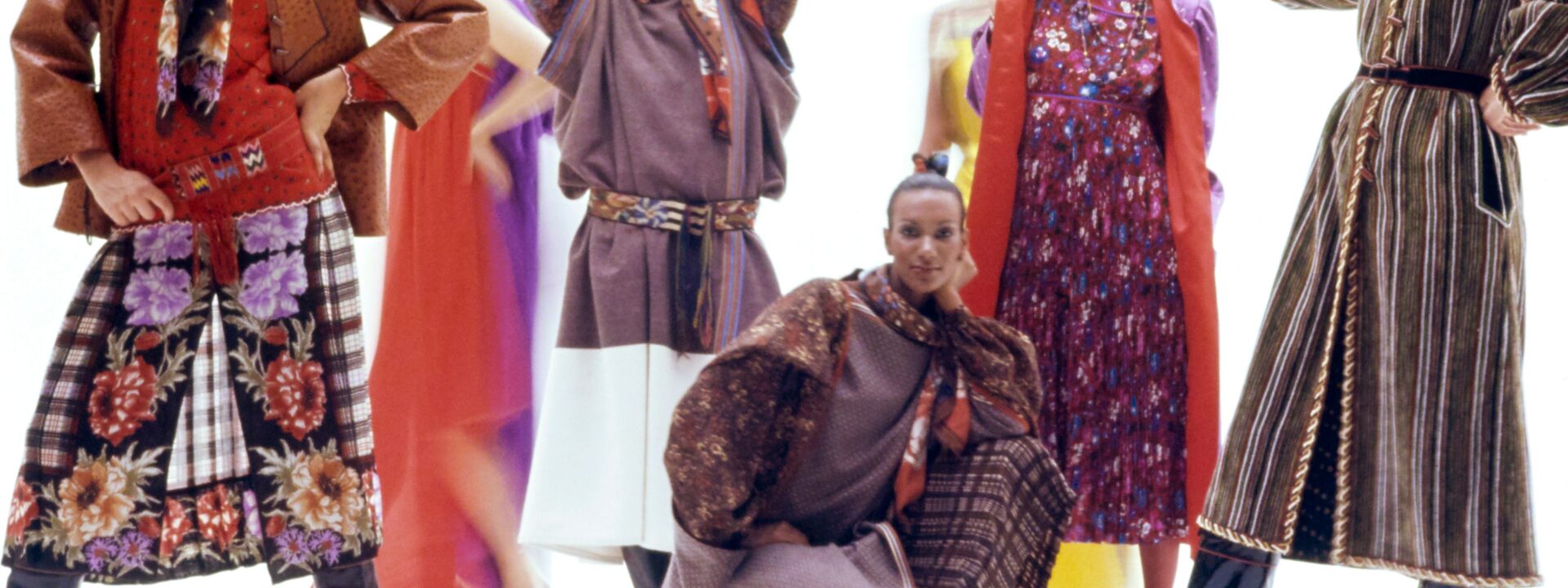
Later that year, Michals took a completely different approach for the fall collections. Instead of his usual location shoots, he chose to work in a studio—but not just any studio. Michals gathered a group of models, including Royer, in the legendary Carnegie Hall studio of photographer Edita Sherman. Sherman was known as the “Duchess of Carnegie Hall” and lived and worked there for over 60 years.
Christiaan was the hair stylist on several of the pictures and remembers that Michals was…He was “somewhat demure with a friendly determination” and quickly began “orchestrating everyone around the room, like a slow-moving carousel that he was allowed to move about.” The resulting images are a high point in fashion photography. Not only did Michals skillfully manage a large group of models—no easy feat—but his use of a slow shutter to create a slight blur gave the photos an energy and emotion rarely seen in studio fashion shots.
Christiaan admits that at the start of the shoot, everyone on set was a bit nervous, since Michals wasn’t your typical fashion photographer. “Nevertheless,” he recalls, “everyone sensed that they were part of something special.”
Chris Royer, center, reviewing film in the Vogue planning room at 350 Madison Avenue.
Photographed by Duane Michals, Vogue, February 1976
Chris Royer, right, and a colleague busy at work.
Photographed by Duane Michals, Vogue, February 1976
Gunilla Lindblad demonstrating “clothes that work.”
Photographed by Duane Michals, Vogue, February 1976
Melanie Cain, Beverly Johnson, Lisa Cooper, and Pat Cleveland in looks from John Anthony’s fall 1976 collection.
Photographed by Duane Michals, Vogue, October 1976
Lisa Cooper, Pat Cleveland, and models in looks from Geoffrey Beene’s fall 1976 collection.
Photographed by Duane Michals, Vogue, October 1976
Models in looks from Valentino’s fall 1976 collection.
Photographed by Duane Michals, Vogue, October 1976
Drena Van Alen, development director for the San Francisco Ballet, riding on the back of a BMW 750.
Photographed by Duane Michals, Vogue, April 15, 1972
David Warrilow, JoAnne Akalaitis, and Ruth Maleczech of The Mabou Mines recreate the form of a galloping horse.
Photographed by Duane Michals, Vogue, July 1, 1972
Robert Redford as Jay Gatsby on set.
Photographed by Duane Michals, Vogue, December 1973
Actor Dudley Moore.
Photographed by Duane Michals, Vogue, February 1974
Frequently Asked Questions
Here is a list of FAQs about the passing of Duane Michals written in a natural tone with clear concise answers
FAQs The Passing of Duane Michals
1 Is it true that Duane Michals has died
Yes it is true Duane Michals the influential photographer passed away at the age of 94 His death was confirmed in late 2024
2 Who was Duane Michals
He was a groundbreaking American photographer best known for his work with Vogue and for inventing the photo story He used multiple images text and handpainting to tell stories about life death and dreams
3 What was Duane Michals most famous for
He was famous for rejecting a single perfect photograph Instead he created sequences of images to show the passage of time and inner thoughts He also often wrote handwritten text directly on his photos
4 Did he only work for Vogue
No but his work for Vogue was very famous He shot portraits of celebrities like Andy Warhol and Meryl Streep However his personal surreal and philosophical work is what made him an art world legend
5 How old was he when he died
He was 94 years old
6 What was the cause of death
As of now the specific cause of death has not been publicly released by his family or representatives His age was a significant factor
7 Why is his death such a big deal for photography
He completely changed what people thought a photograph could be Before him photos were mostly about capturing a single perfect moment He proved they could tell a story show a dream or express a feeling over time
8 Is there a specific photo or series I should look at to understand his work
Yes Start with his series called The Spirit of St Louis or Things Are Queer They are short powerful and explain his genius in just a few minutes
9 Did he influence any modern artists or photographers
Absolutely His use of narrative sequences heavily influenced modern film directors and contemporary photographers who use Instagram or TikTok to tell stories in a series