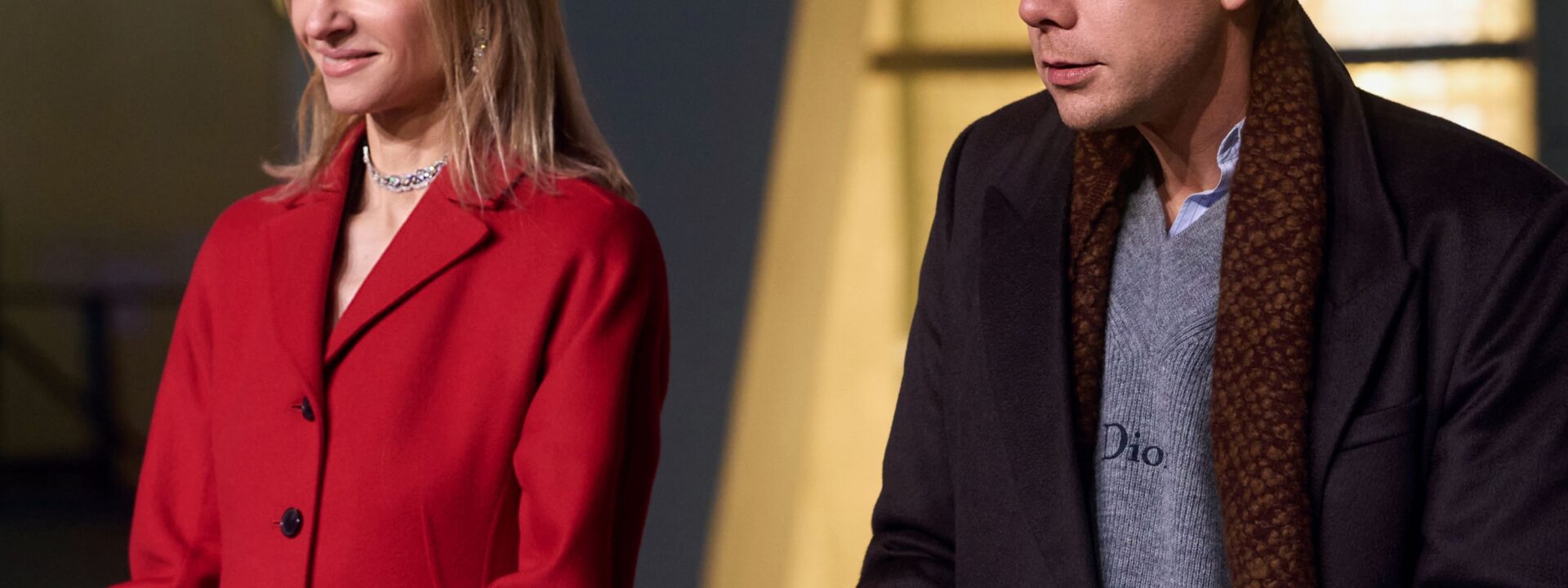
On December 11, Dior unveiled its most ambitious retail project in China to date: the House of Dior Beijing. This five-story sculptural flagship is located in Sanlitun, the capital’s cultural and luxury shopping hub.
The presence of Jonathan Anderson alongside Delphine Arnault, Chair and CEO of Christian Dior Couture, highlighted the strategic importance of the Chinese market for the brand. The ribbon-cutting ceremony, attended by long-standing Dior celebrity partners such as Chinese actor Zhang Ziyi and global brand ambassadors Zheng Qinwen and Liu Yuxin, generated significant visibility for the flagship. It quickly gained attention across major social media platforms. Candid sightings of Anderson and Arnault in the city, widely shared on Xiaohongshu and Weibo, further amplified Dior’s presence and strengthened the brand’s cultural momentum in China.
A day later, Dior offered Beijing a preview of Anderson’s Spring 2026 ready-to-wear collection—a move that signaled intent as much as it was a programming choice.
The timing is deliberate. The luxury market in China is entering a delicate yet decisive phase. After nearly two years of volatility, third-quarter results for the luxury sector showed the first signs of stabilization, raising the question of whether this recovery can be sustained. In this context, few gestures demonstrate long-term confidence more clearly than Dior’s new Beijing store.
“This exceptional venue is much more than a boutique; it is truly a place of unique experiences where fashion meets art in all its forms,” Arnault tells Vogue Business. “The House of Dior Beijing represents a tremendous new chapter for Dior in China… making our historic and artistic links with the inspiring country of China stronger than ever.”
A Cultural Beacon Disguised as a Flagship
Designed by architect Christian de Portzamparc, the House of Dior Beijing extends the architectural language Dior introduced in Seoul (2015) and Geneva (2024). Featuring petal-shaped shells, golden vertical tiles—traditionally reserved in China for royal dignitaries—and a star crowning the façade, the building is both sculptural and symbolic, resembling a cultural installation more than a retail environment.
Inside, the flagship houses women’s and men’s collections, high jewelry, watches, Dior Maison, and a room filled with white toiles, designed by the world-renowned Rotterdam-based firm OMA, echoing Dior’s historic flagship at 30 Avenue Montaigne. The Monsieur Dior restaurant on the garden level reinforces the maison’s ambition to embed French art de vivre within China’s most influential urban centers.
“A perfect showcase for new creative energy—in the highly dynamic Sanlitun district—the House of Dior Beijing allows French art de vivre, so dear to Dior, to radiate,” Arnault says. “China exudes tremendous energy and a breath of inventiveness that speaks to all generations.”
Dior’s long-standing dialogue with Chinese artists, architects, and designers is extended through the Beijing flagship. French sculptor Claude Lalanne’s Ginkgo Leaf bench anchors the entrance, followed by visual artist Sarah Meyohas’s mist-like painting and Valeria Nascimento’s ceramic installation Gold Cascade. Works by furniture designers Hervé Van der Straeten and Franck Evennou, visual artist Not Vital, multimedia creative Xu Zhen, painter Xiyao Wang, and sculptor Annalu introduce a vibrant energy throughout the space.
At Monsieur Dior, three commissioned works by Chinese multimedia artist Hong Hao—one in shimmering silver and multicolored tones, and two in striking red geometric forms—reference the vitality of Beijing and reflect Dior’s continuous engagement with Chinese contemporary art, including its ongoing Dior Lady Art collaborations.
Arnault notes that young Chinese artists “are writing a new chapter inThis new location is intended to showcase the brand’s vibrant energy and cultural connections. This reflects a wider industry view that future growth will depend less on simple transactions and more on cultural integration, local creativity, and experiential spaces that justify luxury’s high prices.
A Strategic View on China’s Next Luxury Cycle
The store opening comes at a pivotal time. Since the third quarter of 2025, Chinese shoppers have shown early signs of returning to discretionary spending. Analysts point to a gradual soft landing: slower but more stable growth, a resurgence in domestic purchasing, and rising demand for high-quality retail experiences.
By the third quarter, several major luxury groups reported a turning point in their China performance after nearly two years of volatility. LVMH, Dior’s parent company, described a “progressive normalization” in Chinese consumption, with improving trends in fashion and leather goods. Richemont, owner of Cartier, noted “encouraging momentum” led by jewelry, though growth varied across cities. Kering, which is still repositioning Gucci, confirmed that Chinese sales were “showing early signs of re-engagement,” albeit at a “more moderate pace than pre-2021 levels.”
For Dior, making a strong move now is a powerful strategy. It positions the brand proactively while much of the industry is still adjusting its expectations.
“Today more than ever, Dior views China as a key driver of growth for the global luxury market,” says Arnault. “This goes beyond the purely economic context, as China is also a huge creative hub that inspires us… at the convergence of heritage, ancestral local savoir-faire, and the most avant-garde innovations.”
Her emphasis on China as a creative engine—not just a revenue source—mirrors a broader shift among leading luxury houses: the need to engage more deeply with China’s cultural fabric to sustain long-term loyalty. Dior’s ongoing collaborations with Chinese artists, its Dior Lady Art commissions, and its support for young Chinese creators serve as both symbolic investments and strategic hedges against an increasingly discerning consumer.
Frequently Asked Questions
Of course Here is a list of FAQs about Diors strategy in Chinas reviving luxury market designed to be clear and conversational
Beginner General Questions
1 Why is China so important for a luxury brand like Dior
China is the worlds largest and fastestgrowing market for luxury goods Even during economic slowdowns its longterm potential is massive Success in China is essential for any global luxury brands growth
2 What does reviving luxury market mean in China
It means that after a period of slower growth consumer spending on highend goods in China is picking up speed again People are returning to stores and feeling more confident about making luxury purchases
3 How is Dior strengthening its presence there
Dior is using a multipronged approach opening new larger flagship stores in key cities heavily investing in digital marketing and ecommerce on Chinese platforms like Tmall and Douyin and creating exclusive products and campaigns that resonate with local tastes and cultural moments
4 Is Dior just targeting wealthy older customers in China
Not at all While they serve their established clients a huge focus is on attracting younger GenZ consumers They do this through collaborations with popular Chinese celebrities gaming partnerships and social media campaigns that speak to a younger audience
Advanced Strategic Questions
5 What specific localized strategies is Dior using
Beyond celebrities Dior integrates Chinese culture thoughtfully Examples include designing limitededition products for the Lunar New Year using traditional motifs like porcelain blue in collections and hosting exclusive events during major shopping festivals like Singles Day
6 How does Dior handle the challenge of parallel imports or daigou in China
Dior is combating unauthorized resellers by controlling its distribution tightly ensuring pricing is aligned globally and most importantly by making the official purchase experience so seamless that buyers prefer to buy directly
7 With the rise of Guochao is there a risk for Western brands like Dior
Its a challenge and an opportunity The