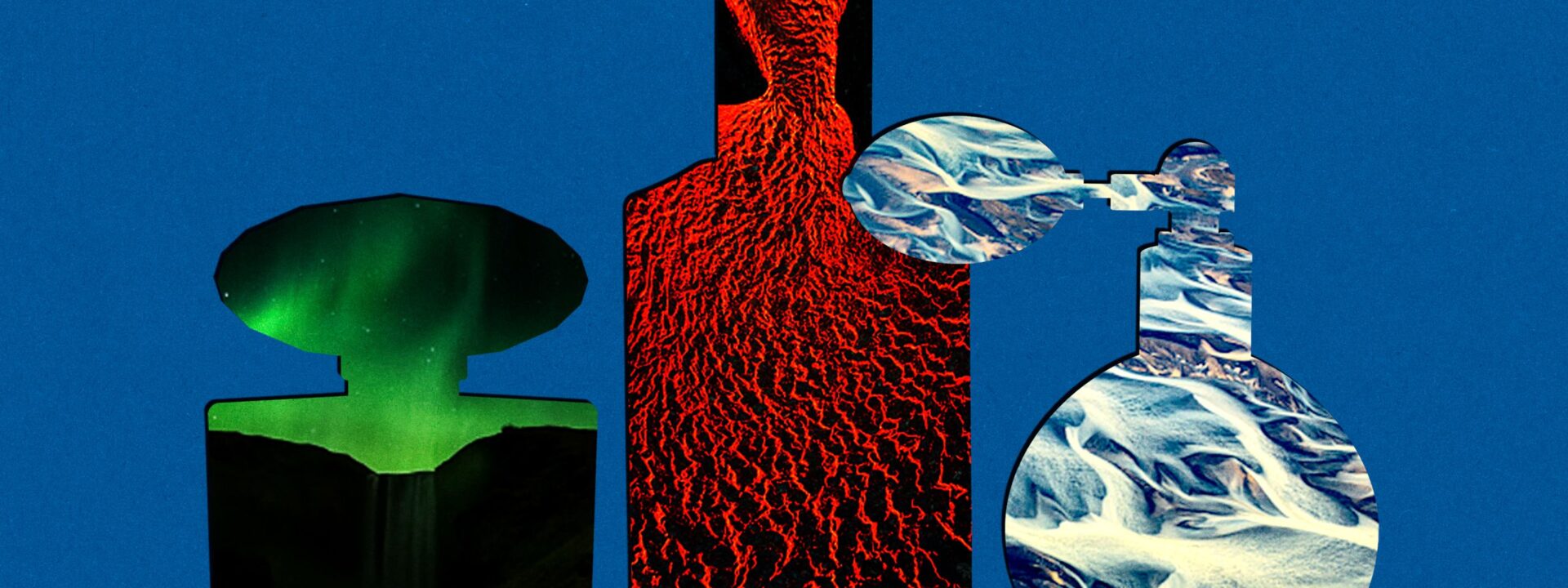
The small, crowded shop in downtown Manhattan was packed. A tiered display of cookies sat mostly ignored in the corner. The real draw was the visiting speakers: Icelandic musician Jónsi (best known as the frontman of Sigur Rós) and two of his three sisters, Lilja and Sigurrós (the band’s namesake, who goes by Rosa). Lilja stepped to the center of the room. Wearing a long black dress with a white Peter Pan collar, her long, pin-straight hair gave her the look of a cheerful, grown-up Wednesday Addams.
“Close your eyes,” she instructed as small, scent-soaked paper strips were passed around. “We rely too much on our eyes, analyzing everything.” Then she began her story: “Brand new sneakers crushing fresh flower stalks against hot asphalt. A mouth full of lemon candy and fingers sticky with motor oil. An arctic wind blowing through hair in a damp pine forest.” If you had stumbled in from the street, you might have thought this was the launch of an experimental literary magazine, not a new fragrance from the siblings’ family-run perfume company, Fischersund.
This reflects the state of perfume today: everything has a story, often one that matters more than the scent’s actual composition. Elaborate origin stories aren’t entirely new. Chanel No. 5, created in the 1920s, was partly inspired not by flowers, but by the icy freshness of frozen rivers and lakes—an observation made by the Russian-French perfumer Gabrielle Chanel hired while she was stationed above the Arctic Circle. In the 1990s, Issey Miyake tasked perfumer Jacques Cavalier with interpreting Japanese bathing rituals, like adding iris leaves to steaming waters on Children’s Day, which led to his famous L’Eau d’Issey.
But while perfumers of the past drew on memory and tradition, today’s scent-makers craft far more maximalist narratives. On a windy day last fall, I met with the elegant perfumer Christopher Sheldrake and Véronique Spoturno, great-granddaughter of François Spoturno (better known as Coty, the father of modern perfumery). They were introducing Spoturno, a company quietly launched in 2021 that arrived in America last fall. My favorite of their new scents is the breezy, brisk Alphée, inspired by the rocky coast of Corsica with notes of juniper berry, myrtle leaves, cardamom, and coriander. But what really sells it is Spoturno’s vision of nautical life: long, lazy trips with friends under an azure sky on a yacht named Alphée, its interior decorated by René Lalique. Véronique carefully flipped through an antique logbook by French author Paul Morand, filled with trip notes and photos of the yacht. I spritzed the scent on my wrists and felt as if I were floating on the Tyrrhenian Sea for the rest of the day.
The urge to link scent and story is understandable. More than any other sense, smell has always been tied to narrative. We detect odors in our nostrils, but the processing happens deep in the brain, where scent and emotion are closely linked. Yet contemporary fragrances have become so invested in storytelling that they often rely on references with little connection to actual smell. (There’s precedent: Marc Jacobs’ Daisy, a popular fragrance launched in 2007, is based on a flower with no strong scent. Many perfumes cite tulips, which mostly have no discernible odor.) In January, Le Labo introduced a candle inspired by Japanese indigo dyeing. Frederic Malle’s newest series revolves around “desert gems,” including a popular one called “The Moon.” If you want to smell like an actual stone, the jewelry company Mateo offers scents based on turquoise, mother of pearl, and malachite.
“What would it smell like if you could reach the rainbow?” asks DS &David Seth Moltz, co-founder of Durga, poses a question that is more than rhetorical—it’s the inspiration behind his newer “Steamed Rainbow” fragrance. To me, it smells like clean laundry with a peppery, arugula-like undertone. “I have synesthesia,” Moltz explains. “I can smell colors, and colors have smells.” Meanwhile, Byredo’s popular Alto Astral, launched last summer, is described as “an embodiment of positive energy,” taking its name from a Brazilian expression of joy.
On a winter afternoon, perfumer Michael Nostrand, founder of Mythologist Studio, was in his Montclair, New Jersey studio crafting a scent inspired by rain—a fluid and abstract concept. Rain can smell like nothing or everything: earthy greenness with damp, fungal notes; the crisp, ozonic chill outside; or cigarette smoke and wet pavement after stepping out of a stuffy bar. Yet “rain” isn’t the strangest request he’s received. He once had to create the scent of a “swamp,” and another time, interpret a Japanese tale about a vengeful phantom whale. “For that one,” he says, “I had to imagine being alone in the ocean, on a rocking boat overturned by a ghost whale.”
Nostrand describes perfume creation as a balance between novelty and nostalgia—the pull of the new and the comfort of the familiar. Food-inspired scents, for instance, have been common for years and often feel comforting (vanillin, found even in breastmilk, is widely appealing). But he’s excited by new gourmand experiments, like a savory cacao fragrance he developed in 2024, accented with chili and paprika, or Maison Tahité’s Tonka Sel-Noir, which he calls a salty take on tonka.
Nostrand believes our growing attraction to scents with a story comes from a generation that experienced isolation during the Covid years—many temporarily lost their sense of smell—making people more curious about their impact on the world. “People increasingly want fragrances that make them feel things,” he says. “More than an odor, they are looking for a sensation.” They want something delicious, but with a twist. After all, none of us are a simple story.
Frequently Asked Questions
Of course Here is a list of FAQs about the idea of a perfume that tells a story designed to answer questions from curious beginners to fragrance enthusiasts
FAQs Perfumes That Tell a Story
Beginner Definition Questions
1 What does it mean for a perfume to tell a story
It means the fragrance is designed to evoke a specific memory place emotion or narrative Instead of just smelling like flowers it might transport you to a rainy evening in a pine forest or grandmas sunlit linen closet
2 How is a storytelling perfume different from a regular perfume
All perfumes have a character but storytelling perfumes are intentionally crafted with a specific scene or concept in mind The name notes and marketing are all aligned to create a full sensory experience and emotional connection beyond just the scent itself
3 Can you give me an example of a perfume that tells a story
Imagine a perfume called Midnight Garden Its story might be about a secret dewcovered garden at night The notes could include jasmine wet soil and a hint of dark plum all working together to create that specific evocative atmosphere
Benefits Experience
4 Whats the benefit of choosing a storytelling perfume
It creates a deeper more personal connection to your fragrance It can serve as a scent memory boost your mood or feel like an invisible accessory that expresses a part of your personality or desired vibe for the day
5 Do I need to know the story to enjoy the perfume
Not at all The story is a guide for the perfumer and a fun narrative for you Your personal experience and the memories you associate with the scent are what matter most The story is just the starting point
6 Are these perfumes only for special occasions
No they can be for everyday wear You might have a confident sunny day story scent and a cozy comforting one for relaxing at home Its about choosing the story you want to embody
Common Questions Practical Tips
7 I often blindbuy perfumes online How do I choose a storytelling scent without smelling it
Read the listed fragrance notes