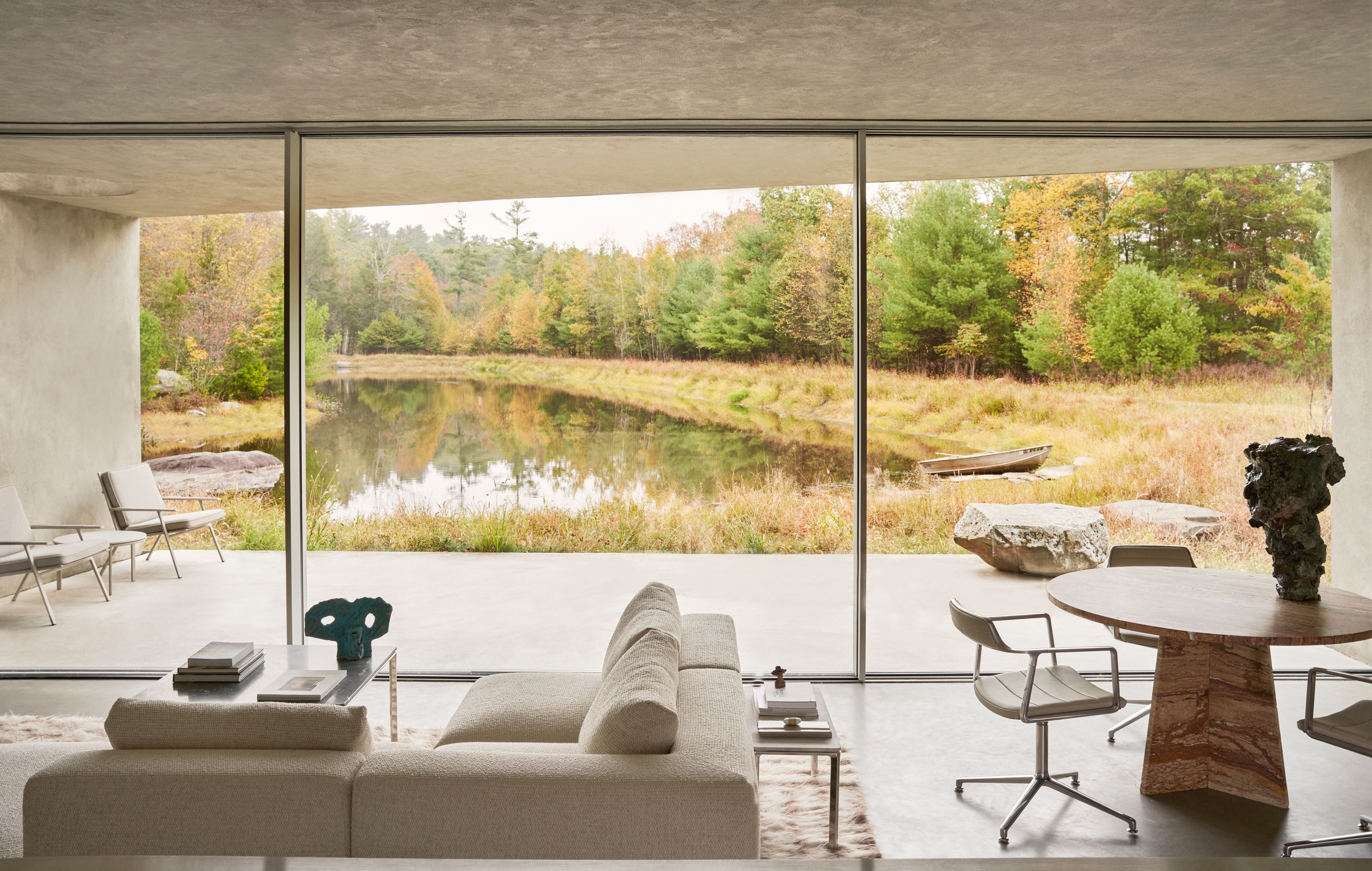
It’s hard to believe it all started with a trash can. I first came across the Danish lifestyle brand Vipp during Copenhagen’s annual design festival, 3 Days of Design. Last summer, I visited one of their experiential spaces, Vipp Garage, where a mid-century industrial building had been turned into a stylish Moroccan guesthouse. The project was a collaboration with Studio KO—the architecture firm based in Marrakesh and Paris, known for designing the Yves Saint Laurent Museum in Marrakesh and Chiltern Firehouse in London. For this space, they introduced Vipp’s signature modular V1 kitchen in a striking copper finish.
Also finished in a luminous rose-gold-like tone was Vipp’s very first product: the simple pedal bin, created in 1939 by Holger Nielsen. Back in 1932, when Nielsen was just 17, he won the lottery. His prize was a car—but since he didn’t have a license, he sold it and used the money to build a metal factory. When his wife Marie opened a hair salon in 1939, she asked him to make a bin. Over the decades, Nielsen’s design went from being a favorite among local businesses to an international design icon (in 2009, it even became part of the collection at the Museum of Modern Art in New York).
Today, Vipp is run by Nielsen’s grandchildren, Kasper Egelund and Sofie Christensen Egelund, and produces everything from sofas and rugs to lighting and mugs. In 2014, Vipp opened its first guesthouse—a 592-square-foot steel pod on Lake Immeln in Sweden. Since then, the company’s portfolio has grown to include 14 more properties, usually set in nature-filled, off-the-beaten-path locations like Todos Santos on Mexico’s Pacific coast or Tasmania’s Bruny Island.
As a new fan of the Vipp world, I was thrilled to hear that the company’s latest guesthouse would open in spring 2026 in my own backyard, the Catskills—and that I’d have the chance to stay there this April. The 1,200-square-foot building sits beside a private pond at the edge of a forest in Pond Eddy, a small hamlet in Sullivan County. After a two-hour drive door to door (with a very scenic, winding route along the Delaware River), my husband Craig and I arrived at the Vipp Pavilion in our rented SUV—a recommendation we were grateful for when navigating the property’s unpaved roads.
The first thing we noticed was that the pond felt much bigger in person. And while I’d been promised a lush meadow designed by Larry Weaner Landscape Associates (who also worked on Glenstone’s stunning landscape), I didn’t expect the brief feeling of being dropped into the Mediterranean, with dramatic rock formations, blooming azaleas, and even a waterfall. The rugged terrain seemed a bit at odds with the futuristic concrete block at the other end of the pond, but at the same time, that contrast set the tone for a one-of-a-kind experience unlike anything I’d had in Upstate New York—or anywhere, really.
“The very first thing we told the architect was that this should feel like a livable sculpture in the middle of a meadow—and it should feel like somewhere no one has been before,” Sofie Christensen Egelund told me the following week at her TriBeCa loft, which also serves as Vipp’s Manhattan showroom. In her 12 years living in New York City, Egelund, her husband Frank, and their two kids have grown to love the Catskills, where they’ve escaped during chaotic construction periods or whenever they just need fresh air. When the chance to buy the secluded property came up nearly a decade ago, the couple jumped on it. Even though the home sits on 16 acres, it has a modest footprint, staying true to Vipp’s “less but better” philosophy. Egelund notes, “Even though the guesthouse is small, a million thoughts went into it.”The energy in these environments largely comes from putting Vipp’s language into conversation with those of different architects. For the Upstate guesthouse, she brought in Johnston Marklee, the Los Angeles-based firm known for its bold, geometric structures for cultural institutions like the MCA Chicago, Dallas Museum of Art, and Kunstmuseum Basel, as well as LA galleries for Marian Goodman and Michael Werner, among others.
For the firm’s founding partners, husband-and-wife duo Mark Lee and Sharon Johnston, working at such a small scale and in such a remote location was an exciting challenge. “It’s such a stripped-down program: a courtyard, living space, two bedrooms, one bathroom. Everything else you’d expect in a more traditional home has been removed,” Johnston said during a Zoom call with Lee and me. “It was a really interesting challenge to figure out how to create an environment that feels complete but also open to the landscape.” For Lee, who emphasized how inspiring the home’s focus on “essentialness” was, Vipp’s brief reminded him of the Case Study Houses—a program from the 1940s through the 1960s where architects designed affordable, modern homes in response to the mid-century housing boom.
Photo: Eric Petschek
At the same time, Johnston Marklee’s design for Vipp’s guesthouse is deceptively simple. From the outside, it looks like a boxy structure, but it’s actually made up of two half-ellipse shapes that mirror the pond’s curves (so inside, you’ll hardly find any straight lines). “As you approach the house, the pond is very visible, but then you walk into a courtyard where you can’t see anything at all. In a way, it clears your senses before you step inside, and then the pond comes back into view,” said Lee, noting that the firm loves to play with repetition and contrast. The courtyard and the home’s living area have nearly the same footprint, but while the courtyard is completely open to the sky, the living room’s floor-to-ceiling window focuses on the horizontal view.
Photo: Eric Petschek
“As you enter the house, the richness of the space slowly unfolds like a cinematic experience,” Lee said. Johnston added that the dynamic light (achieved through various skylights and vertical openings in the bedrooms), the panoramic view, and the rough finish of the stucco walls (which evoke garden walls) draw nature inside. “There’s this in-between feeling of inside and outside that reflects the atmospheric quality we aim for in our work,” she noted.
Photo: Eric Petschek
Photo: Eric Petschek
Another key quality the architects share with Egelund is the uncanny. “We try to bring in something that feels a bit foreign. The best spaces are the ones where you feel like you’re in a slightly different world, but you can’t quite explain why,” said Lee. With its only detail being a ribbed texture, the exterior gives the house an air of mystery. “It almost looks like something left over from another time,” said Johnston. “When someone sees the house for the first time, they might think, ‘Is this from the ’70s, is it recent, or is it a ruin?’”
Photo: Eric Petschek
Egelund also values unconventional design and moments of discovery. For example, the bathroom is noticeably large compared to the cozy bedrooms. Stained in an earthy red clay color, it’s the only room that breaks away from the otherwise sparse Scandinavian palette of whites and cool-toned metal. If you’re feeling adventurous, an outdoor shower and sink, completely exposed to the elements, offer another surprise. Egelund noted it’s a nod to the Danish tradition of a quick outdoor rinse (though guests will be happy to hear the water can be piping hot). She also recommended brushing your teeth outside while stargazing.
Photo: Eric Petschek
Of course, the center of the home is Vipp’sThe anodized aluminum V3 kitchen comes fully equipped with every appliance or tool you could want to prepare a Noma-worthy meal—minus the Piet Oudolf-designed garden, of course. I’ll admit, my husband and I were pretty worn out after a day spent making fluffy friends at Buck Brook Alpacas and shopping in nearby Narrowsburg (don’t miss Madame Fortuna for vintage fine jewelry and Maison Bergogne, which feels like stepping into a Paris flea market). We had big plans to test every gadget, but ended up settling on premade lobster ravioli and vodka sauce from the artisanal grocer Proper to Go, washed down with rosé from Narrowsburg Fine Wine.
Before dinner, we decided to take a walk around the grounds, snacking on fresh bread and cheese we’d also picked up from Proper to Go. It wasn’t a Michelin-starred meal, but it reminded me of the simple, deep contentment I felt during a solo walk through Copenhagen’s Assistens Cemetery, after enjoying a pumpkin-seed roll from Meyers Bageri with fresh butter and that crystal-textured gouda-style cheese I’ve been talking about nonstop for nearly a year.
Even though every detail of Vipp’s guesthouse felt luxurious—from the espresso machine to the linens and the curated ceramic art—it felt more like a way to connect with other guests and the natural surroundings. On our second day, when the rain poured down, it was so cozy curling up on the sofa with a coffee and watching the mist drift over the pond. At home, I usually go for more colorful, patterned, and ornate décor, but I found the simplicity here surprisingly refreshing, especially compared to how over-designed a lot of modern accommodations have become.
While Egelund had plenty of ideas for future Vipp guesthouses in America (Big Sur came to mind), new locations in Scotland and Sicily are in the works for next year. There’s no global plan for expanding—Egelund described it as an “organic” process that focuses on finding like-minded collaborators rather than sticking to a set schedule. Like all its guesthouses, which encourage visitors to slow down and enjoy the moment, Vipp is in no rush: “Good things take time.”
Frequently Asked Questions
Here is a list of FAQs about the Danish design brand opening its first US guesthouse in upstate New York
General Brand Questions
Q Which Danish brand is this
A The brand is Vipp They are famous for their iconic pedal bin and highend minimalist kitchen and bathroom designs
Q Where exactly in upstate New York is the guesthouse
A Its located in the Hudson Valley specifically in the town of Saugerties New York about a 2hour drive north of New York City
Q Is this a hotel or a private home
A Its a private guesthouse You book the entire property for yourself so its like having your own designer vacation home not a hotel with a front desk
Booking Staying
Q How much does it cost to stay there
A Prices vary by season but it starts around 1500 to 2000 per night Its a premium luxury experience
Q How many people can stay there
A The guesthouse sleeps up to 6 guests
Q Is there a minimum stay requirement
A Yes most dates require a 2night minimum stay and sometimes 3 nights during peak seasons or holidays
Q Can I bring my pets
A No the guesthouse is not petfriendly
Q What is the cancellation policy
A It is very strict Typically you must cancel at least 30 days before checkin for a partial refund Lastminute cancellations are nonrefundable
The House Amenities
Q What makes this house special compared to a normal rental
A The entire house is a showroom for Vipp products Its fully furnished with their minimalist furniture kitchen and bathroom fixtures It feels like living inside a design magazine
Q Whats in the kitchen
A A fully equipped Vipp kitchen with highend appliances They also stock the pantry with local coffee tea and basic cooking essentials
Q Is there a hot tub or pool