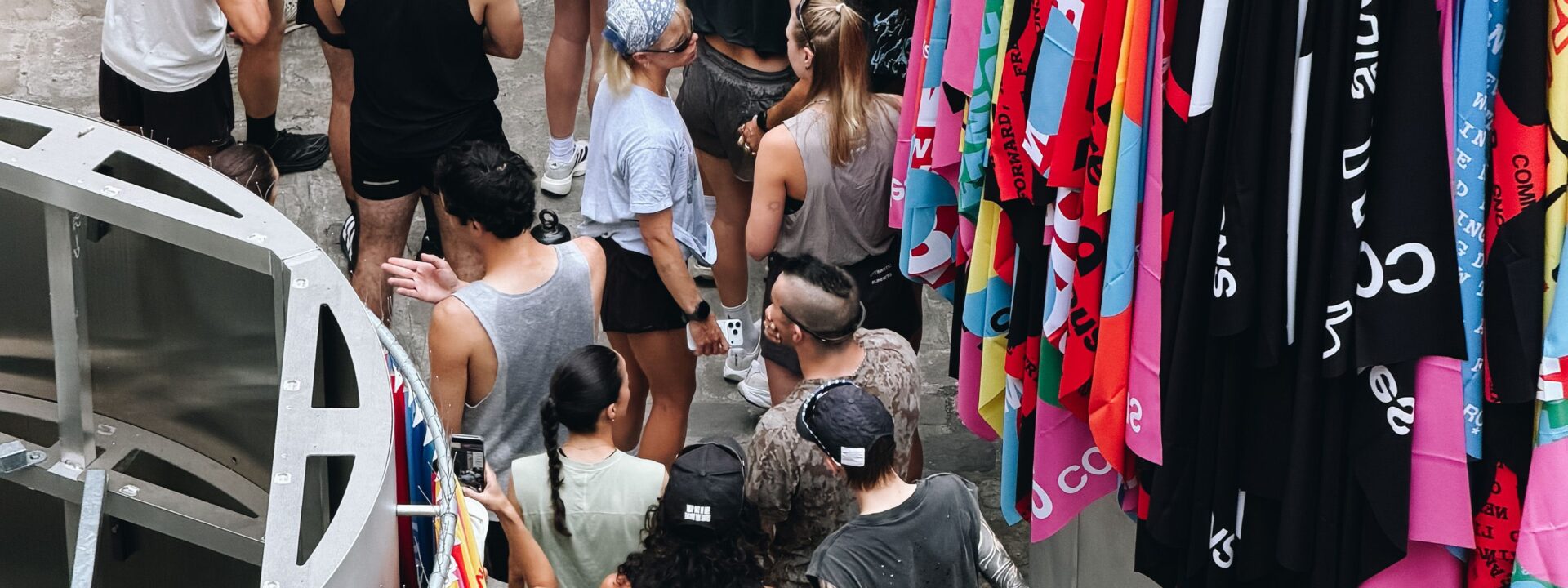
At Dover Street Market’s Rose Bakery in Paris, on the fourth day of Men’s Fashion Week, about 40 runners showed up for breakfast, dripping with sweat. The invite-only event was hosted by Satisfy, a French running brand with a punk rock vibe. Afterward, the brand held showroom appointments where buyers could place orders for its Spring/Summer 2027 collection.
Just two days earlier, District Vision, a design-focused LA brand, hosted an evening drinks reception in its showroom in the Marais. Guests from retailers like Mr Porter were invited for a night of building relationships and organic networking in a setting that’s more relaxed than a typical sales meeting. Sports brands haven’t traditionally been a regular part of Paris Fashion Week, but it’s becoming more common: this is how modern running brands are now doing business.
While marathon weekends have become a big draw for customer events, Paris Fashion Week has turned into the running industry’s luxury trade show for brands with wholesale goals. Running brands used to sell their products almost exclusively through mainstream specialty stores, either by setting up individual meetings in local markets or at sport-specific trade shows like The Running Event (TRE) in Texas. But today, fashion-focused retailers are among the biggest stockists for many style-minded performance brands that focus on apparel. Plus, Paris Fashion Week is a great place to grab attention.
Satisfy’s event during Men’s Fashion Week was held at Dover Street Market’s Rose Bakery in Paris.
Photo: Courtesy of Satisfy
“It’s the one place where 120 of our wholesale accounts show up, all of our sales agents reliably show up, and our orders are growing 30-40% season after season,” says Max Vallot, co-founder of District Vision.
Running has become a fashionable activity in recent years. Running clubs have become popular as a sober way to socialize, and finishing a marathon—once a niche goal—has become a modern status symbol for today’s consumers. The global running apparel and footwear industry was worth $23.3 billion in 2024, according to a report by Custom Market Insights, and it’s expected to grow at a compound annual growth rate (CAGR) of 9.2% until 2033, reaching $51.6 billion. “We’re a luxury retailer, but our sports category is on a constant upward trend,” says Daniel Todd, head of buying at Mr Porter, which stocks design-minded brands like District Vision, Satisfy, Norda, and Literary Sport, among others (the latter is known as “The Row of running”). “Previously, sports was driven by footwear, but right now, there’s stronger growth in the apparel category.”
It makes sense. The lines between sportswear and lifestyle keep blurring, as performance labels become part of wealthy consumers’ everyday wardrobes, often paired with luxury fashion. “We’ve always said we make products for people who run, not ‘runners’,” says Daniel Groh, head of design at Satisfy. “That naturally attracts a much broader audience.” Similar to how Arc’teryx Beta jackets became an urban staple, performance pieces today don’t always look like performance wear. District Vision’s collection includes lightweight, floppy-collared merino sweaters, for example, which are sold alongside its precision sports eyewear, handmade in Japan.
District Vision’s collection includes precision sports eyewear, handmade in Japan.
Photo: Courtesy of District Vision
This seamless crossover is a key reason why Paris Fashion Week works as a location for like-minded brands; currently, there’s no dedicated trade show for style-led premium brands in sports. As a result, this closeness to luxury fashion is changing how brands show up in the market: running as a sector has typically focused on open, community events, but in Paris, the invites are exclusive and it rarely involves running. On Wednesday, Literary Sport held a morning walk and breakfast to launch its vibram-soled sandals, while on Friday evening, On held a dinner for 60 people from its network, where guests were…They served an elegant, multi-course feast that ended with hand-blown sugar flowers for dessert, all at a custom-built spherical table designed to reflect the On logo. These evening cocktails and dinners are similar to the hospitality events put on by luxury fashion brands.
On has now reached a scale that rivals some established players. But building wholesale partnerships with fashion stores helps smaller, independent sports brands reach a wider customer base beyond just runners. The price point of their products also makes them a more natural fit for luxury retailers than traditional running stores. For example, Literary Sport’s bike shorts for women cost £176, District Vision’s waffle-knit tops are £160, and Satisfy’s shorts start at £150. “Sport has traditionally been very discount-driven,” says Todd. “When you place these brands next to the cost of luxury products, they’re still expensive, but the value for money is good.”
Satisfy introduced Heat Crush technology, which has been shown to lower surface temperatures by 8°C in 30 minutes.
Photo: Courtesy of Satisfy
The Benefits of Luxury Wholesale
The luxury side of the running market is still small. Wholesale partnerships with global fashion retailers give brands more customers, worldwide visibility, larger orders (which help small brands get better factory prices), and often upfront payment for products. “For the first seven years, we wouldn’t have gotten our foot in the door at some factories without the larger order volumes from fashion retailers,” says Tom Daly, co-founder of District Vision. The business is still mostly direct-to-consumer (DTC) — the brand recently opened its first store in Los Angeles — but wholesale is a key part of its strategy, especially with tariffs on overseas shipments.
Inside the District Vision FW26 showroom.
Photo: Courtesy of District Vision
Wholesale, Daly says, powers the “commercial engine.” The buying relationships built with fashion stores have allowed the brand to grow in line with the market. That outside insight into what global customers want can be invaluable for smaller brands. “We’ll always prioritize our DTC customers with our collections, but we’ve responded to buyer feedback very quickly and aggressively, so now we’re much closer to the market,” adds Vallot. “It’s better priced, it’s better merchandise — we’ve expanded our accessories as entry-level price points based on what buyers asked for.”
Satisfy’s business is split 50-50 between direct-to-consumer and wholesale, and 70% of its wholesale accounts are fashion stores. Since launching ten years ago, it has grown into a brand with €11 million in annual revenue. In 2025, it secured €11 million in Series B funding, led by Chanel heir David Wertheimer. The brand aims to become a €100 million company. The remaining 30% of wholesale accounts are for independent, design-focused running stores — a growing market, especially in Europe. Stores like Knees Up (London), Handshake (Brussels), Metta Running House (Mexico City), Long Slow Distance (LA), and Running Wylder (San Francisco) are creating retail spaces that feel like fashion concept boutiques. The brands’ design-led products created a need for a different kind of shopping experience than Runners Need, Sports Direct, or Dick’s Sporting Goods — places that are often uninspiring and focused mainly on function.
Since not every brand has a physical store, boutique running retailers play an important role in getting products in front of design-conscious customers. Plus, these stores are usually owned and run by runners themselves — people who are turning their passion for the sport into a business. Many, like Knees Up and Handshake, even started from run clubs.
This means the type of buyers at Paris Fashion Week Men’s is changing too. It’s no longer just about reaching major luxury retailers, but also about getting orders fromFrom smaller specialty stores: one type of retailer gives a brand reach, while the other gives it credibility in the space. Unna, from Stockholm, and Literary Sport, from Toronto, are both sold at Knees Up in London — a “living room” style space with a café, a co-working area, and a concept boutique popular with runners and cyclists. For brands like Unna, this visibility for attracting new customers is “unparalleled,” says Unna founder John-Ruben Holtback. Knees Up co-owner Matt Horrocks and buyer Ethan Buttress were both in Paris this season, and both previously worked in marketing (Buttress for menswear brand Oliver Spencer). For them, Paris is the main trade show they visit to spend their budget and discover brands; a trip to the US for an alternative like TRE is too expensive for small independents, especially those in Europe.
Knees Up, located in London, is a concept boutique popular with runners and cyclists.
Photo: Courtesy of Unna
“Our network has grown a lot since we started coming to Paris,” says Horrocks. “It’s a mix of buyers and creatives, and for me, it’s a chance to meet with brands and create opportunities for the future of the business.” For small stores, Paris offers the chance to expand their networks and improve their buying. Knees Up hosted a morning run attended by representatives from Hoka and Blender, a sales agency in Norway. Smaller independent brands get similar benefits. Creativity and a sense of energy are what make Paris as a hub so special: young stores and brands increasingly feel that TRE is too traditional and doesn’t offer the sports-as-lifestyle vibe found during fashion week — which is key to how these businesses are building their ecosystems.
While Paris Fashion Week is a great place for new business, wholesale partnerships need to be handled carefully. Many brands, including District Vision, are “being more cautious” about the order quantities they place with boutique stores, according to Vallot. Enthusiasm and a special interest in running don’t always mean building a stable retail business; there’s a difference between having a community and being able to sell to that community. Satisfy is also being more cautious about launching its new women’s collection. “It’s a very new and exciting market, but not all of them show the sell-through and payment reliability that a small brand like District Vision depends on,” says Vallot. “During Covid, we thought we might go under… until Mr Porter paid for their orders upfront.”
Operating on the fashion calendar isn’t just a way for running brands to secure a broader cultural position and a larger customer base — it can also help future-proof their businesses.
Frequently Asked Questions
Here is a list of FAQs about running brands targeting luxury customers
BeginnerLevel Questions
1 Why would a running brand want to attract luxury customers
Running brands want luxury customers because they spend more money per item are loyal to brands that signal status and help a brand look more exclusive and premium Its a way to sell fewer items for a much higher profit
2 Are luxury running shoes actually better for running
Not always Luxury running shoes often prioritize premium materials and design aesthetics over pure performance For serious racing or daily training a performancefocused shoe is usually better Luxury shoes are often for lifestyle wear or casual jogging
3 What makes a running brand luxury
It usually comes down to three things rare or highquality materials limited availability and a higher price point They also focus on storytelling and brand image not just function
4 Can I still wear luxury running gear for actual workouts
Yes but carefully Some items are both stylish and functional Others are not durable for sweat and impact Check the care label and intended use
5 What are some examples of running brands that have gone luxury
Notable examples include On Hoka and APL which started as a luxury performance brand Also Nike and Adidas have luxury sublines
AdvancedLevel Questions
6 How do luxury running brands balance performance with exclusivity
They often create halo productsa hightech limitededition shoe that proves performance credibility while the rest of the line focuses on lifestyle The tech is real but the scarcity and price make it a collectors item
7 Do luxury running brands face a function vs fashion backlash
Yes Purists criticize them for making shoes that look fast but arent practical for long runs or races Brands