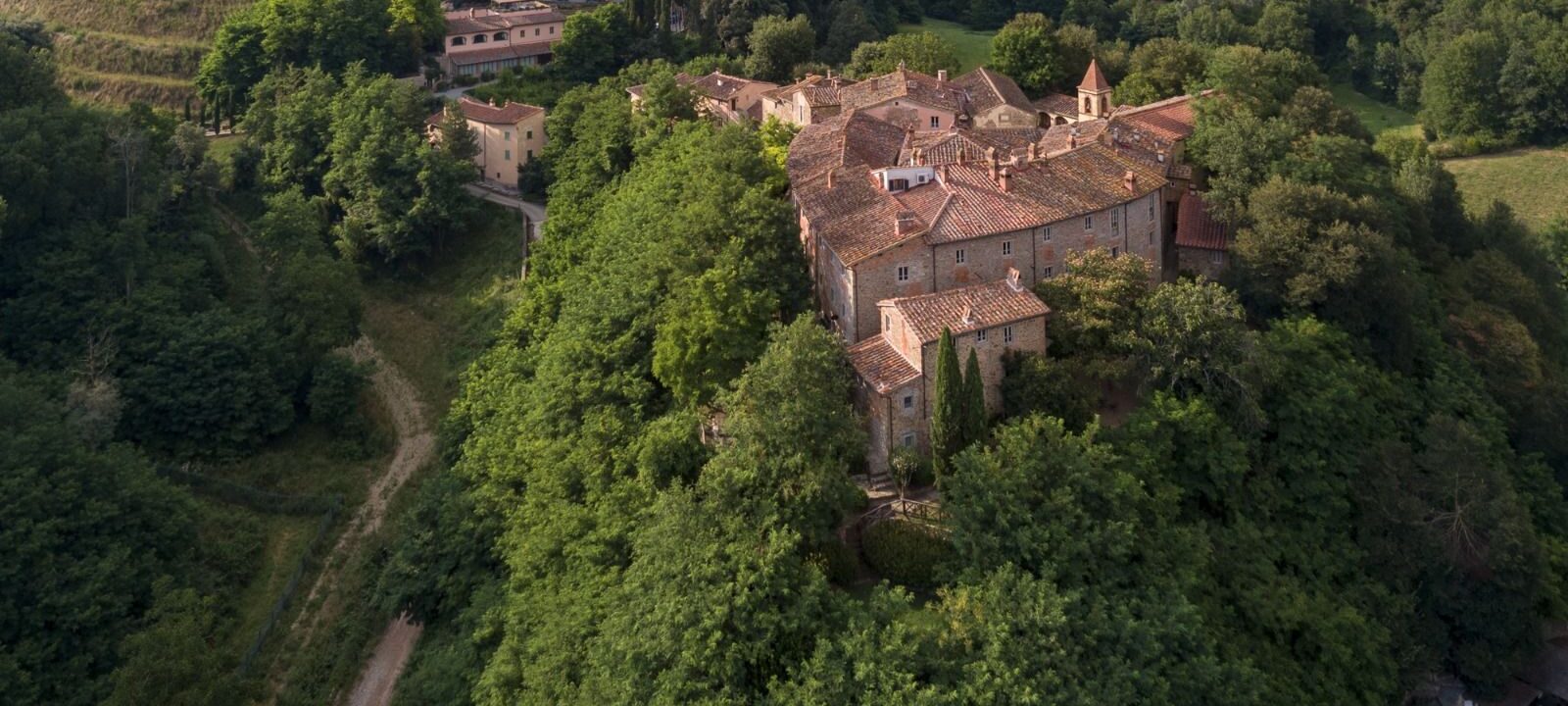
Can you really call yourself an Italian fashion dynasty if you don’t own a village? In Umbria, there’s the medieval hamlet of Solomeo, where Brunello Cucinelli’s luxury empire is based across a collection of historic buildings, including a library, a theater, and its own vineyard. In the Biellese Alps of Piedmont, there’s Ermenegildo Zegna’s stunning nature reserve, Oasi Zegna, where the designer and his family have planted over half a million trees and run the eco-friendly hotel Albergo Bucaneve. Down in Sicily, there’s Feudo del Castelluccio, where Luisa Beccaria has restored a group of farmhouses and beach villas inside the Vendicari Wildlife Reserve—originally meant as holiday homes for herself and her five children, they’re now available for weekly rentals.
But in the heart of the Tuscan countryside, you’ll find what might be the most charming fashion family estate of them all: the Ferragamos’ Il Borro. About 30 minutes from Arezzo—a town well worth visiting for its stunning Piero della Francesca frescoes and excellent designer shops—and less than an hour from Florence’s outer suburbs, Il Borro is a 1,000-year-old hamlet that has been carefully preserved (and restored where needed) to offer a taste of life as Tuscans might have known it centuries ago. (Though, of course, with plenty of modern comforts added in—but more on that later.)
Photo: Francesca Pagliai
To talk about Il Borro, you have to start with its rich and fascinating history. It was bought in 1993 by Ferruccio Ferragamo, the eldest son of the Florentine leather house’s founder, Salvatore. Today, he still serves as chairman of the Salvatore Ferragamo board, after decades as CEO. And Il Borro remains very much a family affair: his children, Salvatore and Vittoria, are closely involved in the estate’s daily operations, as CEO and head of sustainability, respectively. But the story of the borgo goes back much further—all the way to the Romans, who are thought to have built a fortress here because of its strategic position overlooking the crossing of two major ancient roads, the Via Clodia and Via Cassia.
Throughout the medieval period, the borgo was fiercely fought over by the city-states of Arezzo and Florence. In the 19th century, a German noble family built the elegant central villa that dominates the estate. During World War II, much of the village was badly damaged by German forces—and it wasn’t until Ferruccio stumbled upon it during a hunting trip in the early ’90s, and immediately saw its potential, that the decades-long project to restore it to its former glory began.
When I visited on an unseasonably chilly weekend in early March, the thick oak and chestnut forests around the property were bare, with skeletal branches still—though a few almond trees were starting to show the first tiny pink blossoms of the season as I drove through the estate’s imposing, ivy-covered gates and up the long driveway lined with classic Tuscan rows of cypress trees. After stopping at the deliberately low-key reception area—a simple, traditional stone outbuilding next to a small boutique selling various items made on the estate, from cold-pressed olive oil and organic honey to suede loafers crafted by the village shoemaker—I was handed a detailed, beautifully illustrated map of the estate and whisked away by electric buggy to my accommodations.
Photo: Victor Fitz
It’s at this point that Il Borro’s crown jewel reveals itself—not the grand villa you might have spotted on your way in, but instead the scattered clusters of townhouses and cottages that wind their way up to its peak, where a historic jewel-box chapel overlooks the village square, its sturdy bell tower rising above the rooftops. I was staying just off the main square, in one of the many suites.Rooms are scattered throughout the buildings.
Mine was a perfect example of understated Tuscan country estate style. The living room had soft, plum-colored sofas and antique walnut furniture, with pastoral prints on the walls and stacks of horse-themed coffee table books on every surface. The bedroom was painted in a softer sage green, with exposed whitewashed wooden ceiling beams and rafters above. Just off the bedroom was the highlight: a freestanding clawfoot tub in the middle of a terracotta-floored bathroom, with a dramatic historic brick alcove on one wall where a fireplace used to be. Nothing was overdone or fussy, but every detail was just right.
Photo: Francesca Pagliai
My main plan, though, was to explore the shops and active artisan workshops along the hamlet’s main street. They all have charming hanging signs outside inviting you in: the jewelry restorers and boutique Oro del Borro, the shoemaker and leather belt craftsman at Palaia, and the needlework and embroidery workshop Busatti. Nearly all of them offer workshops that guests can book, where you can learn traditional local techniques that are dying out in many places—but here, they’ve been kept alive under the Ferragamos’ care. (I also stumbled through a dark doorway and found an elaborate, highly detailed mechanical nativity scene lit up inside an artificial cave, which was a welcome bit of whimsy on that chilly March morning.)
Instead of a workshop, though, I was whisked off to the riding school for an afternoon of trotting through olive groves and surrounding forests on a thoroughbred horse. Then I squeezed in an hour by the infinity pool overlooking the village, grabbing a quick lunch of cold cuts from across the Casentino valley and cheese from the estate. (The charcoal-crusted aged pecorino was a particular favorite.)
Photo: Valeria Raniolo
I kept lunch light on purpose, since I was heading to the estate’s flagship restaurant, Osteria del Borro, that evening. The menu changes constantly to match Il Borro’s hyper-seasonal philosophy. When I visited in early spring, the meal started with a bread course that alone would have satisfied me: freshly baked, super crispy grissini and perfectly fluffy focaccia, ready to dip into a velvety pool of extra virgin olive oil. (Made on the estate, of course.) And there was plenty more: a rich smoked cheese tortelli sprinkled with thin, zesty slivers of truffle and fennel; an intensely savory slice of spit-roasted pigeon with charred spring leeks and pickled mustard seeds; and an elegant scoop of ricotta ice cream with estate honey on a base of crumbled biscuits and raspberry coulis. All served in a crisp, white-tableclothed dining room with oak floors and a roaring fireplace at the center. It’s fine dining, but effortless—and I imagine it’s even lovelier in summer, when dishes are served on the panoramic outdoor terrace, watching the village lights flicker on as dusk falls.
After a long night sleeping off that meal, I decided to spend my last morning at Il Borro on a long walk. With an estate map from the reception team—every staff member I spoke to seemed genuinely proud to work there and spoke warmly about the local traditions the Ferragamos have worked hard to keep alive—I set off down a winding road, crossed a river, and climbed a steep hill on the other side. There, I followed a path through rolling, peaceful fields. About an hour later, after looping back to one of the estate’s dirt roads, I ran into one of the estate’s majestic white Chianina cows walking toward me, a bell jangling around its neck. We both froze: a brief, unblinking standoff between a thousand-pound cow and an overfed travel writer. After a minute or so, I decided to turn around and head back to the village. BecauseIf there’s one thing I was encouraged to do during my few nights at Il Borro, it was to follow—and respect—the rhythms of the farm.
Frequently Asked Questions
Here is a list of FAQs about the Ferragamo familyowned Tuscan estate designed to sound natural and cover a range of topics
General Booking
Q What exactly is this place Is it a hotel or a private village
A Its a restored medieval village that acts like a private luxury resort Think of it as your own Tuscan town with a hotel restaurants and villas all within the walls
Q Is it just one big building or are there separate houses
A Its a collection of historic stone buildings You can stay in a room in the main Castiglion del Bosco or rent an entire private villa or farmhouse within the estate
Q Do I need a car to get around the estate
A A car is helpful for exploring the region but once youre inside the estate everything is walkable or they provide buggygolf cart service to get you around the hilltop
Q Is this place open to the public or only for guests
A Its primarily for resort guests The restaurants and spa are usually for guests only unless you book a specific experience like a wine tasting at their winery
The Experience Activities
Q Is this just for couples or is it good for families
A Its great for both Couples love the romance and spa while families enjoy the private villas with kitchens the pool and activities like cooking classes and bike riding
Q What is there to actually do all day
A A lot You can do wine tastings at their Brunello winery take a cooking class hike or bike the trails play golf on their championship course get a spa treatment or just relax by the infinity pool overlooking the valley
Q Can I visit the Ferragamo familys winery
A Yes The estate has its own prestigious winery Castiglion del Bosco Guests can book private tastings and tours of the cellars
Q Is there a golf course I heard something about that