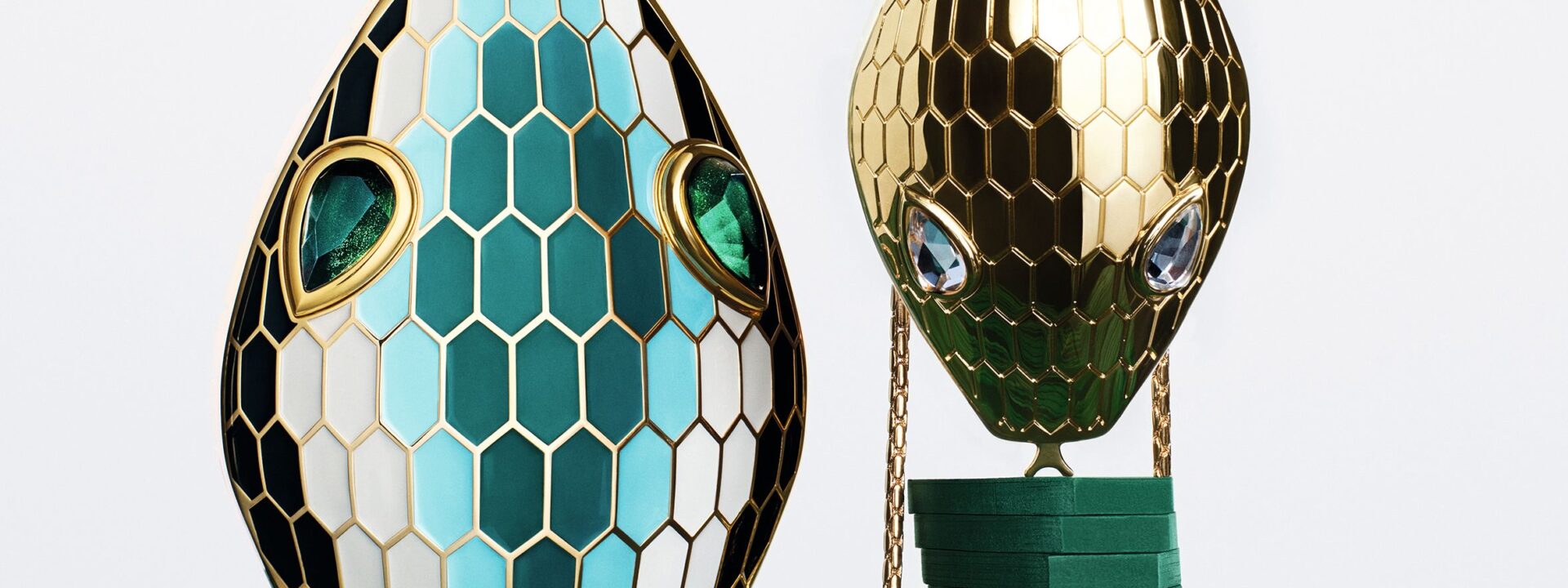
Imagine a bag so unique it won’t fit your iPhone, yet gladly holds a tiny book. For Bulgari’s creative director Mary Katrantzou, this is a deliberate choice. In an era where our phones serve as memory, map, diary, and favorite distraction, Katrantzou has designed a series of minaudières as part of the Bulgari Icons project—a polite but firm pushback. Their small size isn’t a shortcoming but a statement: practicality is softly set aside to make space for meaning. If your phone doesn’t fit, what can you carry instead? “Culture,” answers Katrantzou.
A small book replaces the screen; personal reflection replaces the endless scroll. To Katrantzou, these minaudières are less about being a handbag and more about making a declaration—one that champions presence, intention, and the rare luxury of being briefly out of reach. In today’s hyperconnected world, that might be their most radical quality. The design sparks curiosity and, inevitably, conversation. “These five Bulgari Icons minaudières function almost like talismans,” says Katrantzou. “They hold an idea, not excess. They invite us to see luxury not as accumulation, but as intention, and to consider that what we choose to carry can reflect not just our style, but our values.”
The project features an advertising campaign photographed by Ethan James Green under the artistic direction of Ferdinando Verderi, starring five remarkable women: Isabella Rossellini, Chimamanda Ngozi Adichie, Linda Evangelista, Sumayya Vally, and Kim Ji-won. Each is paired with a minaudière containing a custom miniature book, hand-bound to match the bag’s shape and written by the woman carrying it.
Titled ‘Notes On,’ these little volumes hold personal reflections shaped by curiosity, heritage, and self-discovery. With Rossellini, the series starts in the animal kingdom, exploring its wisdom and mystery, and how a lifelong fascination with animal behavior can deepen our understanding of the world we share. Evangelista’s contribution is a personal tribute to strength and resilience, framed through her Italian roots and the power of tradition.
Architect Vally turns ‘Notes On’ into a meditation on home as a fluid, plural space—an architecture built from memory, belonging, and meaning rather than fixed walls. Author Ngozi Adichie expands the focus to culture itself, considering its resonance, our role in shaping it, and the power of women as storytellers and guardians across generations. Finally, actress Ji-won brings the series inward, offering a thoughtful exploration of inner peace and self-acceptance, reflecting on the balance between perfection and presence.
Together, these voices weave a narrative about observation and inheritance, resilience and belonging, and the ways we come to understand ourselves and the worlds we live in. Each of the five minaudières is rich with historical symbolism, creating a dialogue across time where the present playfully engages with the past. Monete reimagines an ancient Roman coin, now adorned with precious enamel. Tubogas slinks into view, its metal coils wrapping a jewel-like ‘egg’ of lizard skin—a nod to nature. Divas’ Dream channels the grandeur of the Baths of Caracalla, transforming ancient mosaics into a dazzling jewel inlay. BVLGARI BVLGARI steps into modernity with a sleek cylindrical minaudière, hand-inlaid with mother of pearl. The Serpenti sheds its body to become a standalone piece that whispers sophistication, with the serpent being “a symbol of transformation evolving across time,” says Katrantzou.
The designer emphasized that cultural symbolism is central to the project, with each bag rooted in Greek, Italian, and Roman heritage, “carrying the history of its origin.” She added, “I believe these references don’t need to be explained for their heritage to be felt. Their power lies in their evolution. This balance between legacy and innovation defines Bulgari.”The project was unveiled at a dinner in Rome, held while the campaign was still in production—a rare occasion that brought all five remarkable women together. The mood was warm and effortless, an evening where glamour felt authentic rather than performed. Laughter came easily, and there was a palpable sense that everyone was truly happy to be there, and to be in each other’s company.
Katrantzou led the table with her warmth and sharp wit, acting as host, creative guide, and engaging conversationalist all at once. I was seated next to Ngozi Adichie, who looked stunning in a boldly printed Nigerian dress. We talked about what it meant to become a Bulgari muse and, inevitably, about fashion itself: why it matters, why it brings joy, and why it shouldn’t always be taken as seriously as some insist.
I wanted to ask you about the Bulgari project. What made you decide to take part? It isn’t obvious that a writer of your stature would join a fashion campaign, however prestigious.
Well, I actually said no at first. But I changed my mind once I learned more—and it was because of the little books. I really loved that idea. We read so little these days that anything which references books, celebrates them, or brings them into spaces where they don’t usually appear really speaks to me. When I heard about the tiny books hidden inside the minaudières, I thought, “Okay, this could be interesting.”
What is your Bulgari book about?
I’m writing about culture—how it’s created. Years ago in a TED Talk, I made the point that culture doesn’t need to be defended as something fixed, because we create it ourselves. Too often, “culture” is used as an excuse to justify things like the subjugation of women. My view is simple: culture didn’t fall from the sky. We made it. And if we made it, we can remake it. That’s what the little book is about.
I also wanted to ask you about fashion. It’s become such a powerful form of communication today, and you’re known for having a strong personal style. Where does that come from? I’ve read it comes from your mother.
My mother was a remarkable woman. It’s still hard for me to talk about her. But I often say that if you were raised by my mother, you didn’t really have a choice but to care about fashion. When I was little, she dressed me beautifully and always looked beautiful herself. She cared deeply about appearance and taught all of us to do the same.
But she also taught us something deeper: that taking care with your appearance is a way of honoring others. How you present yourself is a form of courtesy, a sign of respect for the people you meet.
She was a teacher and believed in certain standards. When I was young, I wore proper dresses, ribbons in my hair, socks pulled up—the whole look. As a teenager, I rebelled a bit. My taste got a little strange. I remember wearing my brother’s tie to a birthday party—everyone was shocked. I don’t even particularly like men’s clothes, but it was my way of pushing back.
Now that I’m older, and hopefully wiser, my style feels much more instinctive. It’s about how I feel. It’s very much me.
How would you describe your style today?
I love celebration and joy, especially expressed through color. I’m drawn to the unconventional—unexpected shapes, interesting structures.I’m a huge admirer of Nigerian designers. What I’m wearing right now, for example, is by a designer based in Abuja who creates a line called Aru by Fibi. I love the tailoring, the detailing, and the color. I have a real affection for bold, bright colors.
For me, fashion isn’t about rules or trends. It’s deeply personal—it’s about what makes me feel happy. I believe fashion connects to what’s inside us. When I feel good in what I’m wearing, I think I do better in general.
That leads to a tougher question: does fashion still matter? Is it art, an indulgence, or something we’re secretly embarrassed to enjoy, especially in a world that feels like it’s constantly in crisis?
My answer is: why shouldn’t it? I once wrote an essay called “Why Shouldn’t a Smart Woman Like Fashion?” because there’s a hint of misogyny in the idea that we should be ashamed to care about it. Fashion has long been seen as a “woman’s interest,” and that’s exactly why it’s often dismissed.
But being human means having many sides. We have our serious side, and we also care about small, personal things. While researching a novel about the Nigerian civil war, I was struck by stories from women who lived through unimaginable hardship. They spoke about the dresses they missed, the hats they used to wear, the wigs, the face cream they no longer had. Those details stayed with me, because sometimes it’s precisely those small things that remind us of our humanity.
I also think it’s important to separate the fashion industry from fashion itself. I don’t really care about the industry, and I don’t know much about it. But fashion—how we dress, what we choose, what makes us feel good—that matters.
I understand why people ask: the world is in turmoil, there are wars, children are dying—why talk about fashion? But we are not just one thing. To be human is to hold many things at once. Fashion can say a lot about who we are and what we care about. Think of students today wearing the Palestinian keffiyeh—it’s a small gesture, but it carries power. Fashion can be symbolic. It can inspire.
I’ve never agreed that fashion is frivolous. Sometimes it’s a form of resistance. Other times, it’s an expression of nationalism or identity. My own choice to wear mostly Nigerian designers is, in a way, a gentle form of nationalism for me.
Frequently Asked Questions
Of course Here is a list of FAQs about Small Bags Big Dreams designed to answer questions from beginners to those more familiar with the concept
Getting Started The Basics
Q What exactly is Small Bags Big Dreams
A Its a mindset and strategy for achieving large ambitious goals by consistently taking small manageable actions Instead of being overwhelmed by the big picture you focus on the next tiny step
Q Isnt this just another term for setting small goals
A Its related but its more specific Its about directly linking those tiny daily actions to a massive longterm vision The small actions are the fuel for the dream
Q Whats an example of a Small Bag and a Big Dream
A
Big Dream Write and publish a novel
Small Bag Write 200 words every single day before breakfast
Big Dream Run a marathon
Small Bag Walk for 15 minutes after dinner three times a week
Benefits and Why It Works
Q Whats the main benefit of this approach
A It defeats overwhelm and procrastination A small bag feels doable so youre more likely to start and build momentum which is crucial for longterm success
Q How does this help with motivation
A Every time you complete a small bag you get a win These small wins build confidence create positive habits and prove to yourself that youre making progress which fuels motivation over time
Q Can this really work for huge complex dreams
A Yes absolutely Big dreams are just a series of smaller projects and skills stacked together By breaking them into microscopic actions you make the complex simple and executable
Common Problems Solutions
Q What if my small bag still feels too big some days
A Make it smaller The rule is it must feel ridiculously easy Cant write 200 words Write one sentence Cant walk 15 minutes put on your shoes and step outside The act of starting is the victory