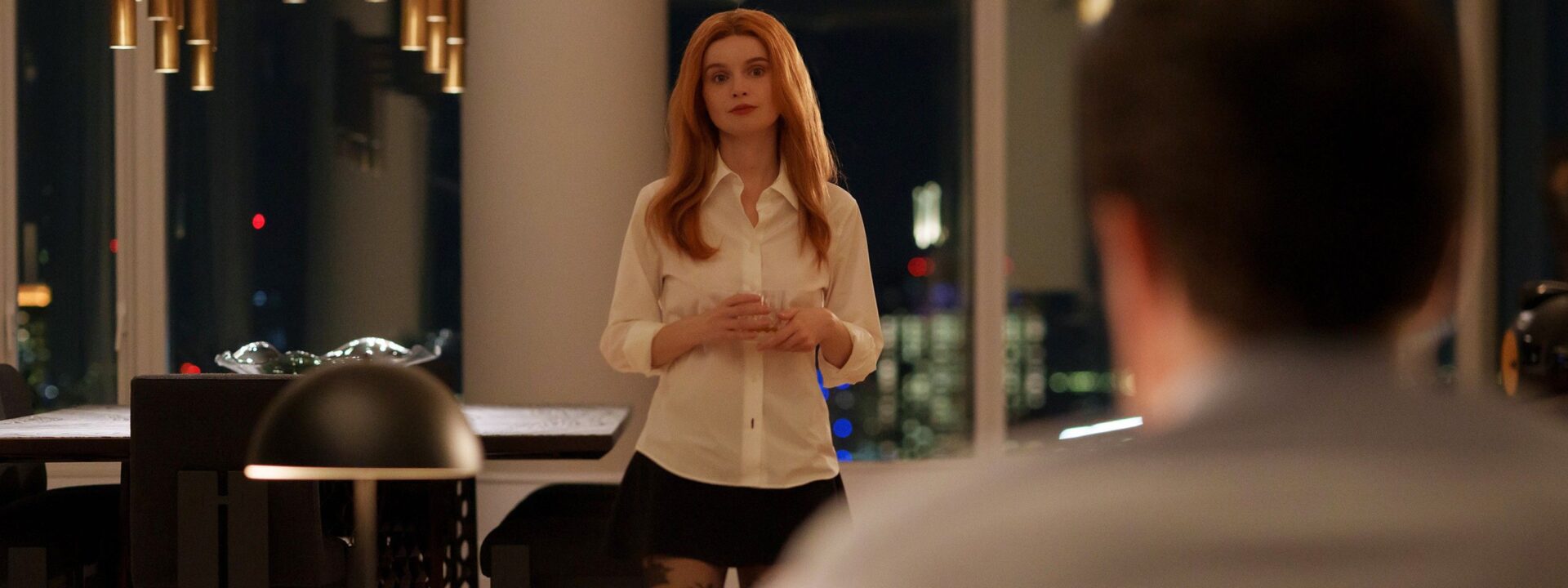
In the second episode of Furious, Hulu’s 2026 series about a survivor of childhood sex trafficking who seeks revenge on her abusers, Catherine Grace (Lola Pettigrew) stands in a kitchen preparing raw chicken breasts. A man at the edge of the frame suddenly starts commando crawling toward her across the floor. He grabs her ankle aggressively—a move that in most stories would signal she’s in immediate danger. But in Furious, Catherine easily overpowers him, forcing his head back to the floor. In the next scene, he lies helpless in bed while she stands over him with a syringe.
It’s a striking reversal of how the show presented them just one episode earlier: he was tall, middle-aged, powerful, and physically imposing; she was young, working-class, and small enough to be almost swallowed up by him. Now, his size doesn’t matter. She has made him powerless and is deciding what happens to his body. Much of the satisfaction in Furious comes from this transformation—from seeming prey to the most dangerous person in the room.
In real life, women are overwhelmingly the victims of violence, not the perpetrators. According to the National Coalition Against Domestic Violence, an average of 24 people per minute in the United States are victims of rape, physical violence, or stalking by an intimate partner, with women experiencing such violence at three times the rate of men. Meanwhile, the Epstein files and related legal battles have revealed both the scale of sexual abuse against girls and young women and how deeply it reaches into national and international elite circles—alongside the lack of consequences for powerful men.
Faced with such impunity, many women are burning with rage—a rage made stronger by how little power we have to fix the injustices that spark it. That’s why Furious offers such a powerful fantasy: a woman who doesn’t wait for justice she knows won’t come, but instead appoints herself to deliver it.
Of course, stories built on that fantasy aren’t new or rare. In Aleshea Harris’s Is God Is (2026), adapted from her play of the same name, twin sisters set out to avenge the cruelties of their estranged father. In last year’s The Housemaid, Sydney Sweeney plays Millie, a formerly incarcerated young woman hired to work in the home of Nina (Amanda Seyfried) and her abusive husband, Andrew, and the two women eventually team up against him. Emerald Fennell’s Promising Young Woman, released after #MeToo, followed a woman seeking revenge on the men who enabled the assault of her best friend. Naomi Alderman’s 2016 novel The Power imagined a world where women suddenly became the physically dominant sex. And in Buffy the Vampire Slayer, the tiny teenager who in most horror movies would be destined to die in a dark alley was instead the one powerful enough to kill the monster.
Sarah Michelle Gellar in Buffy the Vampire Slayer.
Photo: ©20thCentFox/Courtesy Everett Collection
But these stories carry extra weight now, after the overturning of Roe v. Wade and amid abortion bans that have turned the state itself into a tool for controlling women’s bodies—forcing women to stay pregnant against their will and, in some cases, preventing doctors from giving urgently needed medical care. They hit differently in a political climate where some on the Right openly talk about restoring male authority over women and bringing back a patriarchal family where men provide and women depend on them. At the same time, more than 845,000 women have left the U.S. labor force since January—more than twice the number of men—due to job losses in female-dominated sectors that have hit Black women especially hard.
In such an environment, many women are understandably exhausted and, yes, furious. We can call our representatives and campaign for the midterms, but we can’t actually stop the administration from pushing its agenda. We can read every page of the Epstein files, but we can’tWe can’t bring the powerful men named in those documents to justice. Shows like Furious—and even Prime Video’s upcoming adaptation of Stephen King’s Carrie, about a bullied teenage girl who becomes a force of terror and revenge—offer a temporary escape into a world where women can do what often feels impossible in real life.
Summer H. Howell in Prime Video’s Carrie.
Courtesy of Prime
Novelist Sarah-Jane Collins’s upcoming book Slayers (Gallery) follows two best friends who seek revenge on morally corrupt men in New York City, including a sexual predator, an abusive police officer, and a CEO involved in Epstein-style sex trafficking. She says the story grew from her frustration “of watching #MeToo unfold in such an unsatisfying way, and seeing that men are never held accountable. Women as a group carry a lot of anger that we haven’t dealt with or found an outlet for.”
She believes that stories where “the ‘bad guy’ gets what he deserves for what he does to women and girls” have always appealed to women—we just haven’t always had the chance to tell or enjoy them. But now, Collins says, “we’re seeing a large number of women directors, writers, and actresses like Reese Witherspoon, Shonda Rhimes, and Margot Robbie, who have significant power and are using it to create the content they want to see.”
Neither the women in Slayers nor those in Furious are meant to be role models. These stories also don’t set up a simple divide between predatory men and innocent women. In Furious, female characters protect abusers, uphold harmful systems, and sacrifice other women to keep their own closeness to power—just as women in real life can enable trafficking, defend abusive partners, or help institutions discredit victims. Female power, the series suggests, doesn’t guarantee doing what’s right.
Still, the vision the show offers is striking. Furious imagines a world where a woman’s anger can lead to real consequences, and where the powerful can be genuinely scared of someone they once saw as unimportant. Its popularity might say less about women’s love of violence and more about our fading trust in justice systems.
When those in power act without consequences, revenge can start to feel like justice being restored.
Frequently Asked Questions
Here is a list of frequently asked questions about watching content on Hulu designed to be helpful for both new and experienced users
General Account Basics
1 What exactly is Hulu
Hulu is a streaming service that lets you watch TV shows movies and original content on demand Its known for having currentseason episodes of popular network TV shows shortly after they air
2 Whats the difference between the With Ads and No Ads plans
The With Ads plan is cheaper but plays commercials before and during your shows The No Ads plan costs a few dollars more per month but plays most content without any interruptions
3 Can I watch Hulu on my TV phone and tablet
Yes Hulu is available on a huge range of devices including smart TVs streaming sticks game consoles and mobile devices
4 Can I download shows to watch offline
Yes but this feature is only available on the No Ads plan You can download most movies and shows to your phone or tablet to watch later without an internet connection
5 Can I watch Hulu while traveling outside the US
Generally no Hulu is only licensed for viewing within the United States If you try to access it from abroad youll likely get an error message saying the service is unavailable in your location
Content Library
6 Does Hulu have new movies
It has a rotating library of movies but it isnt usually the first place to get brandnew theatrical releases Those often go to premium services like HBO Max or are available for rental first Hulu focuses heavily on TV shows original series and a solid selection of classic and recent films
7 What are Hulu Originals
These are shows and movies that are produced exclusively for Hulu Examples include The Handmaids Tale Only Murders in the Building and The Bear You can only watch these on Hulu
8 How fast do new episodes of current TV shows appear on Hulu
For most network shows new episodes are typically available to stream on Hulu the day after they air on live TV