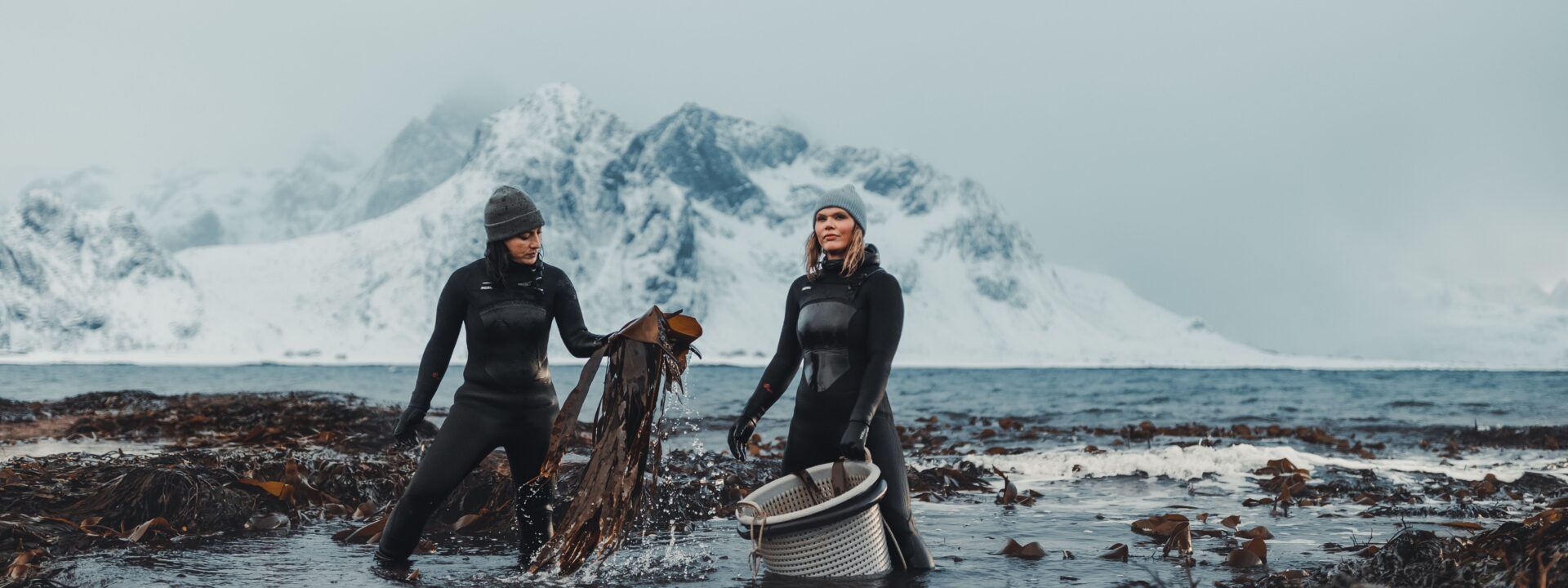
It’s still dark as I make my way down a rocky path toward the sea. The air is as cold as you’d expect from a Norwegian winter, but the wind has died down—a small mercy as I peel off my robe and pull on my wetsuit. I’m getting ready to dive. Not for fish, but for seaweed, a natural resource that’s abundant in this part of the world.
For centuries, the story of these windswept northern shores has been told through the lens of the male-dominated fishing industry. But today, a seaweed-based movement led mostly by women is quickly changing what it means to eat, farm, and live sustainably.
Photo: Courtesy of Lilløy Lindenberg
“It’s like a tropical rainforest of seaweed that grows around this tiny island,” explains Antje de Vries, emerging from the water with a handful of ribbon-like sugar kelp. Antje—a chef and ecotrophologist—runs the plant-based kitchen at Lilløy Lindenberg, a private island retreat off the coast of Bergen where I’ve spent the weekend. I zip up my wetsuit and join her, gliding past colorful starfish and sea urchins in search of those curling fronds. Two nights earlier, I’d joined Antje for ‘Kelp Club’, a roaming, nine-course supper where every dish was made or infused with hand-harvested seaweed from this very fjord. “Fermenting, dehydrating, caramelising, searing,” she raves, “what you can do with it is endless.”
Antje de Vries in the sea near Lilløy Lindenberg.
Photo: Courtesy of Lilløy Lindenberg
Her enthusiasm is far from a one-off culinary quirk. As the UN warns that we must cultivate the oceans to prevent food insecurity by 2050, these northern coasts are quickly becoming a testing ground for a new ecological approach. Seaweed has a unique potential to scale up sustainable, nutrient-rich food supplies—it needs no farmland, fresh water, or synthetic fertilisers. It produces up to sixty percent of the world’s oxygen, absorbs dissolved nitrogen, and captures carbon at rates that rival rainforests.
Little wonder, then, that the global seaweed market has more than tripled over the last two decades. And that’s before we even mention the plant’s incredible health benefits. Packed with iodine, essential minerals, and gut-stabilising compounds, research shows that ocean-grown plants act as natural antibacterial agents and help regulate blood sugar—a key reason why seaweed-rich diets in coastal Asian nations are consistently linked to longevity and lower rates of chronic disease.
Photo: Bruno Veiga / Courtesy of Lilløy Lindenberg
But long before global institutions began hailing seaweed as a future food, Angelita Eriksen knew it only as a nuisance—a weed that tangled her father’s boat propellers in the Arctic waters of the Lofoten Islands. It wasn’t until she returned home after many years abroad that her perspective started to shift. “I became blown away by its nutritional benefits, the taste, and its environmental impact. I called everyone that had ever mentioned it.” In doing so, she reached out to Tamara Singer, who knew seaweed through her Japanese heritage. Together, they founded Lofoten Seaweed, a business that creates seaweed-based products, from salts and sprinkles to seaweed-enhanced beauty items.
Tamara Singer of Lofoten Seaweed.
Photo: Morten Munthee / Courtesy of Lofoten Seaweed
At first, local fishermen laughed at the sight of two women gathering weeds in their baskets. “It’s a tough, male-dominated environment,” says Angelita. “Many people didn’t understand what we were doing.” But as the company grew—eventually earning a spot on the menu at Copenhagen’s famed Noma and representing Norway at the prestigious Bocuse d’Or in Lyon—that skepticism turned to respect. Though seemingly novel, their work is part of a much older, global tradition of women working with seaweed. For 3,000 years, Japan’s legendary Ama ‘sea women’ have freedived to harvest kelp. Centuries later, in VictoriIn England, women who were barred from scientific institutions turned to beachcombing, and their efforts became the foundation of modern seaweed classification. Today, along the coasts of Zanzibar and Tanzania, the seaweed industry is about 80% women-led, and it has changed local communities by giving women direct financial independence and a stronger role in civic life.
Angelita Eriksen of Lofoten Seaweed.
Photo: Morten Munthee / Courtesy of Lofoten Seaweed
“Here in Lofoten, it goes way back to the Viking ages,” Angelita explains, “when women stayed behind to run the farms while the men were away. Harvesting seaweed was something they could do while staying home with their children. It’s a tradition we’ve lost in modern society, but sometimes older people come up to us and say, ‘You know, I picked seaweed as a child too.'” This return to old ways of working points to a bigger cultural change, as policymakers start shifting from controlling nature to caring for it. “From a female perspective, it makes sense to work with the ocean in a more sustainable, harmonious way,” says Tamara. “It’s gentler, not so harsh. For us, success means helping to improve things—people’s health, the environment.” Unlike fishing, which is all about the catch, seaweed farming requires ongoing attention. You can’t over-harvest a reef without ruining your own livelihood; to take from the ocean, you have to look after it.
Photo: Morten Munthee / Courtesy of Lofoten Seaweed
Photo: Morten Munthee / Courtesy of Lofoten Seaweed
“That feels like a uniquely female strength,” Antje reflects. This more nurturing way of connecting with nature also shows in how these women physically interact with the ocean. While male commercial divers often wear thick, insulated drysuits, Norway’s female harvesters almost always wear wetsuits. It’s a deliberate choice to skip full protection in favor of feeling the water directly. “We’re feeling the water,” Antje says, her gloves worn thin at the fingertips on purpose. “I think that’s really important—that connection with nature. Feeling the elements is something we’re all missing.”
Photo: Courtesy of Lilløy Lindenberg
Last year, the EU recognized algae as a key resource for the continent’s green and blue transition, and Norway is leading the way so far, testing large offshore farms along its coast and investing in research projects like Arctic Seaweed and Seaweed Solutions. Advocates like Antje and founders like Angelita and Tamara are making sure gender equality is built into the movement from the start. But even as these projects grow, their goal stays the same: a deliberate move away from taking resources and toward a more healing approach to our oceans. “It’s the birthplace of everything on Earth, right?” Antje says with a smile. For these women, seaweed isn’t just a superfood—it’s a way to change how we relate to the wild. And by caring for the ocean, we might just find our way back to ourselves.
Frequently Asked Questions
Here is a list of FAQs about the women leading Norways seaweed revolution designed to cover everything from basic definitions to deeper insights
Beginner Questions
1 What exactly is the seaweed revolution in Norway
It refers to the rapid growth of the seaweed farming industry in Norway For decades Norway has been a giant in salmon farming but now a new wave of entrepreneursmany of whom are womenare looking to the ocean to grow seaweed as a sustainable food source animal feed and even packaging material
2 Who are these women leading the movement
They are a diverse group of marine biologists business owners and researchers Prominent figures include Catherine Ricordel Tone Still and researchers like Alejandra Evja who are working to make seaweed farming a mainstream industry
3 Why is seaweed considered so good for the environment
Seaweed doesnt need fresh water fertilizer or land to grow It actually cleans the ocean by absorbing excess carbon dioxide and nitrogen It also provides a habitat for marine life helping to restore local ecosystems rather than depleting them
4 Is eating seaweed common in Norway
Historically no Norwegians used to feed it to livestock but they didnt eat it themselves That is changing now These female founders are working to introduce seaweed into Norwegian cuisine moving it from cow feed to a gourmet healthy ingredient for humans
5 What does Norwegian seaweed taste like
It depends on the species Some taste salty and briny like the ocean while others have a subtle umami flavor or even a hint of roasted nuts Its often described as a great natural seasoning that reduces the need for salt
Advanced Business Questions
6 What are the biggest challenges these women face in the industry
The main hurdles are regulatory scaling up production to make it profitable and overcoming consumer skepticism Additionally there is the technical challenge of farming in the rough open waters of the North Atlantic which requires robust engineering
7 How does Norwegian seaweed farming differ from Asian seaweed farming
In Asia seaweed is often farmed manually in warm calm waters In Norway the waters are cold and rough Therefore Norwegian farms rely heavily on