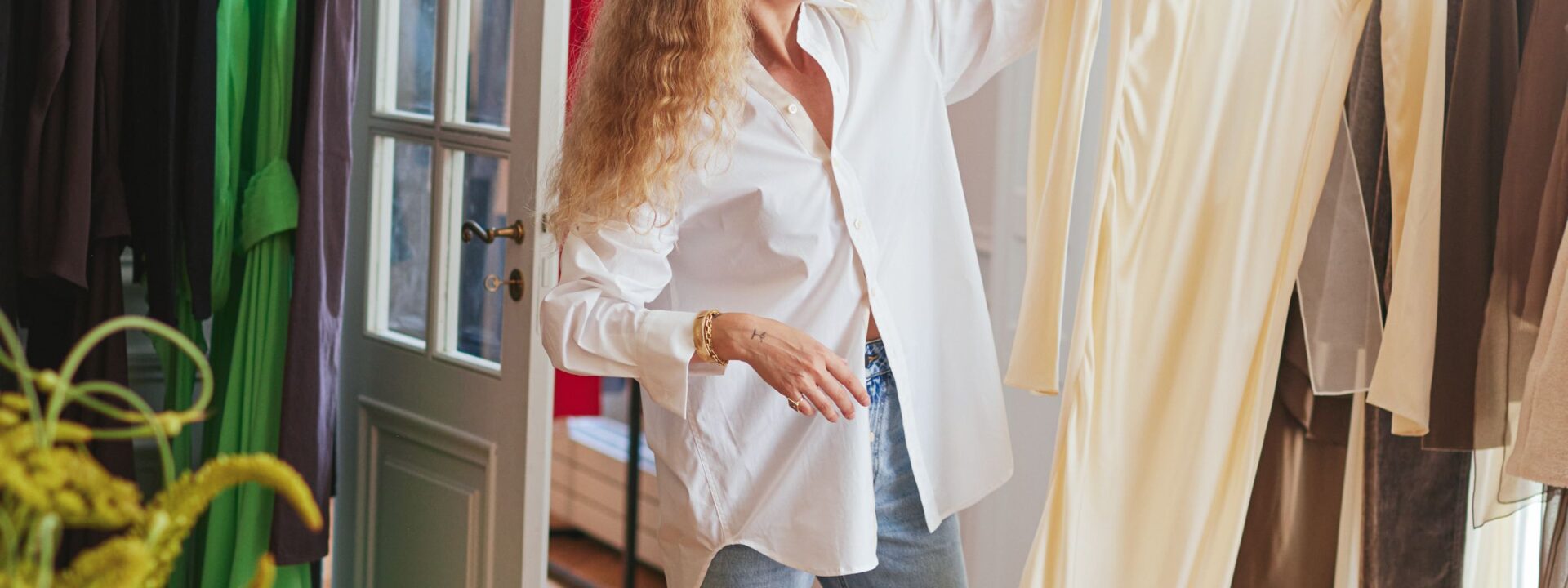
For fashion’s busiest retail buyers, one market appointment at fashion week is a must: RIC. Founded by Rachel Iwaniec, who started her career at Khaite before launching her own wholesale agency just over five years ago, RIC represents a lineup of emerging labels ready to be discovered. Savette, Kallmeyer, Colleen Allen, Skall Studio, Rùadh, B Sides, and Valesque are just a few of the more than ten brands she’s helping build a lasting presence for.
As a talent scout and curator of fresh names, Iwaniec’s sharp eye for what sells has made her a trusted figure in the industry. Her decisions are driven by strong instincts and emotional reactions: “I have to have an immediate reaction,” she says. “Either it’s something I’ve never seen before, or it’s something I see as a huge opportunity for a brand going forward.”
That was the case when she first visited the studio of New York designer Colleen Allen, who launched her namesake label in February 2024. “The colors were just so emotionally captivating. I’d never seen so many references,” Iwaniec recalls. (Allen designed the Met Gala dress for Chloe Malle, Vogue US’s head of editorial content, this year.)
Iwaniec’s ability to sense demand has given her a quiet influence that she uses to support the designers she represents. “The RIC showroom is a highlight every season,” says Lydia Zacharis, buying manager at Net-a-Porter, who has worked closely with Iwaniec since her Khaite days and through RIC’s early stages, when she first introduced the buying team to Savette. Since then, Net-a-Porter has signed more than half a dozen RIC-repped labels, including Kallmeyer and Colleen Allen, both part of its Vanguard mentorship program, plus Rùadh, B Sides, Skall Studio, and soon Kartik Research.
Her “innate understanding of how distribution shapes a brand’s identity” is what founders like Amy Zurek of Savette find so valuable. “Rachel’s contribution went far beyond opening doors,” says Zurek, who has known Iwaniec for over a decade (and well before they started working together in 2019). “She was deeply strategic about where we should—and just as importantly, shouldn’t—be sold. From the beginning, she helped us build the business with intention and discipline. That long-term perspective has been every bit as valuable as the retailer relationships themselves.”
Iwaniec gets the job done with a small but strong team of four, split between London and New York. She divides her own time between the East Coast and Paris, where she recently signed a lease for a permanent showroom in the 10th arrondissement. The space will host both new and longtime clients, including Ceecee footwear, Joswick’s reworked vintage, and Wendy Win eyewear—three names worth investing in now before they inevitably get picked up.
“Rachel is one of the few people in this industry whose point of view I trust completely,” says Courtney Grant, SVP of buying at Elysewalker. “She’s genuinely cool—not because she tries to be, but because she has total confidence in her own perspective.”
It helps that she loves wearing the brands she represents—and doesn’t take no for an answer. “If I’m not excited to wear it, I’m not excited to sell it,” Iwaniec says. One of her favorite parts of the job? Convincing a buyer who says a brand isn’t for them that it actually is. It might take a season, a year, or three before they come around—but as long as it’s up to her, chances are they will.
“She never tells people what they want to hear—she tells them what she believes,” adds Zurek. “That kind of honesty is rare in fashion, and people recognize it.”
Frequently Asked Questions
Here is a list of FAQs about the power brokers and behindthescenes players in the fashion industry written in a natural conversational tone
General Beginner Questions
1 What exactly is a power broker in the fashion world
A power broker is someone who uses their influence connections and business savvy to make things happen for designers They arent the designer themselves but they are the person who opens doorsgetting collections into top stores securing celebrity endorsements and attracting investors Think of them as the ultimate behindthescenes connector
2 How is a power broker different from a fashion agent or a publicist
A publicist focuses specifically on media coverage and brand image An agent might handle sales for a specific category A power broker is more holistic They are a strategic advisor and business partner who orchestrates the entire career path connecting the dots between design retail manufacturing and marketing
3 Why do upandcoming designers need one
Emerging designers are usually great at making clothes but often lack the business network and experience to scale their brand A power broker provides instant credibility and access They can get a young designer a meeting with a buyer at Bergdorf Goodman that would otherwise take years of coldcalling to get
4 Does the designer have to be famous to get a power broker
Yes usually Power brokers are selective They typically look for designers who already have a unique point of view a strong first collection or two and some early buzz They are looking for potential but they need to see a clear spark of talent first
5 What does a power broker actually do on a daytoday basis
Their days are spent on the phone and in meetings This includes negotiating contracts with factories pitching editors at major magazines coordinating showroom appointments with buyers managing the brands finances and even helping to recruit a CEO for the designers company
Advanced IndustrySpecific Questions
6 How do power brokers get paid Do they take a cut of sales
Compensation varies The most common model is taking a percentage of the wholesale or retail sales they secure Some work on a retainer basis for strategic consulting while others might take an equity stake in the company in exchange for their early support