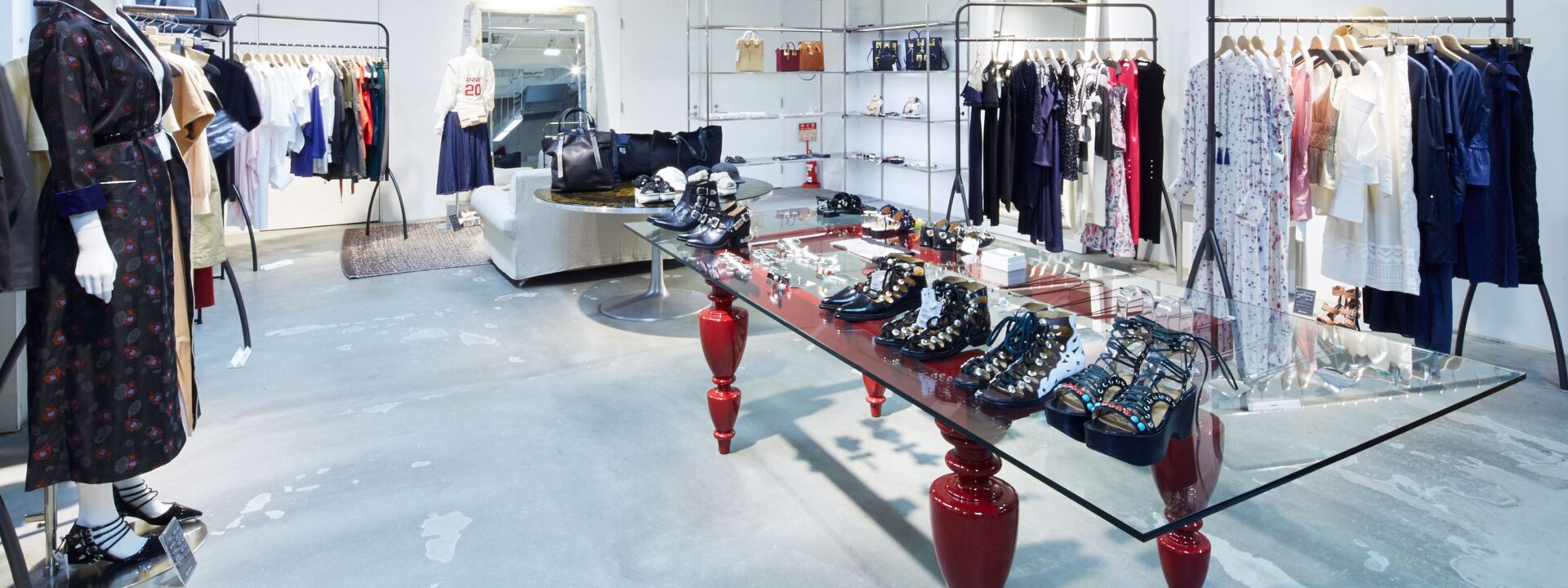
In 1976, Midwest began as a small suburban shop in Nagoya. Today, it stands as one of Japan’s most influential multi-brand retailers, known locally as a “select shop.” These curated, multi-brand stores form the backbone of Japanese fashion retail, with well-known names like Beams, United Arrows, and Dover Street Market. This month, Midwest marks its 50th anniversary.
A family-run independent business now in its third generation, Midwest is led today by CEO Takenori Osawa, a respected buyer and front-row fixture. His son, Ren, heads menswear buying. “People often ask about the meaning of the name Midwest, but there isn’t really one,” Osawa explains. “Mid refers to wanting to stay at the center of fashion, and I grew up in western Nagoya. It’s that simple.” I meet the 58-year-old at his three-story Shibuya store in central Tokyo, where racks feature Rick Owens, Mihara Yasuhiro, and a host of emerging, under-the-radar labels.
Founder Masaru Osawa (centre), with his son (and current CEO) Takenori (right) and grandson Ren (left).
Photo: Courtesy of Midwest
Today, Midwest carries around 100 brands across three stores in Nagoya, Osaka, and Tokyo, drawing a devoted following of fashion enthusiasts. While many multi-brand retailers struggle, Midwest continues to grow profitably, with sales rising roughly 10–20% year-on-year in recent years. This summer, it plans to open a footwear-only store in Nagoya as part of a major luxury development, complete with an adjacent pop-up event space. Expansions in Tokyo and Osaka will follow in 2026 and 2027, respectively.
For its 50th anniversary, Midwest will host charity events across its Japanese stores in June and July, featuring archive pieces donated by designers. Proceeds will go toward supporting young designers through Japan Fashion Week. Beyond local brands like Van Jacket, Midwest was an early champion of international designers—especially Belgian labels such as Maison Margiela, Raf Simons, and Dries van Noten—when they gained prominence in the 1990s. Kris Van Assche was another beneficiary: “Midwest was crucial for my brand’s development, and they supported me across all three locations,” he says. “They invited me to Japan for their 30th anniversary. I remember a huge crowd waiting outside the store—it was incredible.”
Founded by Osawa’s father, Masaru, Midwest is one of the earliest and most successful examples of the select shop model. Masaru, now chairman, took no days off for a full decade after opening, running the store from 10 a.m. to 11 p.m. daily. A young Osawa recalls sleeping beneath racks of designer clothes while his father entertained after-work visitors. “They served alcohol and coffee, people chatted and bought things,” he says. “We sourced items that were expensive even then and impossible to find in Nagoya or elsewhere.”
“Midwest is one of those rare places that truly respects a designer’s vision and supports young brands,” says Viviano Sue, whose label Viviano has been stocked since 2023. The store’s frequent events, talk shows, and pop-ups provide a major boost. “They’ve increased our visibility while creating real sales opportunities,” he adds.
Navigating the Japanese Market
The surge of tourists to Japan in 2024 and 2025 led many luxury retailers to hire more English- and Chinese-speaking staff to cater to demand and drive sales. However, according to Japan’s transport ministry, Chinese tourist arrivals fell by 45% in December 2025 compared to the previous year. (Traditionally, Chinese tourists—Chinese tourists once made up a quarter of all foreign visitors to Japan. While many Japanese retailers felt the impact of their decline, Midwest has avoided the struggles faced by some competitors. The company, which now derives 65% of its sales from domestic customers, does not market to tourists. “I hear many stores have completely shifted their sizing and buying strategies to cater to tourists, and they’re really struggling right now,” says Osawa.
The Osawa family owns its Tokyo store outright, which reduces rent pressure and provides greater financial resilience compared to similar businesses. “That allows us to invest a bit more in designers and grow together,” he adds.
With the weak yen driving up prices for imported brands, Osawa has turned his focus closer to home, allocating more of his buys to domestic designers. Rising Japanese labels like Masu, Fetico, and Pillings are now featured more prominently. “During COVID-19, I wasn’t traveling abroad and didn’t want to buy things I hadn’t seen in person,” he explains. “I started researching new Japanese brands to see what young designers were emerging and realized there’s a lot of talent here.”
Although Japanese fashion has often overlooked local labels in favor of international brands, Osawa believes this is changing. “I really feel Japanese designers have incredible potential right now,” he says. “Some shop owners still look down on domestic brands—I’ve never liked that attitude. Now that Japanese designers have risen to a higher level, I believe we should be promoting them more.”
Shinpei Goto, designer of Masu, notes, “Many designers receive strong support from Midwest. In retail, it’s the only store that combines the presence of a major corporation with the warmth of an independent shop. It’s truly unique in that way.”
Osawa also acts as an informal consultant for many of the Japanese brands Midwest carries. “It’s a two-way street: we buy their products, but we also learn a lot from them. Sometimes over drinks, I might suggest that certain items could sell better in different materials,” he shares. The most common mistake he sees from emerging designers? “Delivery delays—that happens quite often. I tell them timing is crucial; if they miss it, the products become much harder to sell.”
Midwest’s Buying (and Selling) Philosophy
Osawa bases his buying approach on a three-way principle: “It’s about the designers, our company, and the customers all being happy. It’s not just the designer making money, or just the retailer. Customers might be happy buying on sale, but the retailer makes no profit, and the brand suffers too.” Midwest maintains a high full-price sell-through rate, achieving 70% at full price and 90% for the few items that go on sale. “We believe that’s one reason we’ve been able to last for 50 years,” he says. The store also buys its orders in full. “We scrutinize products carefully when sourcing and have never operated with a loose, consignment-based mindset.”
According to Osawa, Midwest’s customer base is broad, but most buyers are in their 30s and 40s. Attracting younger customers remains a constant focus. “No matter the era, I always pay close attention to drawing interest from younger people,” he emphasizes. “Customers don’t age with the brand. As people marry, have children, or get busier with work, their hobbies change. You absolutely have to introduce newness, and I’m always focused on cultivating new customers.””We have to keep introducing newness, and I’m always focused on cultivating new customers,” says Osawa. One key strategy is through regular pop-ups. “Pop-ups are a vital part of our approach. In Tokyo, we typically invite customers and industry contacts, serve drinks, and host a reception,” he explains. These launch events draw about 200 people each time. “It’s our own small way of promoting the brand.”
Osawa’s buying style is intuitive. “I often decide whether to purchase a collection based on the passion and energy I feel from the brand at a runway show,” he says. “That’s probably where my perspective differs a bit from other companies, but I want to do things others can’t.” Beyond pop-ups, the store hosts talk show events; the most recent in 2024 attracted 2,500 guests across five sessions. This focus on in-person experiences means 78% of Midwest’s sales occur in-store.
The company also invests significantly in its staff. Over its 50-year history, Midwest has taken about 50 employees to Paris Fashion Week and encourages the team to attend shows and showrooms in Japan. “In larger companies, usually only buyers get to go to events like fashion weeks, but we try to bring as many staff as possible,” says Osawa. “We invest in giving them an authentic experience.”
These opportunities not only make staff feel valued and connected to the industry but also build their expertise, which helps in making sales. “The staff become emotionally invested and learn a lot about the designers’ work,” he adds. This allows Midwest’s team to offer genuine insight to customers. “Being able to casually share that kind of information is what sets us apart from other retailers.”
Osawa is equally committed to nurturing relationships with designers; many collaborations and pop-ups are planned over dinners and drinks. “Many designers told me their work was sometimes misunderstood, so we created spaces where they could hold talk sessions with customers at pop-ups,” he explains.
The Midwest annual Christmas party is a legendary event. Last year, key figures from the Japanese fashion industry joined a large karaoke party with Osawa as MC. The previous year, he dressed as Santa Claus. “What I really admire about Midwest is how they bring the Japanese fashion community together,” says Sue. “It’s rare to see so many designers from different backgrounds gathering like that.”
Osawa also attributes the business’s longevity to Japan’s adventurous customers, who look beyond trends to avant-garde brands and designers. Brands with a strong design language, like Rick Owens and Mihara Yasuhiro, perform especially well. “We’re not a huge company, but there’s always been a core group of people who appreciate our niche,” he says. “If we can continue to connect with them, we’ll survive.”
This approach benefits designers as well, reducing pressure to play it safe with their collections. In a typically risk-averse retail environment, that stance is uncommon. “Knowing a store like Midwest exists allows for bolder creations,” says Goto. “It gives you courage.”
Frequently Asked Questions
Of course Here is a list of FAQs about Inside Midwest The Store That Shaped Japanese Fashion Retail designed to answer questions from general interest to deeper industry insights
General Beginner Questions
1 What is Inside Midwest
Inside Midwest was a pioneering and highly influential fashion boutique that operated in Osaka Japan from the 1970s through the 1990s It wasnt just a store it was a cultural hub that introduced avantgarde Western designers to Japan and shaped the countrys modern fashion sensibility
2 Why is it so important
Its considered the birthplace of select shop culture in Japan Before department stores dominated Midwest curated a unique mix of highend international designers and underground streetwear creating a new model for fashion retail that prioritized curation and a specific worldview over brand names alone
3 Who founded it
It was founded by Mitsuhiro Matsuda and his partner graphic designer Takahiro Yamashita Their combined vision for music art and fashion made the store iconic
4 Where was it located
It was located in the Amerikamura district of Osaka which became the epicenter of Japanese youth culture and fashion in the 1970s and 80s
5 Is Inside Midwest still open
No the original Inside Midwest closed its doors in 1999 Its legacy lives on through the countless retailers brands and stylists it influenced
Deeper Insights Impact
6 What does select shop mean and how did Midwest define it
A select shop is a boutique that buys and curates items from various designers based on the owners taste rather than simply carrying all items from a single brand Midwest defined this by blending high fashion with casual and military surplus treating all items with equal importance to build a cohesive stylish outfit The focus was on the total style not the logo
7 What kind of brands did they sell
They were among the first in Japan to sell nowlegendary labels like