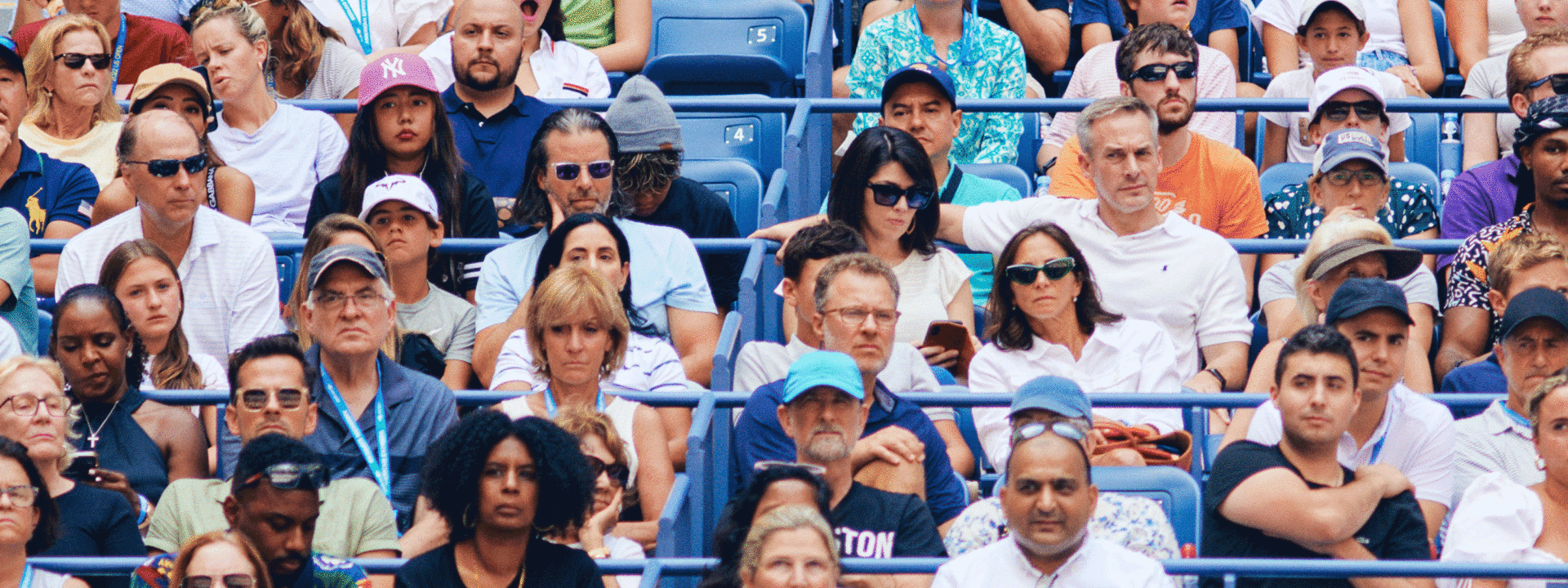
Hey, we heard the amazing news: you’re headed to the US Open! Maybe you bought the tickets yourself (and yeah, we know—they’re getting pretty expensive), or maybe you’re one of the lucky few invited by a brand to watch from their fancy suite. Either way, you’re in for a treat for the senses, from chicken nuggets topped with Petrossian caviar and crème fraiche to the famous Honey Deuce cocktail. There’s the glamorous, see-and-be-seen vibe of Arthur Ashe Stadium (with DJ Trizz on the decks), where Travis Scott, Kaia Gerber, Homer Gere, Orlando Bloom, and Queen Latifah (just to name a few) have already stopped by in the early days of this year’s tournament. And, oh yeah, there’s some great tennis too.
If that last part seems like an afterthought, we’ve got some helpful advice for you.
Maybe you’re one of the 1.5 million people who’ve been outraged after watching those viral videos of influencers supposedly ruining tennis for everyone the other night. Or maybe you’re an influencer yourself—or hoping to become one. Let’s first get you up to speed and clear up a few easy assumptions: Yes, the crowds at the Open are bigger than ever. And yes, there do seem to be more influencers around than before. The press office of the United States Tennis Association (the sport’s governing body in the US, which owns and runs the Open) handed out about 100 credentials this year to content creators, as influencers are officially called.
And yeah, there have been problems. After a rowdy group with ring lights on stands seemed to be filming content on the balcony of their suite during Naomi Osaka’s late-night opening match against Anastasia Zakharova—not between games or even between points, but while the players were actually playing—the deep-voiced chair umpire, Kader Nouni (who, by the way, is known among insiders as the Barry White of tennis), had to tell them off.
“Guys, please, in the suite behind me,” Nouni pleaded, his voice completely lacking any charm or smoothness, “please, thank you guys, please take your seat.”
Osaka, asked about the situation after her second-round win on Thursday, gave her usual thoughtful response. “Obviously, if you come to a sporting event, you have to respect the sport,” she said, “and I feel like it’s common courtesy to read up on the sport, especially the etiquette. It could be a good thing for people to make the sport of tennis popular to their specific audience,” she continued, “but it has to be managed a lot better, especially in a situation like my first-round match.”
I mean, it couldn’t be clearer: Influencers are bad… right? Sadly, it’s not that simple, and we’ll get to why in a moment.
But here’s another complaint about this year’s Open: The noise in Arthur Ashe Stadium is out of control. Watch a match at Wimbledon’s Centre Court, and you can hear a pin drop. Part of that magic is about the acoustics, of course. Comparing the grass of an open-air Centre Court to the massive echo chamber of a closed-roof Ashe Stadium (which also holds about 10,000 more fans) on a rainy day or night is a pointless exercise. It’s also worth noting that many people (including me) have complained about the noise since Ashe opened in 1997—but yeah, it’s a real issue, and yeah, it seems to be getting worse.
Arthur Ashe Stadium in 1997—less loud, but still loud.
Photo: Getty Images
But is this the fault of influencers? No—it’s the fault of ticket prices. With resellers grabbing a huge chunk of the Open’s face-value tickets and selling them at whatever price the (admittedly wealthy) market will bear, more and more fans in Ashe have little or no interest in what’s actually happening on the court. They’re there to tell the incredibly boring 25-minute story of their time “cowboyin'” on a dude ranch in Wyoming in the 1960s, like the elderly gentleman sitting directly behind me.A few nights ago, in one of the stadium’s most exclusive boxes, someone did just that. Or maybe they were busy telling their seatmate the dramatic, fascinating story of how their neighbor Phyllis has gone “completely off her rocker,” as the lady next to me did yesterday. “Do I care one bit about her personal business?” she said, her voice getting shriller and louder. “No—but am I supposed to just sit here and handle everything for her? I don’t think so!”
I braced myself for the chair umpire to step in quickly—maybe even kick her out. Instead, a middle-aged man a few rows away—who seemed even more bothered by the Phyllis story than I was—suddenly had a seizure. He came to, calmed down, and was wheeled away by medics. I left soon after, but on my own two feet.
But this issue isn’t just about clueless tennis fans. At another match yesterday in Armstrong Stadium, I found myself again stuck near someone talking nonstop, this time about the boring inner workings of a mid-America tennis tournament. When I turned to see who it was, the badge around his neck showed he worked for the USTA.
All this to say: blaming “influencers” is just the easy, shallow criticism of the moment—like blaming “the media” for everything you dislike about modern life. Could we all live more in the present instead of feeling the need to post an Instagram Story showing how much fun we’re having? Sure—but for every pouty influencer who has to take 147 selfies holding a Honey Deuce in a luxury suite, there’s another one sharing real info and inspiration. (Dylan Gee recently showed bringing his mom—the reason he first picked up a tennis racket—to the Open for the first time, while Eliza Wastcoat shared tips on getting the most out of the event, like skipping the Honey Deuce for the Frozen Honey Deuce, only sold at one spot on site.)
What many people who complain about the “influencer problem” are really upset about is this: tennis—and especially the US Open—isn’t what it used to be. I’ll admit that. In 1972, before Billie Jean King pushed the Open to become the first tournament to pay men and women equally, she got $10,000 for winning, while Ilie Nastase made $25,000. This year, both the men’s and women’s champions will earn a record $5.5 million each. Food at the Open used to mean hot dogs and burgers, and before the Honey Deuce came along, drinks were simple: beer or soda. The sport itself was once seen as slowly dying out.
There’s a lively debate to be had about whether tennis’s recent rock-and-roll vibe has gone too far. But what’s not up for discussion, in our post-Challengers moment, is whether tennis—and the US Open—is more popular than ever. As the New York Times noted recently: “With its unique mix of high-end fans and massive crowds—a record 1.14 million people attended last year—the US Open has the luxury spending power of a polo match and the mass appeal of an NFL team.”
In fact, the Open draws about as many fans in 15 days as the New York Giants and Jets do combined over their entire football seasons at MetLife Stadium in New Jersey. It also brings more money to New York City than the Mets and Yankees do over their full 162-game seasons.
Yes, some of those people are incredibly annoying—and some aren’t even real fans. Like it or not, there are a few strict rules of etiquette unique to the sport that, as Osaka mentioned earlier, need to be followed. So here are our no-nonsense, non-negotiable rules for behaving at the US Open:
Never, ever stand up or move around while the point is still going on.The players on the court are competing for points. This rule is strict and non-negotiable—break it, and you might get called out by the chair umpire. It’s not about being overly formal; it’s about avoiding distractions. Playing tennis—especially returning a serve that can hit 150 mph—in front of 14,000 people takes intense focus. You casually walking down the aisle, pointing at seats you think might be yours, isn’t helpful. When players switch sides (after every two games), that’s your chance to move too.
Feel free to chat quietly (and ideally, just between yourselves)—and shout as loud and as often as you like… but only after the point ends. Again, the Open isn’t Wimbledon: it’s loud, rowdy, and sometimes a bit rude. That’s not a flaw—it’s what makes it what it is. But as hard as it might be to believe, just because you—or your company, or your friend’s company—paid $3,500 each for courtside seats doesn’t mean you can treat them like your living room couch. Arthur Ashe Stadium isn’t your private lounge.
“People are down there trying to perform, and it’s their career and their job,” as Jessica Pegula recently said. “It seems a bit disrespectful.” In simple terms: it’s nice to be important, but it’s more important to be nice. Keep quiet, and those around you will silently thank you. And if you’re in one of Ashe’s luxury suites? Good for you—just take your exciting story indoors.
That said: when the action on the court calls for it, let your voice shine. Yell, scream, cheer, groan, cry, plead—but don’t dare do it while the players are still hitting the ball. If you have kids, you’ll recognize this idea: not every feeling needs to be expressed right away. If it matters to you, hold onto it, and if it still matters later, share it then.
Snap some selfies and share them with the world—just don’t forget there’s a tennis match happening.
We get it, we really do: you’ve reached a kind of ultimate status symbol—sport meets wealth meets fashion meets an aspirational, luxury lifestyle, complete with its own signature cocktail—and we’re happy for you. (My late boss and mentor Hunter S. Thompson had a phrase for this odd mix of trying too hard and acting casual: he called it the “fuck you, I’m rich” crowd.) But down below—or right in front of you—are two (or sometimes four) players who have spent much of their lives chasing excellence in a demanding sport that can be cruel, grand, grueling, epic, tragic, elegant, ugly, and glorious all at once. So take your photos—crop them, tag them, post them—and then move on. And please: skip the ring light. (After the other night’s incident, the Open has now made official what was once an unspoken rule, with a big sign at Armstrong Stadium reading: PLEASE REFRAIN FROM THE USE OF FLASH PHOTOGRAPHY OR OTHER LIGHTING. THANK YOU AND ENJOY THE TENNIS!)
Are you a brand or a host? Let your guests know what’s expected of them.
While we’re all responsible for ourselves, let’s recognize that the growing money and prestige around the Open brings more brands chasing a slice of the affluent crowd, and more newcomers eager to experience the buzz—many of whom may never have been to a Grand Slam tennis event before. So it falls on the brand—whether they’re running the luxury boxes or the USTA itself, giving credentials to influencers and new media—to make sure the people they’re inviting to the show aren’t causing trouble. The best brands usually get this and run their suites with quiet, unspoken rules, but I’ve been in other spaces where the suite hosts themselves were the worst offenders. Think of it this way: with all the growing frustration over influencer misbehavior lately, it’s time to step up.Particularly at the Open, would you want your brand caught in the middle of all that chaos? The Open is the perfect place to show off a new tennis outfit—or even better, a stylish tennis-inspired look. Tennis skirts, tennis dresses, tennis bracelets—all great choices. Just keep one thing in mind when putting yourself together: aim for that sporty, chic tennis vibe, not the over-the-top, try-hard energy of someone who didn’t make the team. (This goes for both women and men equally; kids, though, can go all out with their fantasies.) Choose a hat over a visor, and skip the sweatbands and racquet bags.
When you’re moving through the packed crowds during that crazy transition time—when daytime fans are leaving and evening fans are pouring in—stick to the edges to move faster, and remember: the person not staring at their phone always has the right of way.
This one is pretty self-explanatory!
Get familiar with the rules of the game.
Think of this as a nudge, a plea, a challenge, and a push all in one. Beyond those “do no harm” basics, there’s a real chance to watch some of the best tennis ever played. Don’t know much—or anything—about the sport? Spend five minutes learning how scoring works; it’s not that hard. Start there. Pick a player you enjoy—whether it’s for their backhand, their passion, their entrance outfits, their occasionally wild temperament, or their, um, occasional wardrobe slips. Watch them compete and learn what drives them and how they pull it off.
Here’s the next step: check out some matches at the Open beyond Arthur Ashe or Armstrong. There are smaller courts seating a few hundred people and bigger ones (like Grandstand and Stadium 17) that hold a few thousand; get close and watch—and listen—to the players. The Open is a huge event that can mean different things to different people, but it’s definitely not one big bachelorette party.
And if you’re an influencer, or hoping to be one: maybe you can get thousands more people into watching tennis, or even dreaming of playing on its biggest stage—Arthur Ashe Stadium at the US Open. Or maybe they’ll be planning a different path: as ring-camera-toting influencers faking a carefree, perfect life. In other words, they’ll be after your spot in the suite.
Frequently Asked Questions
Here is a list of frequently asked questions about etiquette and behavior at the US Open ranging from beginner to advanced
General Tickets
1 What is the dress code Do I need to wear white like at Wimbledon
No the US Open does not have a dress code for spectators Wear comfortable breathable clothing and most importantly comfortable walking shoes You will be doing a lot of walking
2 Can I bring a backpack or a large bag
You can bring a bag but it must be smaller than 12 x 12 x 16 All bags are subject to search at the entrance Its best to bring a clear bag or a small drawstring to speed up the security line
3 Can I bring my own food and drinks
Yes you are allowed to bring in your own food and nonalcoholic beverages Glass bottles and hardsided coolers are strictly prohibited You can bring an empty reusable water bottle to fill at hydration stations
4 Are kids allowed and is it a good idea to bring them
Kids are absolutely allowed The grounds are familyfriendly However matches can be long and crowded Its a good idea to bring ear protection for young children as the sound of the crowd and the crack of the ball can be loud
Match Etiquette
5 When am I allowed to clap or cheer
You can clap and cheer as much as you want between points You must remain completely silent and still during the point Cheering during a rally is considered a major faux pas
6 Is it okay to move to my seat while a match is happening
No If you arrive late or need to leave you must wait for the changeover to enter or exit the stadium Ushers will block the aisles until that time
7 What happens if my phone rings during a match
You will likely get a lot of dirty looks and security may even ask you to leave if its disruptive Put your phone on silent or vibrate before you enter the stadium If you must take a call leave the stadium area completely