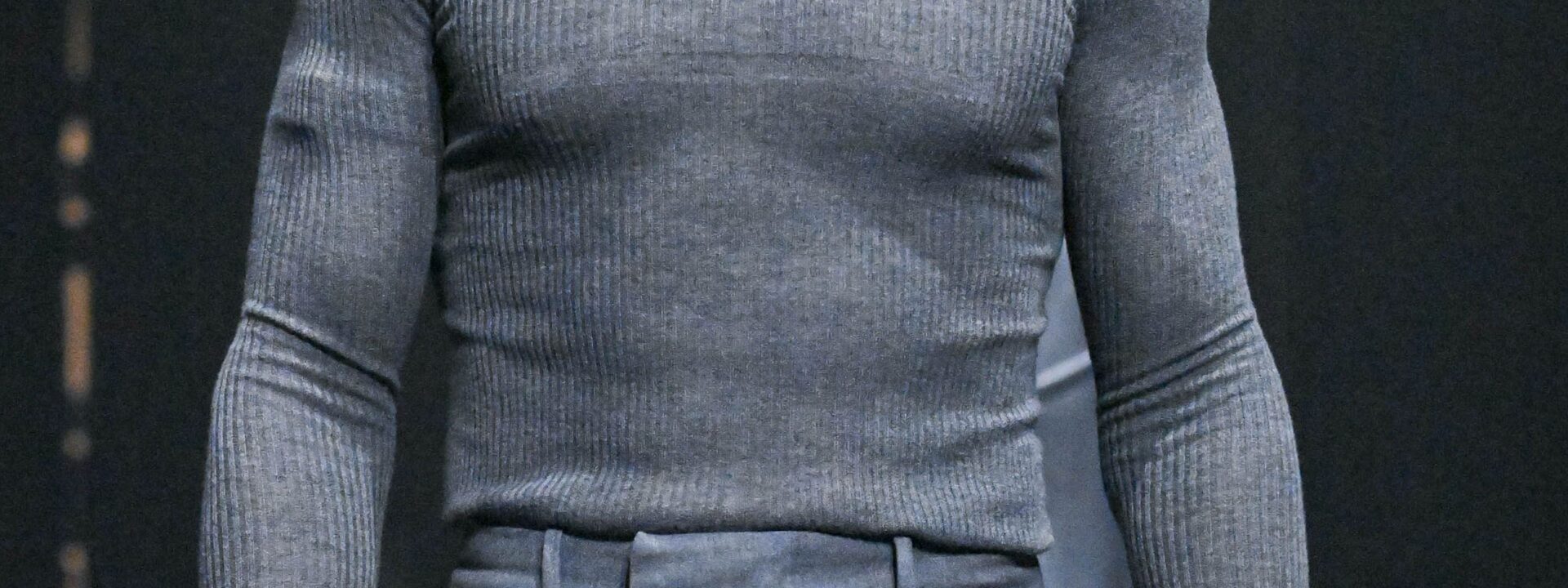
Is this the era of the hyper-optimized man? The recent runway debut of Bryan Johnson—the 48-year-old longevity enthusiast who spends $2 million annually trying to reverse his biological age—at Matières Fécales in Paris is just the latest example. This season has seen a parade of looksmaxxing influencers, muscle-bound models, and biohacking tech figures at Fall/Winter 2026 fashion weeks.
As “protein chic” reaches new heights, menswear silhouettes are leaning bulky. At Matières Fécales, Johnson wore a second-skin gray knit designed to highlight his defined muscles. Meanwhile, Demna’s debut Gucci show featured T-shirts so tight they made pecs and abs look like vacuum-sealed chicken breasts (GQ quipped, “Demna wants you to start Guccimaxxing”). But beneath the flexing of biceps and wealth lies a deeper shift in what masculinity means in the algorithmic age.
It all started at New York Fashion Week. Designer Elena Velez cast Braden Peters—the controversial poster boy for looksmaxxing, better known as ‘Clavicular’—to close her show, a move that set the tone for the season. Peters, 20, who claims to use “bonesmashing” (hitting his face with a hammer) to alter his bone structure and has taken crystal meth to stay lean, wore a silicon-soaked white shirt. Velez described it as referencing “the Botox-like activity of synthetically freezing wrinkles in time.”
“I think his project of looksmaxxing comprises many unique and paradoxical points of interest, making him worthy of contemplation across disparate industries: performance art, tech, fashion, and beauty,” says Velez. When asked about the controversy of platforming such a narcissistic figure, she was unbothered. “I’m not morally attached to the trends I consider within my work. For me, it’s about a more intricate tale of youthful nihilism in the algorithmic era. Men seem to feel disenfranchised these days and are looking for non-traditional ways to get a competitive edge in a deteriorating socioeconomic landscape.”
Why is this surge of manosphere-adjacent aesthetics happening now? And as increasingly exaggerated expressions of fitness, wellness, and status hit the runway, will it change how men want to look?
Revenge of the Nerds
In a move the menswear podcast Throwing Fits called “revenge of the nerds,” Mark Zuckerberg attended the Prada FW26 show in Milan. This coincided with reports that Meta is exploring a collaboration with the Italian brand on a luxury version of its AI smart glasses. Buff billionaire Jeff Bezos is also becoming a more frequent front-row presence, having attended Jonathan Anderson’s first couture show for Dior this year.
“Their attendance is about the evolution of luxury, as well as the intersection of fashion, technology, and entertainment,” says Dr. Antonia Ward, chief futurist at trends intelligence agency Stylus. “It’s not a consumer trend, per se, but an industry trend about the luxury sector going where the money is.” Amid an ongoing luxury slowdown, where aspirational shoppers are spending less, high-fashion brands are increasingly courting the mega-rich—with tech billionaires being one of the most visible groups. Throwing Fits co-host James Harris puts it more bluntly: “Powerful men buying their way into a spot at the cool kids’ table? Scandal.”
Looksmaxxers and tech bros represent two sides of the same male-optimization coin. Somewhere between them sits the tech bro who wants to live forever. Bryan Johnson walked in a show titled The 1%, which featured looks poking fun at late-stage capitalism and extreme wealth.
It turns out the “lifemaxxer” was in high demand: Velez had also tried to cast him in her show, but the timing didn’t work out. “He would have made a great addition to our cult of personalities on the runway this season, and I’m devastated Matières Fécales beat me to it,” she says.
Revised Markers of Status
Male optimization in 2026 is about finding new ways to signal status and gain an edge.Set yourself apart. If you can’t be the wealthiest or most attractive, perhaps you can aim to live the longest.
“Traditional signs of success are harder to display online, but your appearance is instantly noticeable and can be compared,” explains Olivia Houghton, lead analyst for beauty, health, and wellness at The Future Laboratory, a strategic foresight consultancy. “When your social media profile essentially represents your public identity, looks become a substitute for other forms of status that seem out of reach. Substance doesn’t get as much attention as surface appeal. So people invest their time, money, and focus on what is visible and earns approval.”
One of the most talked-about looks this season was at Gucci, where American football player Gavin Weiss, a redhead, made his runway debut in a skin-tight polo shirt, walking with a tough-guy swagger reminiscent of a Grand Theft Auto character. He was part of a lineup of muscular models straining against shiny, tight clothing. “They looked less like typical fashion models and more like the disciplined, perfected bodies you see in tech, venture capital, and longevity circles,” notes Professor Andrew Groves, director of the Westminster Menswear Archive at the University of Westminster.
An exaggerated vision of masculinity was clearly on many designers’ minds. At Calvin Klein, biceps bulged from sleeveless suits, while at Haider Ackermann’s sensual Tom Ford show, models wore clear plastic raincoats over sharp tailoring, calling to mind Patrick Bateman from American Psycho—a kind of blueprint for maximizing looks—who wears one to protect his suit from blood spatter during a killing spree.
Fashion has a history of embracing exaggerated masculine ideals during uncertain times. “We saw it in the 1930s with Hollywood’s muscular stars, the 1980s with power dressing and gym culture, and the 2000s with the metrosexual backlash and ultra-fit ‘alpha’ advertising,” says Groves. In 2014, Mark Simpson coined the term “spornosexual” to describe a body type blending athlete and porn star. Over a decade later, fueled by social media, this aesthetic has grown even more extreme. “What’s new now is the algorithm. It rewards visual cues that make an immediate impact on-screen, and extreme physiques perform very well online.”
Murray Clark, senior style editor at GQ, sees this evolution as a natural response to broader cultural instability and a reason it appears in shows like Gucci’s. “Masculinity is in a state of flux right now. Many people are questioning what it means, or reinforcing their own version of masculinity,” Clark says. “And sometimes, that just means having really big muscles.”
“We live in a time when many consumers feel powerless in most areas of their lives, but they can still feel like the CEO of their own body,” adds Ward.
The New Male Optimization
As gym-toned bodies and self-improvement become more mainstream, brands are adapting, especially in the mass market. Asos is investing more in men’s muscle-fit tops, with new arrivals up 84% year-over-year in the first quarter of 2026, according to retail intelligence platform EDITED. “Sell-outs have also increased compared to last year at retailers like Boohoo, Abercrombie & Fitch, and H&M, showing demand from a younger, trend-focused audience,” says senior retail analyst Krista Corrigan. At Gucci, designer Demna told the press he viewed the clothes as “consumer-oriented,” suggesting an aim to appeal to a newly muscular demographic.
Brands are also navigating a whole new vocabulary around bodies, much of which comes from highly online communities focused on maximizing appearance. Terms like “mogging”—dominating others through superior looks—aren’t in the Oxford Dictionary yet, but they likely will be, along with a full lexicon related to this trend.Our appearance is a form of “identity capital,” and the term “face card” captures this idea perfectly. As The Future Laboratory’s Houghton explains, it compares beauty to a limitless credit card, suggesting an attractive face grants access, attention, and status. He notes that men are increasingly drawn to “looksmaxxing” through fitness, discipline, and self-improvement, with online communities forming around these pursuits.
Harris offers a different perspective on the muscular models seen on runways. He argues this trend isn’t about creating a new hypermasculine ideal, but rather the fashion industry reflecting existing male subcultures—even those emerging from the darker corners of the internet. According to him, it’s easier for fashion to mirror these identities than to invent new male archetypes.
This raises the question: will these trends lead to a narrower ideal for the male body? Groves points out that once a certain silhouette dominates the runway, it spreads rapidly through media and retail. However, he adds that menswear is inherently built for stability, meaning exaggerated trends rarely last. For brands, the crucial issue isn’t whether hypermasculinity is good or bad, but what value system it reinforces—be it status, authority, desirability, or belonging. Understanding this turns casting and silhouette into strategic decisions rather than reactive ones.
While controversial figures in this space might be seen as cynical, some experts believe they indicate a more nuanced exploration of male beauty, not a restriction of ideals. Ward sees it as men becoming more invested—both in attention and spending—in expressing identity through their physical appearance, presenting a significant opportunity for designers.
Some designers are already seizing this opportunity. Velez, who has primarily focused on womenswear, plans to launch a menswear line. She senses a repressed masculine energy within the culture industry that is now building pressure in various subcultures, describing it as “highly combustible energy.”
Further Reading:
* The New Rules of Menswear Influencing for 2026
* The New Rules of Selling Beauty to Gen Z Guys
* 6 Designers on What’s Ahead for Menswear in 2026
Frequently Asked Questions
Of course Here is a list of FAQs about the topic From Tech Bros to Looksmaxxers How Did Hypermasculinity Dominate Fashion Week designed to be clear concise and in a natural tone
Beginner Definition Questions
1 What does hypermasculinity even mean in fashion
It refers to an exaggerated extreme and often performative version of traditional masculinity In fashion this translates to looks that emphasize bulk power aggression and a rigid muscular physiquethink broad shoulders armored tailoring tactical gear and a stern unemotional demeanor
2 Who are Tech Bros and Looksmaxxers and why are they mentioned
Tech Bros A stereotype of young wealthy men from the tech industry known for a specific uniform that signaled a rejection of traditional fashion Their influence made functional and utilitarian aesthetics highfashion
Looksmaxxers Primarily online these are individuals obsessed with selfimprovement their physical appearance through strict grooming style and sometimes cosmetic procedures to achieve a dominant highstatus look Theyve popularized terms and aesthetics that fashion has coopted
3 So is this just about men wearing suits again
No not at all Its the opposite of a classic elegant suit This is about armored suitingoversized heavily padded with tactical details It mixes formal tailoring with elements from workwear military gear sportswear and even medieval armor creating a fortressed silhouette
Context How Did This Happen Questions
4 How did tech culture influence highfashion runways
Tech culture prized functionality utility and disruption This shifted luxury menswear away from pure ornamentation toward technical fabrics modular designs and a focus on garments that signal preparedness and capability merging the boardroom with the apocalyptic outdoors
5 What role did the internet and social media play
Online male subcultures created and amplified specific ideals of male beauty and power Fashion designers and trend forecasters now mine these digital