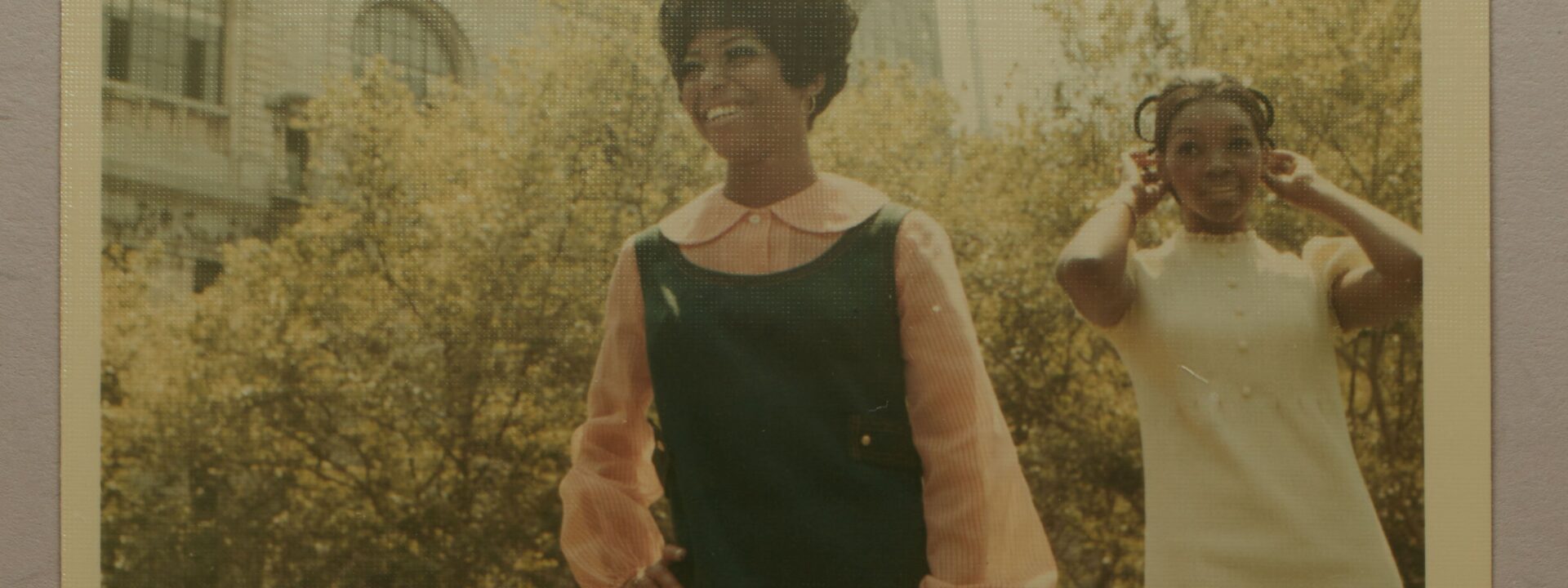
The first Black woman to win the Miss Festival beauty contest at the Cannes Film Festival—another of her models took the title the next year. These wins made Del Marco the top choice for Christian Dior’s push into international markets, and from Del Marco’s talent pool, Dior picked Helen Williams.
But in 1952, with all this momentum, DeVore’s life came to a sudden halt. She was in a car accident during a snowstorm in Detroit. Friends pulled her injured body from the burning wreckage just before her new Buick Special exploded. She woke up from a coma two weeks later, encased in a body cast from the neck down. Her legs were crushed, her shoulders were broken, and one arm was dislocated. Even her teeth were shattered. “The only thing holding me together was the brand-new girdle I had on,” she told her family. She spent nine months in bed, including five in traction at the hospital. Her doctor swore he would never take on a case that difficult again.
“She had one good hand, and she used it to sign contracts from her hospital room,” says Alina Mitchell, author of The Color of Beauty. “She was so determined. It inspires me. Imagine being stuck in a hospital for months and using that time to come up with ways to improve the fashion industry.”
Of course, Fashion Week—like fashion itself—is a collaborative, ever-changing effort. Its earliest modern version began in 1903, when a New York specialty clothing store called Erlich Brothers held what is considered America’s first fashion show in its shop. That new idea became a citywide tradition known as “press week” at the Plaza Hotel in 1943, started by Eleanor Lambert, a well-known fashion publicist. But it lacked the Black community’s spirit of bold rebellion and personal style (for example, in 1984, at Michael Kors’s first fashion show, Iman adjusted a shawl to her own taste before walking the runway).
“You could do things back then. You could just do things—be the first at things. You don’t think about it at the time. You’re so busy integrating,” says Bethann Hardison. “The struggle was a great fight because we knew what we had on our side. We were gangsters, revolutionaries, Buffalo soldiers. But it wasn’t one note. Del Marco knew how to adapt over decades, over generations.” And following New York’s fresh “Black is beautiful” energy, Paris launched its own fashion week in 1973, Milan in 1975, and London in 1984.
As a pioneer of mainstream Black beauty, DeVore wasn’t just changing the fashion industry by featuring models with different skin tones, hair, and names; she was also bringing in Black culture. Suddenly, models walked differently, connected with audiences differently, spoke up differently, and even negotiated their work differently. New Black presence opened up new Black possibilities.
Ophelia DeVore, in an undated photo
Photo: Courtesy of the DeVore family
Many everyday people also went through DeVore’s charm school and modeling agency. One was MaryLouise Patterson, who attended the charm school in the 1950s when she was 15.
“It was like I was going from being a little girl to being a young woman—’lady’ is probably the right word, a young lady rather than a young woman,” she says. “The difference was that you had these manners and this polish that was special. Not everyone had that.”
She says her time at DeVore’s charm school was the first time she felt beautiful. Instead of becoming a model, Patterson went on to be one of America’s most graceful pediatricians. “I always wanted to present myself in the best light, and Ophelia DeVore gave me that—that sense, that awareness,” she says. “She helped me meet my best self and understand why that matters. It has stayed with me throughout my life.”
Today, fashion often debates the fleeting exclusivity of “it” models and the hype of top honors. DeVore was kinder: “They didn’t have to be the most beautiful, the best dancer, or the most talented. All they had to be was the best version of themselves. My philosophy was that there was no such thing as an ugly person.”Only a lazy one.
Contact sheets, courtesy of Alina Mitchell.
Del Marco and the charm school closed in 2006. The fast-paced glamour of Bryant Park’s tents ended in 2010. DeVore passed away in 2014. Fashion often brings things back, and her influence was strong—her charm school and agency helped 40,000 hopefuls over seven decades—but it wasn’t fully recognized.
For example, DeVore’s ongoing impact is clear because Emory’s collection of her archives has led to classes on “Black Beauty,” “The Power of Black Self-Love,” and “Resisting Racism.” Students turn those discussions into essays, dissertations, and other academic work, which become books and wider knowledge. With a life like DeVore’s, says Dudley, “the amazement never fades.”
“She knew she was lifting up Blackness in the fashion world and in our society, and she probably saw it as a step-by-step effort,” Dudley adds, “but we have the advantage of looking back and realizing, wow, she accomplished so much.”
When most artists create their greatest work—a novel, a symphony, a painting, a film, a play, a skyscraper, a shoe—we celebrate their pride in it: the artist putting their name on their craft for everyone to see, whether in paint, ink, lights, carved wood or stone, or stitching. Ironically, we’re less generous when a creator’s best achievement is tied to the idea of beauty itself. Knowing this, DeVore longed to be remembered. When asked why she named her charm school after herself, she said simply: “I had a feeling I was on the edge of something big, and I wanted the world to know I was the one behind it.”
Frequently Asked Questions
Here is a list of FAQs addressing the claim that Fashion Week has lost sight of its Black roots ranging from beginner to advanced levels
Beginner Questions
1 What does Fashion Week has lost sight of its Black roots actually mean
It means that while Black culture style and aesthetics have historically been major drivers of fashion trends the official Fashion Week platforms often fail to properly credit feature or financially support Black designers and creatives in proportion to their influence
2 What are the Black roots of Fashion Week
Historically Black communities have been the originators of many major fashion movements Furthermore Black models stylists and designers have been integral to the industrys evolution even when they were relegated to the backstage or excluded from the main runways
3 Is Fashion Week actually diverse now or is it still a problem
While there is more visible diversity on the runways than 20 years ago the problem has shifted Its less about seeing Black models walk the shows and more about who owns the brands who sits in the front row and who makes the final creative decisions Often Black culture is used as a mood board by big brands while Blackowned labels still struggle for the same prime slots and funding
4 Why does this matter Isnt fashion just about clothes
Fashion is a massive cultural and economic engine When Black contributions are erased or tokenized it perpetuates economic inequality and cultural appropriation It matters because it determines who gets to build wealth and legacy from the trends that start in Black communities
5 Can you give me a simple example of this erasure
A major example is the logomania trend of the 1990s and 2000s This was popularized by Black hiphop artists and streetwear brands like FUBU and Karl Kani However when luxury European houses adopted the same style they were praised as high fashion while the original Black creators were often dismissed as ghetto or too urban for the main Fashion Week calendar
Advanced IndustrySpecific Questions