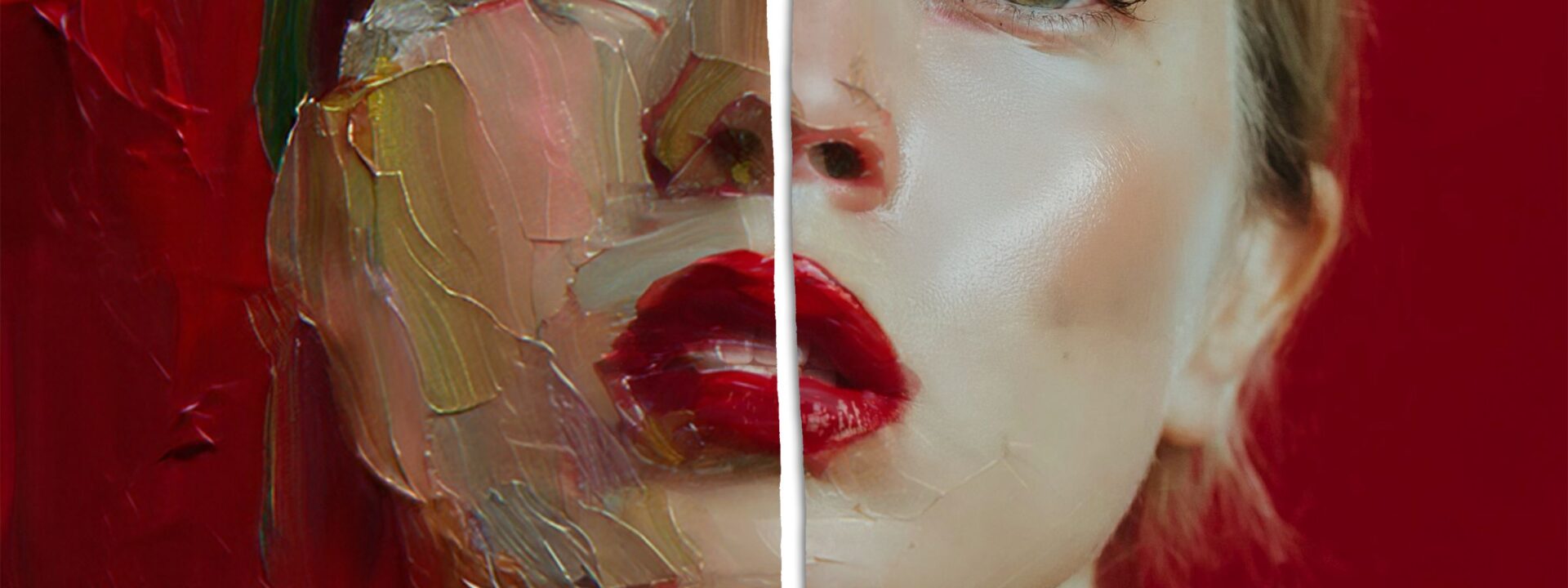
People often tell me I look like I belong in another era. Maybe it’s my style, which swings between a 1950s housewife and a ’70s go-go dancer, or my chin-length bob, which I set into Elizabeth Taylor-inspired curls every week.
My partner has his own theory. “I think it’s all the buccal fat,” he said one night at dinner. “You have it, and that’s not really the trend right now.”
I was surprised he even knew the term—buccal fat is the natural padding everyone has below their cheekbones—and even more surprised when Dr. Shereene Idriss, a board-certified dermatologist in Manhattan, seemed to agree. In her millennial pink office overlooking Bryant Park, she explained that a lack of buccal fat is actually a hallmark of what we’d call a “modern face.” In recent years, surgically removing this fat to hollow out the cheeks and create a more angular look has become one of the most requested procedures among Millennials. This look is central to what writer Jia Tolentino called “Instagram face,” characterized by Kardashian-esque catlike eyes, long lashes, a small nose, and full lips.
Fashion critic and Vogue contributor Lynn Yaeger knows what it’s like to look out of time. She compares her own signature look—cherry red hair, a pointed cupid’s bow, and baby bangs—to a “1920s broken doll.” “Historically, different kinds of faces and body shapes come in and out of fashion,” she says. “It just depends on how your own look coincides with the general aesthetic.”
The harmony between my somewhat retro features and love for vintage could be seen as lucky. For some actors cast in period projects, making their face fit the era can take some work—or the undoing of work. To play 18th-century religious leader Ann Lee, for example, Amanda Seyfried gave up her usual Botox for a full year and went without makeup on set. (It’s doubtful the founder of the American Shakers would have had a perfectly smooth forehead or smudged lipstick.)
“For some roles, it’s required that someone be totally natural—or at least convincingly so,” says casting director Kahleen Crawford, who has worked on projects like Apple TV+’s period drama The Buccaneers. “Even eyebrows are a question. Microblading, for example, can feel too modern, depending on how well it’s done.”
For actor Holliday Grainger, whose first major role was as 15th-century Italian noblewoman Lucrezia Borgia in Showtime’s The Borgias, fitting an era is just part of the job. During her audition, showrunner Neil Jordan compared her pale skin, round eyes, and delicate features to “a Botticelli painting.” He was onto something; she’s spent most of her career since then starring in period pieces.
“Every decade has such a clear visual aesthetic, both in trending features and the makeup used to highlight them,” says makeup artist and beauty historian Erin Parsons. She walks me through them all, from the small, sharply drawn cupid’s bow lips of the 1920s to the heavily contoured look of the 2010s, noting the references and revivals along the way. “When you see thin brows and a high forehead, most people think of the ’90s, but it’s also the ’30s.”She describes her own look as a blend of the 1920s and ’90s—with a single kiss curl gelled onto her forehead—then takes in my makeup-free, heart-shaped face and places me firmly in the 1940s: “Pure Rita Hayworth.”
Next, I meet with the Metropolitan Museum of Art’s Kathryn Calley Galitz to talk about classic portraiture. As we study the high foreheads of 15th-century women—a beauty ideal so coveted that women would pluck their hairlines back—and the delicate, pretty noses of neoclassical French princesses, I find myself wondering how every subject managed to look so dewy and rosy in an era without modern skincare or medicine. “Painters wanted to show their subjects in a flattering light, whether to secure more commissions or to convey a message through their art,” Galitz explains, likening these idealizing touches to a kind of proto-Instagram filter. (Think of it as Ingres face.)
But actors live in 2025—even when playing characters from centuries ago—and the pressure to look youthful in high definition, on social media, and elsewhere is a modern reality with modern solutions. “Actors, especially women, are caught in a bind: they’re expected to keep their faces from changing over the years, while also delivering powerful performances that demand a full emotional range,” Crawford notes. “We feel things, and our muscles respond—I want to see that on screen. When I do, I feel it too, and that’s what pulls me into the performance.”
Frequently Asked Questions
Of course Here is a list of FAQs about Which Era Does Your Face Belong To designed to sound natural and provide clear helpful answers
Getting Started The Basics
Q What is Which Era Does Your Face Belong To
A Its a fun popular trend that analyzes your facial features and style to match you with a historical or artistic era like the Renaissance Roaring Twenties or 1990s
Q How does it work
A Most apps use facial recognition AI They scan key points on your facelike your eyes nose jawline and bone structureand compare them to common beauty ideals or artistic styles from different periods
Q Where can I try this
A You can find these filters on social media platforms like TikTok Instagram or through dedicated face analysis apps and websites Just search for era filter or which era am I
Q Is it safe to use these apps
A Be cautious Only use filters from reputable sources on major platforms Avoid unknown thirdparty apps that might misuse your photo or data Always check the apps privacy policy
Understanding Your Results
Q I got the Renaissance era What does that mean
A This typically suggests features associated with classical beauty ideals balanced symmetrical proportions fuller faces and a serene expressionsimilar to paintings by artists like Botticelli or da Vinci
Q Why did I get a result I dont agree with
A The AI is looking at very specific geometric measurements not your personality or style Lighting makeup expression and even hair can affect the result Its meant for fun not a scientific analysis
Q Can I get more than one era
A Yes Many filters give you a top three or a mix acknowledging that your features might blend elements from different times
Q What are some common eras the filter identifies
A You might see