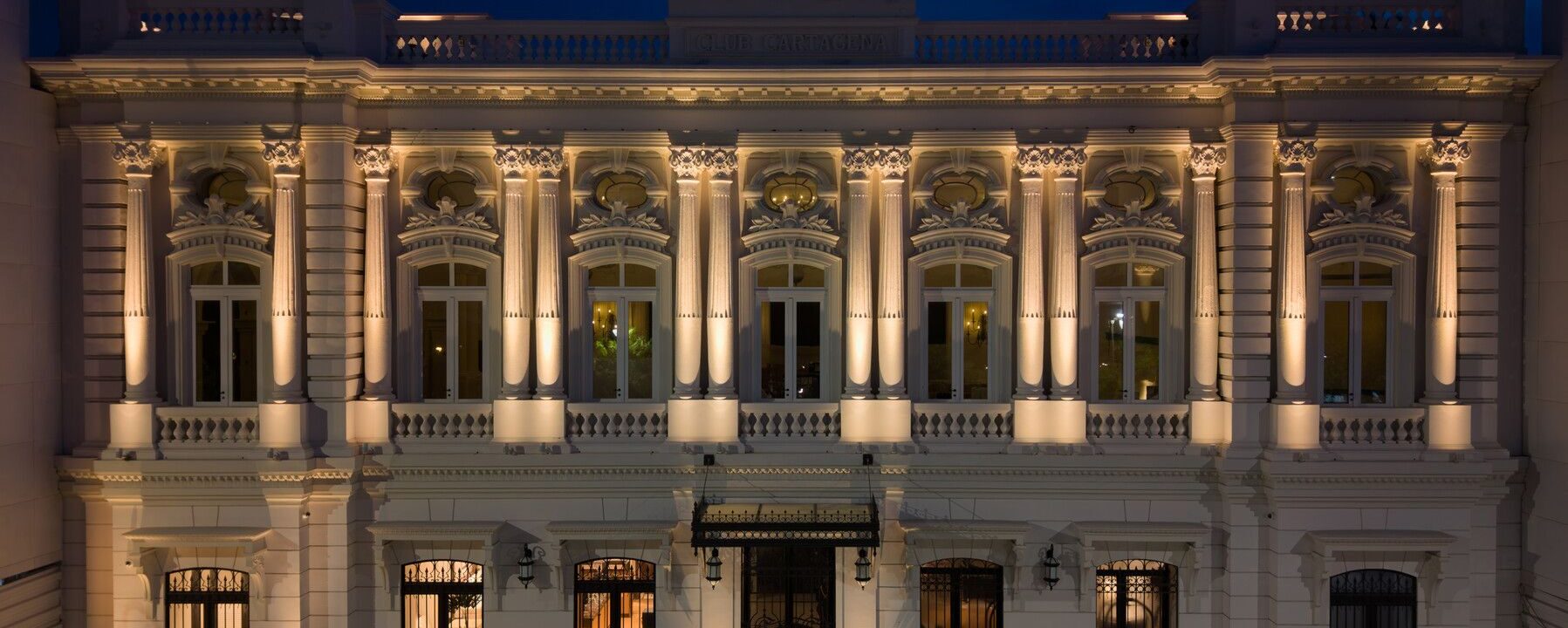
In the late 1920s, if you were strolling through Cartagena’s Getsemani district—especially past the beautifully landscaped Parque de Centenario, where colorful birds chirp and tamarin monkeys leap through the trees—you would likely have been stopped in your tracks by Club Cartagena.
As a social hub for the city’s elite, you might have heard jazz music drifting on the breeze or caught glimpses of women in glittering dresses and men in smart linen suits dancing inside. But above all, you would have been struck by its stunning architecture: a Beaux-Arts masterpiece designed by Gastón Lelarge, the French architect who assisted Charles Garnier in building the Paris Opéra before moving to Colombia in the early 20th century and leaving his mark all over Cartagena.
Now, just over a century after Club Cartagena first captivated passersby, it has returned as the newest jewel in the Four Seasons collection—with a brand-new look to match.
I arrived on a warm April morning—though with temperatures in the 80s year-round, every morning is warm—less than 24 hours after the Four Seasons Cartagena had opened. You wouldn’t have guessed it was so new. The spectacular, and thankfully air-conditioned, former atrium of the club buzzed with activity: guests coming and going from the café for their morning Colombian coffee, while baristas behind a marble bar the length of a snooker table brewed espresso using sleek, Willy Wonka-esque steel levers.
As I was escorted to my room through the hotel’s courtyards and corridors, I saw guests padding back from the spa in plush robes and slippers, or dressed in bright swimwear, heading to the pool for a morning swim. This corner of Cartagena may have lain dormant for decades—apart from a brief period when the ruins hosted underground raves—but it had clearly sprung back to life with vibrant energy.
I soon realized the property extended far beyond the former club. The sprawling complex covers nearly an entire city block, incorporating a 16th-century monastery, five former theaters, and three churches, all thoughtfully woven together to create 131 guest rooms and suites. And that’s not including the entirely new central building designed to connect it all, topped with expansive rooftop terraces and a large infinity pool overlooking the sherbet-orange rooftops and bell towers of the walled old city.
Even in my room—a colonial suite with high, decorative wooden-beamed ceilings and delightful abstract prints by artist Miguel Cardenas inspired by Colombian folklore—the building’s history resonated from every surface. Yet it still had all the modern comforts of a 21st-century five-star suite: a room service app, fast WiFi, wireless chargers. (Fortunately, not everything was overly high-tech; the curtains and lights were still pleasingly analog, fitting for a place steeped in history.)
That attention to detail can be partly explained by the team behind it. The mastermind behind the suite I stayed in—and the entire Club Cartagena building—was none other than…The legendary French designer François Catroux, who was married to Yves Saint Laurent muse Betty, passed away at the end of 2020 while renovations were still in progress, making this one of his final projects. The hotel has been nearly a decade in the making. As general manager Annie Monnier explained during a tour, the lengthy, careful restoration was necessary because “it was more important to get it right than to rush it.” And you can tell.
While Catroux’s signature style is clearly present—bold geometrics, restrained color palettes, clever built-in furniture—it is also enriched by thoughtful local touches. Notably, designer Poli Mallarino interpreted Catroux’s plans for furniture and textiles, adding subtle nods to Latin American craft in the rugs, headboards, and fabrics. Nearly every piece was custom-made for the hotel, so you’ll find recurring motifs like stars, diamonds, and herringbones everywhere from the ceilings to the marquetry tabletops. “From the very beginning, it was essential that this hotel feel of Cartagena, not just in Cartagena,” Monnier adds. “These buildings hold memories, stories, and emotional weight for many people in the city, and we felt a deep responsibility to honor that history.”
“It felt like a huge responsibility,” confirms Laura Acevedo, who oversaw the project as director of concept and design for the developers, the Santo Domingo family. “The property is so unique, so everything in it had to be unique.” Choosing Catroux—best known for residential work—as a lead designer was intentional. “We didn’t want the hotel to feel like a hotel,” Acevedo continues, noting that this is why so many details were created from scratch with local artisans. “It felt like an opportunity to show the world what can be done here in Colombia.”
This vision came from the top. “From the beginning, this was about allowing the destination to lead, ensuring the architecture and interiors feel considered, respectful, and inseparable from Cartagena itself,” says Alejandro Reynal, president and CEO of Four Seasons. He calls it a “perfect representation” of the brand’s future: “entering destinations thoughtfully, partnering closely with local communities, and creating experiences that immerse guests in their surroundings.”
That connection to place is felt throughout the hotel. It’s in the intricate fresco of a tropical scene on the ceiling of the Grand Grill—a classic American steakhouse that marks the Carbone founders’ first venture into South America and serves a standout prawn cocktail—and in the Art Deco glass doorways and inlaid wood mirrors found across the property. “Even if you don’t pay attention to every little detail, I think you can feel it,” says Acevedo. “There’s a harmony to it all.”
And you really can feel it: in the soothing creams and blacks that flow through each space, the airy corridors that seamlessly connect the buildings, and the evident respect for the original structure. (I was especially charmed by the stone column peeking out of the wall in my room.) Over my three nights in Cartagena, the spot I grew most fond of was right outside my bedroom: a wicker chair with a cushioned footrest.A tool overlooks the quiet cloisters, where four massive banyan trees stand in the center, their hanging roots touched by shifting sunlight throughout the day. It doesn’t get much lovelier than that. This is the first floor of the cloisters at the former San Francisco Monastery.
I could have happily spent a few days relaxing at the hotel, but the team was eager for me to explore. To help with that, they’ve partnered with Galavanta for guest experiences—a local travel specialist run by a creative Colombian couple who excel at arranging “ungoogleable” adventures. Of course, they also recommend a few well-known experiences, but only because they’re truly worth it: an afternoon browsing the colorful boutiques of the Old Town with local fashion designer Paola, and lunch at the perennially booked Celele, a World’s 50 Best restaurant, where I had a ginger flower and gulupa salad dotted with Caribbean herbs—possibly the prettiest dish I’ve ever seen.
Galavanta’s local connections run deep. A particular highlight was an afternoon with their historian, Fernando, who led me on a fascinating walking tour of the city. Using vintage photos and maps on his iPad, along with his deep local knowledge, he showed me his childhood home on a street in Getsemani, where neighbors chat on their stoops, and shared memories of making his first friends after moving from Bogotá as a child. As we walked through different neighborhoods, he gave a balanced perspective on how gentrification and Colombia’s complex politics have shaped the area. We ended at a market sampling traditional sweets, and he sent me back to my room with a jar of syrupy stewed papaya for a midnight snack. By the time we returned to the hotel, three hours had flown by—I could have easily spent three more.
What truly makes Cartagena unbeatable, I learned, is how perfectly it blends a city break with a beach holiday. On my last day, I headed to the port next to the hotel and sped by boat through Cartagena Bay and the Bocachica Strait. Just 45 minutes later, I arrived at the Rosario Islands, a postcard-perfect Caribbean paradise of soft white sand, coral reefs, and crystal-clear water. While we passed a few lively party boats on the way, our destination—thanks to Galavanta—was a haven of peace.
Minutes later, we arrived at the almost dreamlike Cala Mambo, a small island with a dusty pink, thatch-roofed villa at one end and a beach bar and jetty at the other. A handful of guests lounged in hammocks, reading books and sipping spicy mezcal margaritas. The owners, Daniela and David, gave me a quick tour before a feast of tuna ceviche, grilled lobster, and plantain fritters was served on an overwater terrace. We watched pelicans dive into the sea nearby to catch their lunch. It felt surreal to think Cartagena’s bustling city was less than an hour away.
But it was, and when I returned to the hotel that evening, it was livelier than ever. At cocktail hour, the atrium buzzed with energy: aperitivo carts laden with fruit and cheese moved across the marble floors, and locals enjoyed ginger mojitos.Guests ascended the dramatic split staircase to enjoy the last of the afternoon sun on the supremely elegant, Catroux-designed terrace. Any initial opening-day hiccups were imperceptible—the hotel felt as if it were already in full stride. A century after Club Cartagena first opened, its story is truly just beginning.
Frequently Asked Questions
Of course Here is a list of helpful FAQs about the beautifully redesigned hotel in Cartagena presented in a natural conversational tone
General Booking
Q What is the name of this newly redesigned hotel
A While the exact name isnt provided in the statement it is a recently and beautifully redesigned hotel in Cartagena Colombia now being celebrated as one of South Americas most stylish new destinations
Q Where in Cartagena is the hotel located
A For precise details you would need to check the hotels official website However such a stylish redesign is typically found in Cartagenas most desirable areas like the historic walled city the trendy Getsemaní neighborhood or the upscale Bocagrande district with beach access
Q When did the redesignreopening happen
A The description suggests it is a very recent transformation positioning it as a new destination Its best to check the hotels official channels for the exact reopening date
Style Experience
Q What makes this hotel so stylish
A The redesign likely blends contemporary luxury with Cartagenas unique colonial charm Expect a focus on sophisticated design curated local art highend furnishings and Instagramworthy spaces that tell a story
Q Is it more for couples families or solo travelers
A A hotel of this caliber typically caters well to couples and luxury solo travelers seeking a designforward experience It may also accommodate families but its best to inquire directly about familyfriendly amenities and room configurations
Q What kind of vibe or atmosphere does it have
A You can expect an atmosphere of relaxed sophistication Its likely chic and vibrant yet intimate offering a peaceful retreat from the bustling city streets possibly with a stunning rooftop or courtyard as a centerpiece
Amenities Services
Q Does the hotel have a pool
A Most stylish redesigned hotels in Cartagena feature a beautiful pool often a rooftop infinity pool with panoramic views This is highly probable but confirming on the hotels website is recommended
Q Is there a spa or wellness center
A A fullservice spa or at least a menu of inroom wellness treatments would be expected at a destination of this stature Details on specific