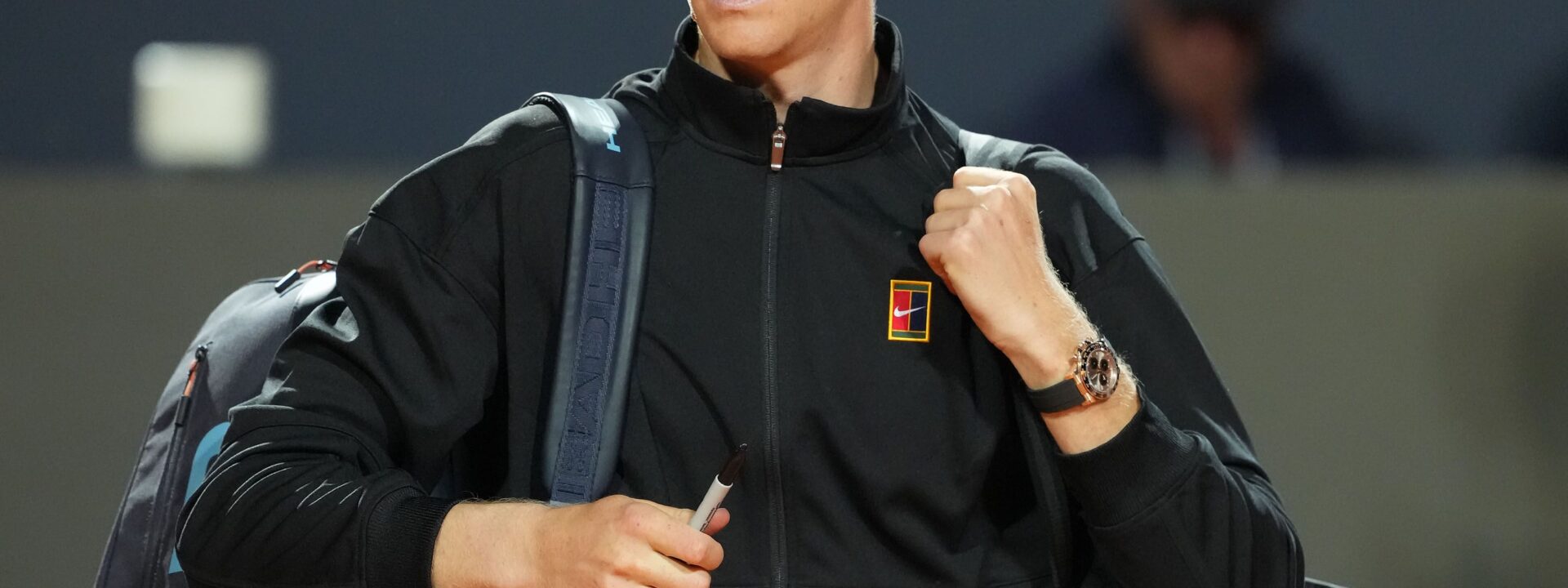
Just a few weeks ago, Gucci cast Jannik Sinner as “The Original Sinner” in a campaign that played with biblical imagery and featured a tennis ball disguised as forbidden fruit. It was playful, self-aware, and a shift from the carefully managed image that has long defined one of tennis’s most private stars. “It was one of my favorite campaigns—you don’t have to take yourself too seriously,” Sinner told Vogue.
Now, as Wimbledon approaches, Gucci is having fun with another idea featuring the world No. 1. Its latest campaign, “Made In Italy,” places Sinner—dressed in sharp white tailoring and matching loafers—at the center of the Italian flag. The imagery nods not only to his status as one of Italy’s most recognizable athletes, but also to the questions about identity that have followed him throughout his rise. Raised in South Tyrol, a mountainous region near Italy’s border with Austria, Sinner has often clashed with stereotypes of what an Italian should look, sound, or act like. With his red hair, pale skin, and quiet personality, he doesn’t fit the cinematic clichés of Italianness that have long dominated popular culture. The campaign cleverly flips that tension, celebrating a more nuanced version of Italian identity that has room for a soft-spoken skier from the Alps.
Photo: Courtesy of Gucci
The campaign will be hard to miss as Sinner returns to Wimbledon to defend his title. Gucci is taking over London’s Piccadilly Circus, covering street furniture across the city, and turning the front of its New Bond Street flagship into a tribute to its longtime ambassador. It comes at an interesting point in his season. After a shortened Roland-Garros campaign, Sinner has spent more time away from competition than he usually would before the grass-court season starts, leaving questions about how he’s feeling physically heading into Wimbledon.
Here, Sinner checks in with Vogue about his health, the challenge of defending his Wimbledon title, and what it means to represent Italy even though he doesn’t fit many of its most familiar clichés.
Vogue: The recent Gucci campaigns have been quite playful. This one plays with the idea of what it means to be Italian, a theme that has followed you throughout your career. So what does being Italian mean to you?
Jannik Sinner: I’m very proud to be Italian. I’ve always felt lucky to be born in such a beautiful country. I grew up in the mountains, but I also love the lakes, the sea, the islands, and the picturesque cities we have. Sports are very important in our culture, and I always enjoy the enthusiasm of Italian people whenever I play at home.
You’ve talked about growing up in South Tyrol, which is quite different from the version of Italy some people imagine. How did growing up there shape who you are today?
It’s a very simple lifestyle. There are so many small towns, and we’re surrounded by a lot of nature. Everyone has the same friends, and when something happens, everyone in the area knows about it [laughs]. I’m very happy to still have my best group of friends there. I know now, from all my traveling, how different life is in big cities, but I’m very glad I grew up where I did, because I had a lot of freedom, a lot of time outside, and a lot of security. We could go to school by ourselves, and then after that we’d all change and do our different sports—it was a very active place. It was an amazing childhood, and every time I come back to see my parents and friends, it feels great.
Do you have a preference now between city life or country living?
I think it’s more about balance. I travel a lot, so I’m very happy when I’m back home in Monaco, where I live now. But whenever I have time, I want to go home, because my grandparents are both still alive, and it’s very important for me to spend as much time with them as I can. Since I was 13, I’ve always been far from home, so whenever I get the chance to go back, I like to take it.It’s really all about how I feel in the moment. Lately, I’ve been more and more drawn to calm places—I feel much more comfortable there than in busy environments.
That makes sense. So, you’ve had some extra time off since Roland-Garros [where Sinner was upset in the second round by Argentina’s Juan Manuel Cerundolo]. What have you been doing during this break?
I took a week off and spent time with my friends and family, which was really important to me. After that, we went straight back to practice because there’s a big stretch coming up—Wimbledon, of course, but we also did a lot of work for the US swing that follows. We usually don’t have much time to prepare for that. I always try to look on the bright side, and the upside of leaving Roland-Garros early—even though I would have loved to go further—is having some extra time. We try to make the most of every day, so there have been a lot of long practice sessions, and I’m really happy with my fitness and mental state right now.
I know there were some concerns about your health after Roland-Garros. How are you feeling physically heading into the tournament?
I feel good. We’ve put in a lot of work over the past few weeks, so physically I’m in a great place. I’ve played a lot in recent months, so a solid training block was exactly what my body needed to get stronger again, and I’ve recovered well. But the most important thing for me is to be in a good headspace, and I’m really happy to be here in London. Hopefully, I can compete at my best.
You and Carlos Alcaraz have been pushing each other for the last few years, trading big titles and shaping this new era of men’s tennis together. With him missing Roland-Garros and now Wimbledon [Alcaraz has been out with a right wrist injury], how has it felt not having your biggest rival around?
Like I’ve said before, tennis needs Carlos. I hope he recovers quickly, and I know he has a great team around him to support him and help him get back.
So you’re coming back to Wimbledon as the defending champion. Does that change anything mentally, or do you treat it like any other tournament?
I approach it the same way. I always say we don’t defend—we always try to go for it, and hopefully we can do that. I know it’s a long tournament. How I start will be really important. I haven’t played any matches on grass yet, so the first match—or the first few—will be tough. But if I can get through them, I know the confidence and good feelings on grass can come back. Right now, we’re just trying to find a good rhythm on grass, and then we’ll see how the tournament goes.
You’ve said Wimbledon was a tournament you dreamed about as a kid. What makes it feel different from the other Grand Slams?
Yeah, you really feel the history and prestige of playing here. Everything about the tournament feels different from other events, and it’s the only big tournament we have on this surface. So it’s really nice to be back here and share this moment with my team. My family isn’t here yet—maybe they’ll come if I go far in the tournament, but we’ll see.
How does your family decide whether or not to come? Do you have any superstitions about them being there too early?
No, not at all. I think they just let me focus on what I need to do. I have my job, and they have theirs, you know. I know what’s best for me and what I need to do. They know tennis, of course, but not as well as I do because they’ve never played [laughs]. That’s just how we are as a family. We like to support each other, but we also give each space. And when we’re at home, we never talk about tennis—we always talk about other things.
So when you’re in London, you’re obviously very focused on training, but is there anything you like to do in your downtime? I know you’ve mentioned settingI set alarms during tournaments to watch Formula 1. When I’m here, my schedule is pretty much: tennis, come back to the house, sleep, repeat. But I think it’s really important to give your mind a break, so when I have time, I’ll play some golf, build Legos, or watch Formula 1. Football is on now too with the World Cup, so I’ll follow that. Tennis is important, of course, but so is taking your mind off it.
Going back to Gucci—you’ve been with the brand for five years now, which in many ways overlaps with your rise on tour and your transition into adulthood. How has your relationship with fashion and your personal style changed during that time?
I’ve learned a lot about fashion over the last five years. I understand the fashion world better now and how much work goes on behind the scenes. Of course, my style has changed a bit along the way, and I’ve been very lucky to wear a lot of nice outfits. I’d say my style is very simple and elegant. I prefer darker colors and like to look relaxed—I’m not going to put the biggest Gucci logo on, you know? But they’ve worked with me for so long and know what I like, so they give me suggestions, and it’s been a great collaboration.
This conversation has been edited and condensed.
Frequently Asked Questions
Here is a list of FAQs about Jannik Sinners return to Wimbledon after his unexpected time away covering beginner and advanced perspectives
BeginnerLevel Questions
1 Why was Jannik Sinner away from tennis before Wimbledon
He had to take time off due to tonsillitis He also skipped the French Open because of a hip injury
2 Is he fully healthy now
He says he feels much better He has been training again and is confident his body is ready for the grass courts though he admits he is still building back to full match fitness
3 Did he play any warmup tournaments before Wimbledon
No Because of his recovery he chose not to play any official grasscourt warmup events Wimbledon will be his first tournament back
4 Is he the favorite to win Wimbledon
Many experts consider him a top contender but not the clear favorite His lack of recent match practice makes it a challenge but his talent and ranking keep him in the conversation
5 How does he feel about coming back
He has said he is very happy and excited to be back He missed competing and is grateful to be healthy enough to play at Wimbledon again
AdvancedLevel Questions
6 What is his track record on grass courts
Its his weakest surface statistically but he has improved He reached the semifinals at Wimbledon in 2023 which was his best result there He won his first grasscourt title in Halle in 2024
7 How does his time away affect his seeding and draw
Because he is the World No 1 he is the top seed This means he avoids other top seeds until the later rounds which is a significant advantage
8 What specific challenges does he face coming back cold to a Grand Slam
The biggest risk is a lack of match sharpness Grass is a lowbounce fast surface that requires precise footwork and quick reflexes Without recent competitive matches his timing and decisionmaking under pressure might be off in the early rounds
9 How has his team adjusted his training for the return
His team has focused on lowimpact high