Key Takeaways
For centuries, cultures around the world have developed their own wedding traditions that communities still practice today. From brides wearing red to shaving the groom, these unique customs are full of meaning, heritage, and fun.
You might already know about American wedding traditions—like the bride wearing white, exchanging rings, and vows that end with “I do.” But there are countless other unique traditions around the world that celebrate the union of two people in love. Some ceremonies are especially important to couples who follow a particular religion, while others are customs passed down through generations in small regional communities. No matter where an engaged couple lives, they can include traditions from their heritage as a way to honor their roots.
Today, many couples plan their weddings in their own way—blending two cultures to create a celebration that reflects who they are and where they come from. Whether it’s skipping bridesmaids or rethinking the classic white wedding dress, here are 17 of the most unique wedding traditions from around the world.
1. Porcelain Smashing – Germany
Photo: Getty Images
In Germany, on the night before the wedding, the couple can host a polterabend—a celebration where guests smash porcelain, usually in front of the bride’s home, to bring good luck to the marriage. After the party, the couple cleans up the broken pieces together to ward off evil spirits, symbolizing their ability to face challenges as a team in married life. After the wedding, the newlyweds walk over a path of fir branches, which represents a lucky and fertile future, and take part in baumstamm sägen—a ritual where they work together to saw a log in half. Like the polterabend cleanup, this custom shows the couple’s strength when they work as one.
Today, polterabend celebrations are still fairly common in rural German communities. However, since this event often involves heavy drinking, similar to a bachelor or bachelorette party, many couples choose to host it days or weeks before the wedding to avoid being hungover on the big day.
2. Money Dance – International
Photo: Nicole Ivanov
The money dance is a wedding tradition found in many cultures, and it varies depending on the region. At Mexican weddings, anyone who dances with the bride or groom is expected to pin money on their outfit—a festive gesture that helps pay for the honeymoon and other wedding costs. In Nigeria, a similar version takes place where the couple is showered with money while they dance. Collectors then gather the money into bags for the couple to take home after the celebration. In a recent Vogue wedding feature, couple Juju Smith-Schuster and Laura Kruk performed a Taualuga dance—a Samoan version of this tradition.
3. Shaving of the Groom – Greece
(Original Caption) A man being shaved by a barber. Undated photograph, circa 1950s.
Bettmann
In a traditional Greek wedding, the koumbaro, or best man, has one of the most important roles—quite literally acting as the groom’s barber. On the morning of the ceremony, he gives the groom a wet shave. This tradition reflects the deep trust between them, going beyond just being friends. Today, this custom is still widely practiced in Greece and among people of Greek descent around the world.
4. The Bride Wears Red – Hungary
Photo: Gábor Eszterle
At a Hungarian wedding, you might see the bride wearing red later in the evening. According to tradition, at midnight the bride changes into a new dress called a menyecske ruha, meaning “new wife dress.” This symbolizes that the bride is now officially married. Model Barbara Palvin showcased this Hungarian custom at her wedding to actor Dylan Sprouse.
5. Ring-in-the-Rice Game – India
Photo: Bárbara Lanzat
A fun game played during Indian wedding celebrations is the ring-in-the-rice game, or angothi khela. DurinIn this game, the couple searches for a ring hidden in a bowl of rice. Whoever finds it first earns bragging rights and is said to “rule” their household in the future. Bride Meeka Hossain brought this tradition from her culture into her blended wedding in Los Angeles.
6. Bomboniere Favors – Italy
At the end of an Italian wedding, guests often receive small party favors called bomboniere. These are gifts of gratitude, typically made up of five sugared almonds wrapped in tulle or placed in ribbon-adorned boxes. The almonds represent good luck and the joys of family life. Many couples having destination weddings in Italy choose to include this tradition as well.
7. Sofreh Aghd – Iran
In a Persian wedding ceremony, called the Aghd, the couple sits before a table, or Sofreh, filled with symbolic items. These objects represent the shared journey of life they are about to begin. Traditional items include two candlesticks for light, a mirror for eternity, nuts and eggs for fertility, and coins for prosperity. These beautiful displays have appeared in many ceremony setups featured in Vogue.
8. Lasso Ceremony – Mexico
At a Catholic Mexican wedding, a unity ceremony with a lasso, or lazo, is common. During the ritual, the couple’s hands are bound together with a rope or rosary to symbolize their commitment and the joining of their lives. This tradition is also widespread in many Filipino and Latino communities. Irish weddings have a similar handfasting ceremony, which is where the phrase “tying the knot” comes from.
9. Tea Ceremony – China
In Chinese culture, couples often take part in a tea ceremony with their families. The couple serves tea to their parents, grandparents, and other relatives as a sign of respect. In return, they usually receive gifts and well wishes. This ceremony typically takes place before the wedding and is sometimes combined with a rehearsal dinner. We love the traditional attire and custom embroidered pieces often seen at these events. Vogue bride Ann Liu had two bespoke outfits made for her tea ceremony in Greece.
10. Haldi Ceremony – India
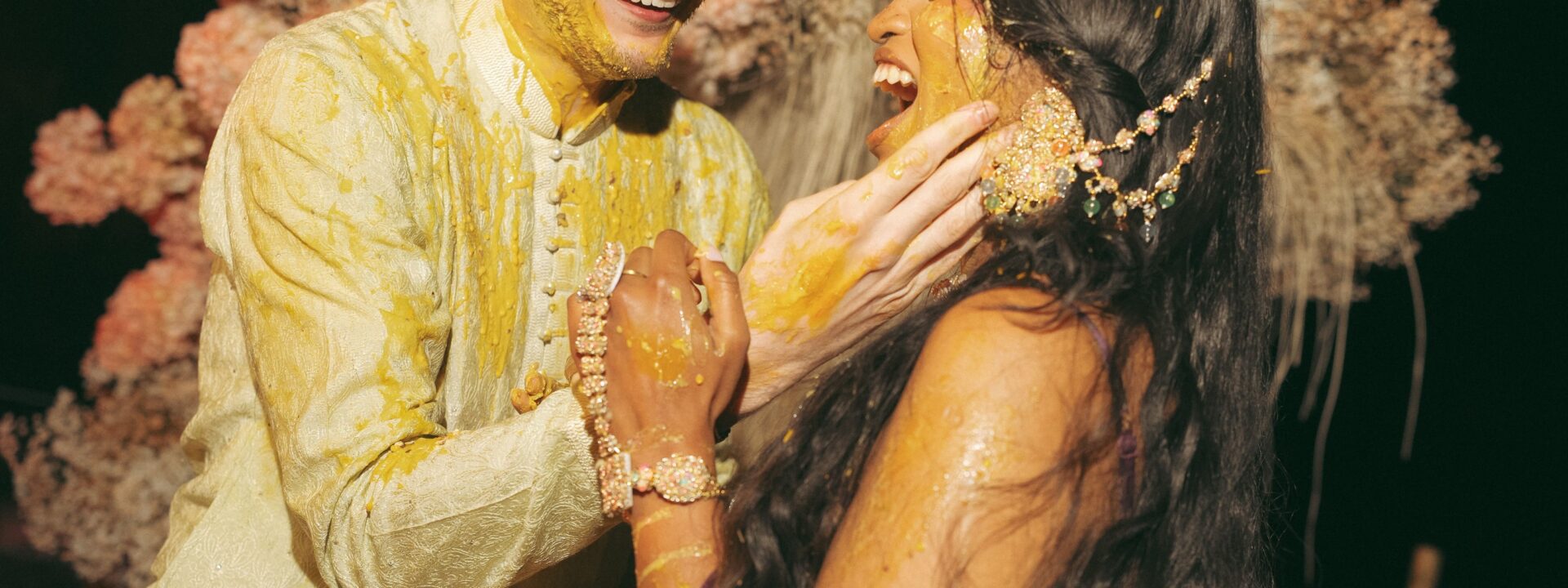
A few days before an Indian wedding, the bride and groom gather with close family and friends for a pre-wedding ritual called the haldi. During the ceremony, guests apply turmeric paste—known as haldi—on the couple while music plays and everyone dances. The ritual is believed to ward off evil spirits and also has purifying benefits for the skin. Traditionally, the haldi was done only with the bride and her close female circle, but many modern couples now make it a joint celebration. One recent Vogue bride and groom held the ceremony by the sea so they could rinse off in the ocean afterward.
11. Cake Pulling – Peru
At Peruvian wedding receptions, the cake has several layers, each attached to ribbons connected to charms—one of which is a fake wedding ring. This tradition, called the Cintas de la Torta, invites all single women to pull a ribbon. The one who finds the fake ring is said to be the next to get married.The next in line gets to say “I do.” This adds a bit of suspense, making it a fun twist on the usual bouquet toss. Some communities in the American South also practice this tradition.
12. Hammam Spa Day and Henna – Morocco
Photo: Getty Images
Moroccan pre-wedding rituals often include the traditional hammam, where the bride-to-be and the women closest to her enjoy a spa day with massages, exfoliation, clay masks, perfume prep, and waxing—every beauty treatment a bride could want to look and feel her best for her big moment. A day or two before the wedding, there’s the henna party, a North African custom seen at both Muslim and Jewish weddings, usually held at the bride’s family home. Guests greet the couple, take photos, mingle, and dance, while a henna artist decorates the bride’s hands and feet for good luck. The best part? Everyone is invited to get henna tattoos and share in the good fortune.
13. Sake Drinking – Japan
Photo: Dear Vincent
Traditional Shinto wedding ceremonies may include a ritual called San-san-kudo, which means “three-three-nine times.” During this ceremony, the bride and groom take three sips from three different sizes of sake cups, symbolizing the joining of families, the couple’s bond, and their individual lives. The number nine is considered lucky in Japanese culture, making this tradition a deeply meaningful part of the wedding. At this Vogue wedding in Japan, the newlyweds broke open a 36-liter sake barrel at their reception before the ritual.
14. Paebaek Ceremony – Korea
Photo: Sarah Falugo
The paebaek is a key moment in a Korean wedding. While it used to be a private event, many couples now include it during the wedding cocktail hour so guests can watch. Both sets of parents sit at a low table filled with food. The couple enters, bows, and pours tea. In return, the parents offer blessings and money. The couple then bows and sits down. After that, the parents throw dates and chestnuts, which the couple tries to catch in a white cloth embroidered with flowers. The dates and chestnuts represent the children they will have in the future. At the end, the groom gives the bride a piggyback ride around the table. This tradition is very common at Korean weddings. Actress Arden Cho recently did this with her now-husband Christopher Lee at their wedding in Italy.
15. Kissing Tradition – Denmark
10th May 1959: British costume designer Tony Walton kisses the cheek of his new bride, British actor and singer Julie Andrews, in England. She wears her bridal veil. (Photo by Michael Hardy/Express/Getty Images)
Michael Hardy/Getty Images
One Danish wedding tradition? When the bride leaves the room, other women can take the chance to give the groom a friendly kiss on the cheek. According to this Scandinavian custom, the bride can also have guests kiss her when the groom steps away. Don’t worry, though—the couple is still encouraged to kiss each other all night long. Guests clink their knives and forks on the table during dinner to prompt the newlyweds to kiss.
16. The Couple Can’t Smile – Congo
Kinshasa, Democratic Republic of the Congo: Marie Olive Lembe di Sita, bride of president of the Democratic Republic of Congo, Joseph Kabila, waits for Kabila to arrive during their wedding ceremony in Kinshasa, 17 June 2006. Kabila married di Sita the previous day in a Roman Catholic ceremony at the couple’s home in Kinshasa. Kabila was a presidential candidate in the July 30 elections, the first free and democratic vote in the vast central African nation in over four decades. AFP PHOTO/TORGHA (Photo credit should read TORGHA/AFP via Getty Images)
AFP/Getty Images
While smiling couples are common at Western weddings, it’s the opposite in Congo. To show they are serious about their upcoming marriage and commitment, the couple avoids smiling during the ceremony.In the Congo, married couples are expected to keep smiles off their faces for the entire wedding day, from the ceremony to the reception. Many traditional families there still follow this custom.
17. Dancing on One Foot — Ireland
Photo: James x Schulze
At a wedding reception in Ireland, keep an eye on the bride. Tradition says that when she dances, she must keep one foot on the floor at all times. If both feet leave the ground, folklore warns that evil fairies might swoop in and carry her away. This Irish custom isn’t as widely practiced today, but couples getting married in the country might think twice before attempting any big lifts during their first dance.
Frequently Asked Questions
Here is a list of FAQs about unique wedding traditions from around the world written in a natural and informative tone
General Questions
1 Why do weddings have so many weird traditions anyway
Most wedding traditions started as ancient superstitions religious symbols or practical solutions to old problems For example bridesmaids originally dressed like the bride to confuse evil spirits and brides carried bouquets to mask body odor before regular bathing was common Today we keep them because theyre fun meaningful or connect us to our heritage
2 What is the weirdest wedding tradition in the world
Weird is subjective but a few stand out In France the groom picks up the brides garter and throws it to the men In Scotland the couple is covered in a blanket and given whiskey And in parts of Germany guests smash plates for good luck and the couple must clean up the mess together to prove they can handle challenges
3 Why do couples break a glass at Jewish weddings
The groom stomps on a glass to remember the destruction of the Temple in Jerusalema moment of solemnity even at the height of joy It also symbolizes that love is fragile and must be protected and guests shout Mazel Tov immediately after to show that even in sadness there is joy
Traditions Meanings
4 What is the blackening tradition in Scotland and is it safe
Its a prewedding ritual where friends and family capture the couple cover them in soot flour feathers and sticky sauces and then parade them around town Its meant to make them unrecognizable to evil spirits and to show they can handle embarrassment together Its messy but usually goodnaturedthough its not recommended for anyone who hates being dirty
5 What is a handfasting ceremony
Its an ancient Celtic tradition where the couples hands are tied together with a cord or ribbon This is where the phrase tying the knot comes from The cord is often woven in three colorsrepresenting love fidelity and friendshipand is later kept as a keepsake or used to wrap the couples marriage certificate