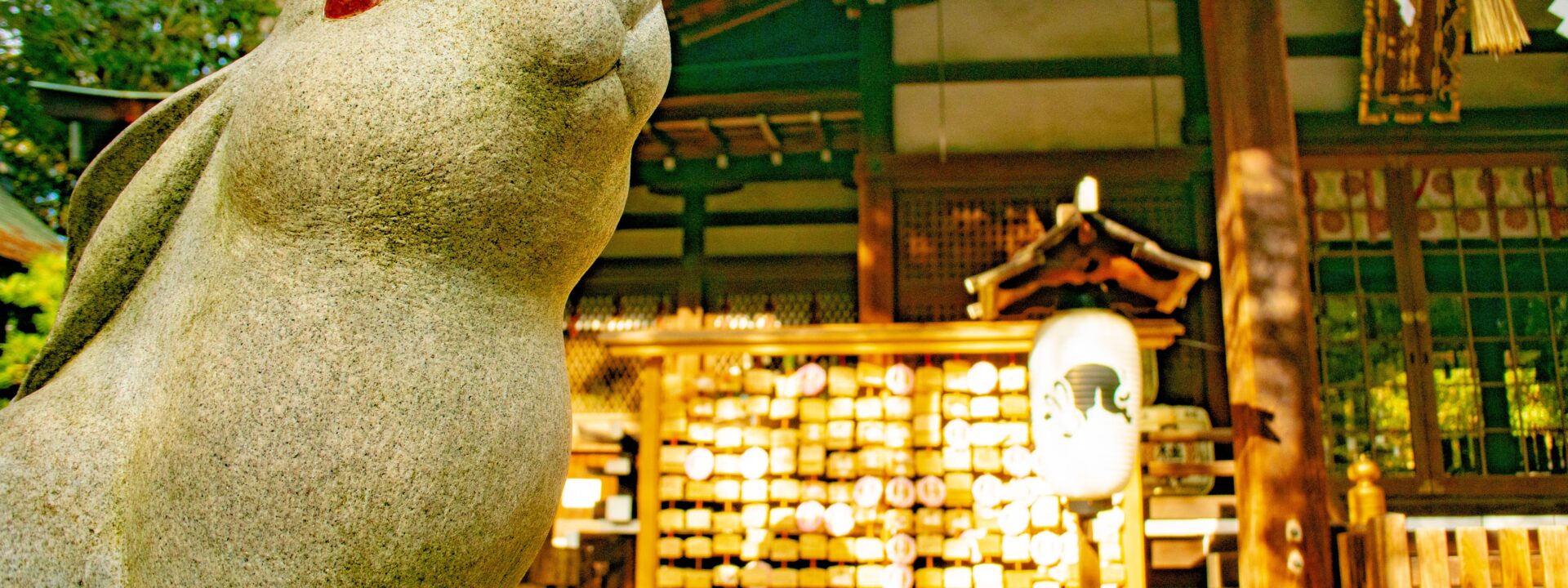
Far from the neon streets of Tokyo and the harsh fluorescent lights of the Atlanta hospital I had grown to resent, Kyoto’s soft morning sun wrapped around me on a chilly November day. My husband and I found ourselves at Okazaki Shrine, nestled in the serene Northern Higashiyama district. This lesser-known Shinto shrine hadn’t been on our itinerary. We passed quietly through its stone torii gate—the threshold into sacred space—and were immediately surrounded by its guardians. Okazaki Shrine is dedicated to fertility and childbirth, watched over by countless rabbit figures: pink concrete, ceramic, stone, even hand-painted on rice paper lanterns. As this gathering of spiritual messengers welcomed us, I reluctantly reflected on how we had come to be here.
Eight months earlier, over pierogies at our local spot on an ordinary evening, my husband Eduardo received a call. Blood work from a routine physical showed his white blood cell count was dangerously high. “It could be a lab error… or leukemia,” the on-call doctor murmured, urging us to the ER. Within hours, he was admitted with a rare type of non-Hodgkin’s lymphoma. The weeks that followed were filled with bone marrow biopsies, PET scans, and tests that left us physically and emotionally drained. Then came another harsh reality: if we wanted a family someday, the path wouldn’t be simple. We had to act fast to preserve our options before treatment that could harm fertility began. Our only choice was IVF.
Less than eighteen months into our marriage, we knew we wanted a child someday but naively assumed it would happen naturally. That assumption, like all our plans, seemed to vanish overnight. My mind raced between two paralyzing fears: losing Eduardo, and never having a child with him. Amidst endless medical appointments, we underwent carefully timed procedures. Through daily injections, I clung to the hope that once this nightmare was over, it would be our turn to be parents. But after zero embryos, that hope proved fragile.
I breathed my first sigh of relief in weeks when Eduardo qualified for a clinical trial using targeted immunotherapy instead of standard chemotherapy. His treatment began, and with it, so did my fight against our infertility. I spent countless hours beside him during long infusions, emailing fertility specialists and scrolling through every online forum I could find. But as his treatment wore on and exhaustion set in, I began to wonder whether the answers I was chasing would change anything at all.
We felt farther from having a family than ever, yet slowly, Eduardo’s health improved. I began to see that even in grief, hope wasn’t just possible—it was necessary to get us through each day. Before the diagnosis, when the future felt wide open, I thrived on spontaneity, especially in travel. I needed a reminder that life could still hold unexpected joy. That reminder came as a dream trip to Japan. Grateful for his doctors’ approval, we both longed for this journey to reconnect with the people we used to be—joyful, optimistic, excited for what lay ahead.
As soon as we landed at Haneda Airport, Tokyo’s electric energy revived us. From Tsukiji Market to Michelin-starred sushi counters, we savored smoky grilled unagiWe savored melt-in-your-mouth eel nigiri and the sweetest candied strawberries. In Harajuku, we met up-and-coming designers, browsed luxury consignment boutiques, and were delighted by an unexpected run-in with friends from home. It ended in a tiny karaoke room, where we gripped a gold microphone and belted out Katy Perry: “You and I will be young forever.”
From Tokyo, we headed to Kanazawa, often called “Little Kyoto” for its well-preserved samurai and geisha districts. We settled into a slower pace, returning each evening to our minimalist sanctuary at Korinkyo, a former art gallery turned 18-room boutique hotel. Our days were spent immersed in the vibrant fall foliage at the D.T. Suzuki Museum and Kenroku-en Gardens, mostly keeping talk of cancer and children at bay.
That was our unspoken agreement—until we arrived in Kyoto and discovered the Okazaki Shrine. Many visit hoping for blessings for conception and safe childbirth, inscribing their wishes on small wooden plaques called ema. We found our own and wrote: “We pray for the blessing of one healthy child together to complete our family. We wish for restored health and to conceive.” We hung it in the perfect spot, and I watched as our deepest hope went out into the world—exposed, yet surrounded by so many others.
“It’s going to happen,” my husband whispered, pulling me close. In the stillness of the shrine, among the rabbits and the quiet dreams of others facing the same uncertain future, I allowed myself to believe it, too.
Frequently Asked Questions
Of course Here is a list of FAQs about the topic After a lifealtering diagnosis a trip to Kyotos fertility shrine gave me hope written in a natural conversational tone
General Beginner Questions
Q What is this story about
A Its a personal essay about someone who after receiving a serious health diagnosis travels to a specific shrine in Kyoto Japan and finds a sense of hope and spiritual comfort there
Q Which shrine in Kyoto is this about
A Its almost certainly referring to Jishu Shrine located within the famous Kiyomizudera temple complex Its one of Japans most wellknown shrines dedicated to love and matchmaking and by extension fertility and successful childbirth
Q Why would someone visit a shrine after a medical diagnosis
A A major diagnosis can make you feel powerless Visiting a sacred place can be a way to seek spiritual support find peace perform a ritual to feel proactive and connect with a tradition that offers hope beyond medical charts
Q Is this about replacing medical treatment with a spiritual visit
A No not at all The story frames the shrine visit as a complement to medical care Its about healing the emotional and spiritual wounds that come with a diagnosis not ignoring the physical ones
Deeper Advanced Questions
Q What kind of rituals or practices happen at Jishu Shrine
A Visitors often write wishes on wooden plaques buy charms for love or easy childbirth and try the Love Stones This involves walking with eyes closed between two stones placed 18 meters apart succeeding means youll find love
Q How can a place give someone hope in a practical sense
A Hope isnt always about a guaranteed outcome The act of traveling engaging in a centuriesold ritual and being in a serene beautiful place can create a mental shift It can reduce isolation provide a symbolic fresh start and rekindle a sense of possibility
Q Isnt this just a placebo effect
A In a way yes but that doesnt make it less valid The placebo effect is a real psychological and physiological phenomenon