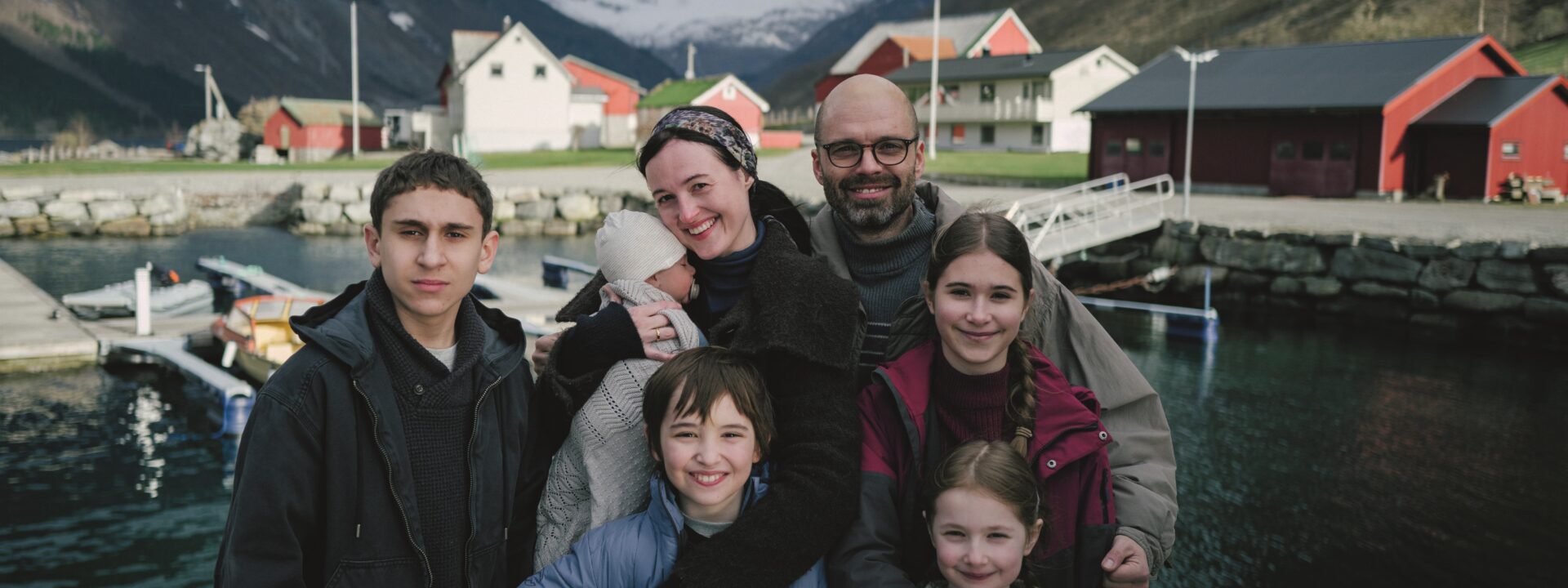
Romanian filmmaker Cristian Mungiu won the Palme d’Or in 2007 for his intense abortion drama 4 Months, 3 Weeks and 2 Days. Now he’s back with another difficult but necessary film: Fjord. It’s a story about immigration, hostility, and clashing cultures, set in a remote part of Norway. The film stars Oscar nominees Sebastian Stan and Renate Reinsve (from Sentimental Value). It’s fascinating, detailed, nuanced, and thorny—easily the best movie I saw at the 2026 Cannes Film Festival.
Read More: I Saw 24 Movies at the 2026 Cannes Film Festival. These Five Were the Best
By Radhika Seth
At the center of the story is the Gheorghiu family: Mihai (Stan, who was born in Romania), his Norwegian wife Lisbet (Reinsve), and their five children. After Mihai’s mother dies, they decide to move from Romania to Norway to be closer to Lisbet’s family. Mungiu and his talented cinematographer, Tudor Vladimir Panduru, frame the mountains, lakes, and picture-perfect houses of their new home with stunning precision. It feels like a fairy tale. The neighbors are warm and generous, the kids start making friends at school, and the family seems to have found their place.
But tension quietly builds beneath the surface. Lisbet is a nurse who cares for the bodies of the recently deceased. She’s told not to bring religion into her workplace, but as a devout Christian, she reaches out to a grieving woman, offering her phone number, a Bible, and an invitation to their church. Meanwhile, Mihai—an aeronautical engineer now working in IT because of the move—plays hymns on the piano, which raises eyebrows among his atheist coworkers. Their children pray and are strictly disciplined, but a new friend and classmate named Noora (Henrikke Lund Olsen) starts to bring out rebellious behavior in the two oldest kids, Elia (Vanessa Ceban) and Emmanuel (Jonathan Ciprian Breazu). The more the Norwegians learn about the Gheorghius, the more uncomfortable they become with their foreign ways.
Read More: Cannes Hit Club Kid Is a Heartwarming Riot
By Radhika Seth
One day, Elia comes to school with a red bruise on her face. Knowing her parents, her teachers assume they hit her. When asked if her parents ever get physical with her, she admits that sometimes they give her a slap on the bottom if she misbehaves.
Without hesitation, and in an eerily calm atmosphere, the authorities decide to involve child protective services. A police officer comes to talk to Mihai about how he punishes his children. In one of the most shocking, painful, and strangely serene scenes in the film, Lisbet is told that her children are being taken away for their own safety—not just Elia, but all five, including her baby, who is still breastfeeding. Reinsve’s face shifts from confusion to stunned terror as a Norwegian flag flutters in the wind outside the window behind her. She’s reminded that this is how the law works when it comes to child safety in her own homeland.
The scene where she’s separated from her baby is another masterclass in filmmaking. Mihai watches through a window that perfectly frames Lisbet placing the child into a car and staggering back as it drives away. You don’t see Stan or Reinsve’s faces, but every bit of their body language shows their complete heartbreak.
So the battle begins. Lisbet takes parenting classes, Mihai takes anger management courses, and they visit their children, who are now in separate foster homes across the region. The kids just want to come home, but a full investigation and trial must happen. When Lisbet asks about getting her breast milk to her baby, she’s told that the authorities will have to check with “the mother”—meaning the baby’s new foster mother.
Delays then push Mihai to take charge. He quickly involves the Romanian press, calling the case an example of religious persecution.Far-right protesters gather outside the trial, calling for the protection of traditional family values—and making an already terrible situation much worse.
Read More: A Twisted Emily in Paris Meets The White Lotus in Kristen Stewart’s Bizarre New Comedy
By Radhika Seth
Mungiu’s light touch is remarkable. We never see the alleged violence at home, and we’re left to decide for ourselves whether it happened or not, and to what extent. When past incidents come up in court—including ones we’ve witnessed—we struggle to remember every detail, word, and gesture, just like the Gheorghiu family. And the parents aren’t perfect either: we often see Mihai’s uglier side—he has angry outbursts, keeps answering questions for his wife, and has a stern, threatening presence. But does that mean he’s definitely abusive?
Stan is completely unrecognizable in this role—bald, bearded, hidden behind thick glasses, speaking gruffly in either Romanian or accented English, and oddly hard to pin down. It’s clear his children are afraid of him, and there are hints of instability that suggest he could be capable of what he’s accused of, but he also seems to deeply love and care for his family. The actor smoothly blends all these contradictions into a worn-down, introverted, and totally believable man you can’t help but support, even as you question his actions and motives.
Read More: Gillian Anderson Romances Hannah Einbinder in This Mind-Melting Cannes Slasher
By Radhika Seth
Reinsve is also excellent, with the polished shine of her characters in Sentimental Value and The Worst Person in the World stripped away to reveal a faded, exhausted mother pushed closer to the edge. Like Stan, her performance is mostly quiet, subtle, and internal, but its emotional impact is often overwhelming.
A subplot follows Lisbet caring for a neighbor’s troubled elderly father—it’s clear she’d do anything to protect him, and his family is grateful. But her devotion to this new community never guarantees their loyalty. It raises compelling questions about the idea of “the good immigrant,” at a time when anti-immigrant feelings and rhetoric are spreading across the US, Britain, and the world: Can someone who moves to a new place bring their culture with them? What happens when that culture is seen as clashing with the values of their new home? And where’s the line between practicing your faith in a place where it’s viewed with suspicion, and so-called religious extremism?
There’s a rare moment of heavy-handedness during the trial, when the couple’s lawyer hints at these issues a bit too directly, but mostly, these questions are raised without comment or judgment. One of the children’s new foster mothers testifies that the kids weren’t allowed to listen to modern music, dance, watch YouTube, play video games, or have their own phones. Is that cruelty or a parental choice? And what about the Norwegian parents we see around the Gheorghius, who also get angry at their kids and lash out, but face no consequences?
Fjord isn’t perfect—the first 40 minutes, though necessary, are a bit slow—but once the main story clicks into place, it kept me on the edge of my seat until the credits rolled. It’s a film that looks humanity straight in the eye, one you’ll keep thinking about for days and weeks, and one that’s sure to reward repeat viewings. In short, it’s a marvel.
Frequently Asked Questions
Here is a list of FAQs about the 2026 Palme dOr winner
Note As the 2026 Cannes Film Festival has not yet occurred this FAQ is based on a hypothetical scenario The answers are written as if the award has just been announced
BeginnerLevel Questions
Q What is the Palme dOr
A Its the top prize awarded at the Cannes Film Festival in France Think of it as the Best Picture award for international and arthouse films
Q Which movie won the Palme dOr in 2026
A The winner is directed by
Q What is about
A Its a drama about a young cartographer who discovers a hidden ancient map in a wartorn city The story follows her journey to reunite the map with its rightful owners while trying to survive the conflict
Q Is the movie in English
A No The film is primarily in French and Arabic with English subtitles
Q Where can I watch it
A It was just announced so it isnt widely available yet It will likely debut in theaters in late 2026 followed by a streaming release on a major platform in early 2027
Intermediate Questions
Q Why did win over the other contenders
A The jury praised its visceral storytelling and breathtaking cinematography They felt it perfectly balanced a deeply personal story with a powerful political commentary on borders and memory
Q Who was the director What is their background
A The director is a firsttime feature filmmaker from Morocco They previously won a Short Film Palme dOr in 2023
Q How long is the movie
A The runtime is 2 hours and 18 minutes
Q Is it a difficult movie to watch
A Its emotionally intense and deals with war and loss so it can be heavy However its not overly graphic or experimental Its more of a slowburn drama than an action film
Advanced ExpertLevel Questions