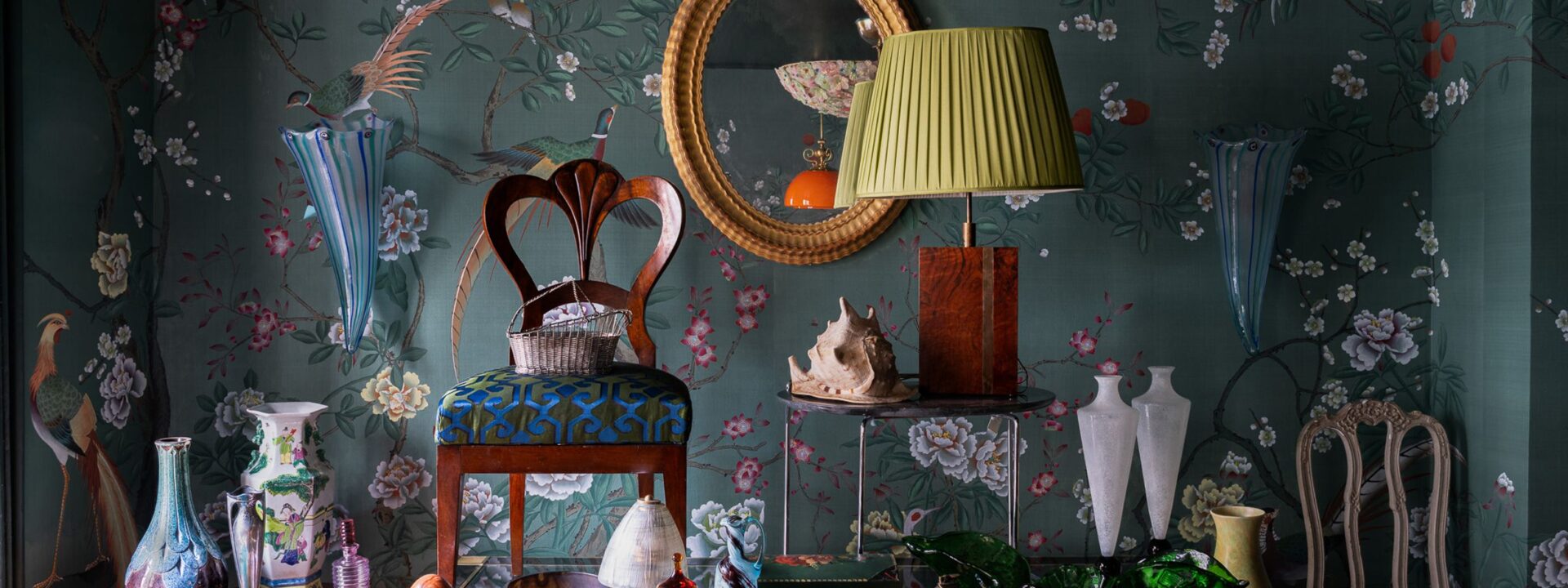
For the past five years, my remedy for the post-holiday slump has been a trip to Paris. Thanks to Paris Design Week, January has become my annual pilgrimage to my favorite city, where I soak up the latest in high-end design while immersing myself in French heritage and beauty. Thousands of interior designers and trade professionals flock to the capital for Maison & Objet—a showcase of furnishings and decorative objects held at a convention center northeast of Paris—and Paris Déco Off, a citywide event where the public can explore showrooms and historic locations to view new wallcovering and textile collections.
If you’re equally passionate about design, art, fashion, and history, I’d argue there’s no better time to visit Paris. This is especially true for fellow Francophiles who love the romance of it all—and who relish the chance to be a fly on the wall as doors to stunning, storied venues and hôtels particuliers swing open. This year, I found myself in a 1920s pagoda where Lelièvre’s latest collections glowed within a Chinese-lacquered interior; at L’Arrosoir, Paris’s oldest flower shop, where Little Greene launched garden-themed wallpapers; and at Galerie Kraemer, one of France’s oldest family-owned art galleries, which hosted an antique soirée complete with baroque court dancers against a backdrop of museum-quality furnishings from legendary collectors like Karl Lagerfeld and Jayne Wrightsman.
My home base for Paris Design Week was the Hotel Panache, a boutique hotel near the bustling Grands Boulevards. It offers convenience, style (think Fornasetti wallpaper and Diptyque bath products), and reasonable prices even during Paris’s busiest weeks. January also means les soldes—France’s biannual sales—so I saved every penny for favorite French brands like Tressé, Maison Guillemette, and Jonak. Plus, I never know what treasures I might find during a weekend trip to the flea market.
Day 1: 400 Years of French Culture, From a Countryside Chateau to Cutting-Edge Art
My week began on January 13, joining a group of designers and journalists to visit Château des Joncherets, a 1620 castle originally designed by Versailles landscape architect André Le Nôtre, about an hour and a half east of Paris. A handful of contemporary designers had reimagined the chateau’s first floor, which is undergoing a major renovation. As we enjoyed local wine and bites, I imagined how delicious future meals will be once the chateau’s vegetable garden is revived by farm-to-table visionary Alice Waters, who will also plant a branch of her Edible Schoolyard on site.
That evening, I returned to Paris just in time for the late-night hours at the newly reopened Fondation Cartier. Having studied abroad and visited Paris many times, I always prioritize temporary exhibitions and openings. While the institution showcases great contemporary art, I was especially drawn to Jean Nouvel’s architectural transformation of the foundation’s cavernous halls, once home to the 19th-century department store Grands Magasins du Louvre.
Day 2: Rive Droite Essentials, Art Deco Galore, and Antique Soirées
The next morning, I walked to Rue du Mail, one of Déco Off’s most vibrant streets lined with patterned lanterns, for two personal must-sees: Sahco and Samuel & Sons. Since leading Scandinavian textile purveyor Kvadrat acquired Sahco in 2018, the German fabric house has developed one of the market’s most interesting offerings, largely thanks to creative director Bengt Thornefors. Having co-founded the cult-favorite Swedish bed linen brand Magniberg and worked extensively in fashion design for houses like Saint Laurent and Acne Studios, Thornefors…Not only does he create some of the most unique color combinations, but his fabrics work beautifully for both furniture and fashion. Sahco’s presentations often reflect Thornefors’s background in fashion, whether by displaying fabrics on garment bags or draped over cowboy boots.
A few doors down, I visited Samuel & Sons, a family-owned passementerie company based in New York City. Their tassels, braids, borders, and fringe are everywhere in projects by the world’s top designers, many of whom collaborate with them on collections. This year, they launched the Romaunt collection with one of my favorites, Martin Brudnizki, who drew inspiration from the romance and artistry of the Pre-Raphaelites.
Not far from Samuel & Sons is the studio of Pierre Frey, who could be called the godfather of French textiles, wallpapers, and rugs. After walking through the Little Tokyo neighborhood—my go-to for treats like the matcha and red bean dorayaki from Tomo—I explored the company’s three new collections. What struck me most as I’ve delved deeper into the design world is just how extensive these collections are. While a fashion collection might feature 20 to 100 looks, design brands easily produce hundreds of designs (Pierre Frey especially) in countless color variations. The headline collection for 2026 is Jardin à la française, which ranges from abstract geometric patterns inspired by garden paths to charming prints based on Le Nôtre’s original sketches for the gardens of Marly and Versailles, held in France’s National Archives. Meanwhile, Mémoires Colorées grew out of a close friendship between Patrick Frey (who now leads Pierre Frey) and the Belgian artist and paper sculptor Isabelle de Borchgrave. Before her passing in 2024, they created a vibrant collection inspired by her artwork and studio, which was also recreated at one of Pierre Frey’s Left Bank showrooms.
I then packed my afternoon with three exhibitions near my favorite green space, the Tuileries Garden. Though it started at NYU’s Grey Art Museum, I was excited to see Berthe Weill: Art Dealer of the Parisian Avant-garde at the Musée de l’Orangerie, in the city where she made her name by championing artists as major as Matisse and Picasso. Next, I stopped by Gagosian’s Rue de Castiglione space, where Joseph Cornell’s New York basement studio—filled with curiosities—had been recreated in the windows. This project was a collaboration with Wes Anderson, who, like me, finds endless inspiration in Cornell’s whimsical shadow boxes that turn everyday materials into fine art. Though Cornell was fascinated by Paris and dedicated many works to the city, he never actually left the United States.
Speaking of wanderlust, I encountered one of my own travel dreams at the Musée des Arts Décoratifs, which might be my favorite museum in the world for its blend of art, design, fashion, and jewelry. While I expected the museum’s Art Deco exhibition to be filled with gorgeous 1920s objects, I hadn’t realized the entire first floor was dedicated to the Orient Express. For as long as I can remember, I’ve been captivated by the history of luxury travel—perhaps from my millennial childhood spent marveling at the Titanic’s interiors and coveting my Samantha American Girl doll’s epic steamer-trunk wardrobe. The revival of luxury train travel, especially the Orient Express’s own comeback, has quickly made stepping back in time aboard a timeless train a top bucket-list item for me. With its recreations of train cars past and present, plus a detailed look at the company’s materials and accessories, the MAD exhibition may be the closest I ever get to the real thing. As a lover of the world’s…I spent hours admiring the rest of the exhibition’s objects, from André Groult’s shagreen chest of drawers to Cartier’s Tutti Frutti jewels and Sonia Delaunay’s wearable art.
Paris is hosting several exhibitions for the 100th anniversary of Art Deco, including LV Dream, which feels like a more streamlined version of Louis Vuitton’s traveling Volez Voguez Voyagez exhibition—one of my all-time favorites. I never tire of the maison’s leather trunks, which magically transform into custom vanities and desks.
I ended my night at Galerie Kraemer, one of the most impressive antique shops I’ve ever visited, where almost everything is for sale (except the Marie Antoinette-era shoes, which I naturally had to ask about!). Jiun Ho, Shiir Rugs, and Lala Curio hosted an 18th-century-themed soirée in the gallery’s grand salons, where an artist sketched a quick portrait of me—the perfect memento of the evening.
Day 3: Adult Crafting, Pampering, and Hôtel Particulier Partying
Perhaps my best souvenir, however, was one I made myself. On January 16, I joined a mask-making workshop with Samuel & Sons, who were hosting a masquerade ball the following night at a Marais theater. A few years ago, when Samuel & Sons was renovating their New York showroom, I was invited to design a pillow using any of their trims. That’s when I realized I must have been a passementerie seller in a past life, so I knew getting to layer on trims in a new way would be a highlight of my week. I was especially delighted to see one of my favorite past fabrics—a blue and green jagged stripe by Sanderson x Giles Deacon—as a base option. With Art Deco plumed jewels in mind, I had the clever idea to flip a tassel upside down so the threads fanned out, creating my homage to Paul Poiret. The other participants were endlessly creative, and my mission to trim anything I can continues.
After several stops in St. Germain, a Déco Off hub, I officially reached the point where my feet and back were aching. I found relief at Calma Spa, where, after viewing new lighting and furniture from Iatesta Studio and California-based designer Kendall Wilkinson, I enjoyed a complimentary 30-minute massage—a brilliant PR move I hope becomes a Paris Design Week tradition! My night ended with cocktails at the treasure-filled home of antique dealer and decorator Jean-Paul Beaujard, who collaborated with Edmond Petit and Carpet Society on a line of floral textiles, wallpapers, and rugs. It was easily one of the most splendidly maximalist private mansions I’ve ever seen.
Day 4: St. Germain and Marais Mainstays, Plus a Divine Dinner
The next day, I returned to St. Germain to visit two British heritage brands: Liberty, which unveiled new wallpapers drawing from its archive of over 60,000 designs for its 150th anniversary, and de Gournay. While de Gournay typically turns its showroom apartment into a moody speakeasy, this year the space was an airy, shoppable antique shop—as always, the company’s hand-painted and embellished wallcoverings provided a dreamy backdrop.
Just upstairs is the utterly elegant Maison Leleu, founded in 1910 by Jules Leleu, who won the prestigious Grand Prize at the 1925 International Exposition of Modern Decorative and Industrial Arts. In 1969, the Shah of Iran commissioned Leleu to create 51 tent…The company created a vast installation to mark the 2,500th anniversary of the Persian Empire, but after three years, the bill remained unpaid, forcing the business to close. In 2017, Alexia Leleu, Jules’s great-granddaughter, revived the maison, blending original designs with occasional modern updates.
Next, I headed to the Marais to see an installation by Nordic Knots and interior designer Marie-Anne Derville at the Hôtel d’Hallwyll, designed by Andrée Putman. While in the area, I stopped by the Fondation Azzedine Alaïa to view the first part of a two-part exhibition showcasing the designer’s remarkable collection of over 500 Christian Dior pieces. I then visited the Victor Hugo house-museum for “Hugo décorateur,” an exhibition exploring the author’s passion for design, which beautifully complemented the preserved salons of his home. I was especially charmed by a dollhouse-like box Hugo built in the 1830s with his friend’s children. The evening ended with a formal dinner at the famed Hôtel Salomon de Rothschild, where Corey Damen Jenkins celebrated his new lighting collaboration with Eichholtz in grand Haussmannian style.
Days 5 & 6: Flea Market Finds, Private Archive Tours, and a Grand Palais Double-Feature
No trip to Paris is complete without visiting the flea markets. While I usually go to the massive Saint-Ouen market, this time I opted for the more manageable and affordable Porte de Vanves market, where hundreds of vendors line two streets with their wares—mostly bric-a-brac and small, portable items. My finds included a pink alabaster casket box on feet, a brass Art Nouveau hand mirror, and a vintage floral jacket by Emanuel Ungaro.
Later, I returned to Pierre Frey for a special private tour of their stunning archive. The guardian of the maison’s roughly 20,000 documents, fragments, and objects is the vibrant Sophie Rouart, who kindly pulled any styles I wished to see. (There’s a drawer for everything—lamé, chiné, moiré!) A standout was viewing a massive 18th-century woodblock with metal detailing for ultra-precise printing. In the archive, it’s clear how closely fashion, art, and design have always been connected—and with such endless inspiration, it’s no wonder Pierre Frey creates such extensive collections.
My last day in Paris was dedicated to museum exhibitions. The show I was most excited to see (and my favorite of the trip) was “Eva Jospin, Grottesco · Claire Tabouret, D’un seul souffle” at the Grand Palais, where each French artist had her own gallery featuring monumental works. Tabouret displayed life-size models and preparatory work for her six stained-glass windows for Notre-Dame Cathedral, a commission she won in 2024. While the choice of a contemporary artist has sparked debate, I was moved by the power and reverence in her thoughtful approach, and can only imagine how impactful the stained glass will be.
While Tabouret’s work envelops you in luminous colors, Jospin uses color more sparingly. Yet her cardboard creations are filled with magic and discovery. I’ve long admired Jospin’s work, but I’d never seen such range and mastery of her materials—primarily cardboard and thread—as in this exhibition, which featured over 15 works of various scales. It was a world away from the luxurious textiles and vibrant wallcoverings I’d seen throughout the week, but just as captivating. I’m always drawn to artists who build entire worlds, and I felt overjoyed…I felt lucky to experience two extraordinary worlds on my trip—those of Eva Jospin and Azzedine Alaïa. Jospin’s work was on display at the Grand Palais, while my final stops included the Palais Galliera. There, the exhibition Weaving, Embroidering, Embellishing: The Crafts and Trades of Fashion brought to mind the Met’s 2016 Manus x Machina, with its focus on craftsmanship and materials. I was especially moved by the collaboration with le19m, which highlighted the embroiderers, feather artisans, and other skilled makers preserving these traditions.
To round out my visit, I went to Galerie Dior to see more pieces from Alaïa’s collection—along with another stunning work by Jospin, a frequent collaborator with the house. Having seen Alaïa’s couture collection at the Palais Galliera a few years ago, it’s even harder now to grasp how one person could amass so many exceptional pieces of fashion history.
With every trip, I’m reminded what a privilege it is to witness such beauty. There’s a poetic cohesion that runs through everything I see in Paris, and somehow my wish list is never complete—but that’s the joy of it. No matter how many times I return, there’s always more beauty to discover.
Frequently Asked Questions
FAQs Why Every Francophile Should Experience Paris Design Week
Q1 What exactly is Paris Design Week
A1 Its a citywide festival celebrating contemporary design running alongside the famous MaisonObjet trade show It features exhibitions showroom openings installations and talks across Paris turning the entire city into a design playground
Q2 I love French culture but Im not a professional designer Is this event for me
A2 Absolutely While professionals attend its a fantastic event for any Francophile Its about experiencing the cuttingedge of French creativity aesthetics and lart de vivre in an accessible inspiring way
Q3 How is this different from just visiting Pariss museums and classic landmarks
A3 Its a living breathing snapshot of current French creativity You move beyond historical masterpieces to engage with todays designers see future trends and discover how modern French culture is evolving right now
Q4 What are the main benefits of attending
A4 Youll get to discover emerging talent see exclusive installations in beautiful venues understand future trends in decor and lifestyle network with creatives and see a dynamic modern side of Paris often missed by tourists
Q5 Where does it take place Is it just in one location
A5 Thats the best partits decentralized Events pop up in showrooms in Le Marais galleries in SaintGermaindesPrés concept stores historic mansions and even in the streets You get to explore diverse Parisian neighborhoods
Q6 When is it held and do I need tickets
A6 Its typically held in early September and January Many events are free and open to the public though some talks or exclusive showroom entries may require registration or an invitation
Q7 It sounds huge and overwhelming How do I navigate it
A7 Start by checking the official Paris Design Week program online Pick a neighborhood or theme and focus on a few key exhibitions Comfortable shoes are a must