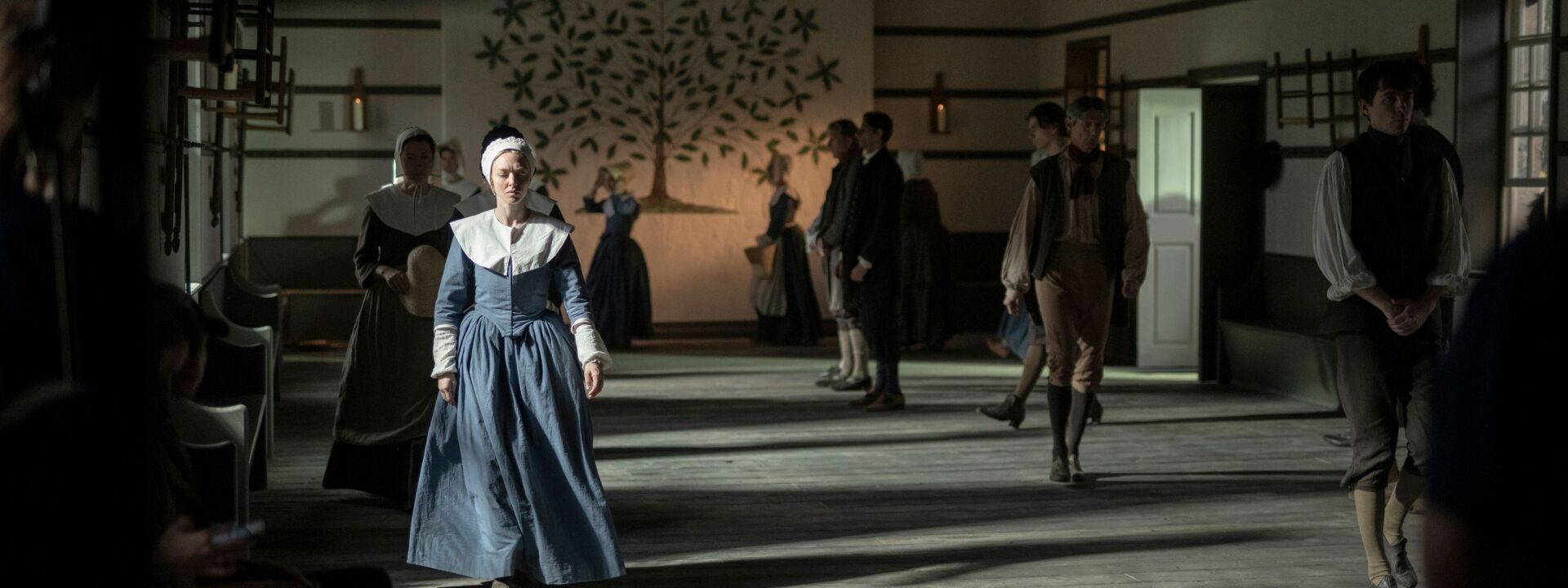
In Mona Fastvold’s The Testament of Ann Lee, a sweeping historical musical starring Amanda Seyfried as the titular, cult-like founder of the Shaker religious movement, you first encounter a vivid recreation of the grime and squalor of 1750s Manchester, England—from its churches and jail cells to its wool workshops. Next, you witness an 18th-century merchant ship battered by towering waves under flashes of lightning, its ensemble cast dancing and singing, soaked by rain, on the deck. Then, you see New York in the 1770s, its grid-like streets lined with Georgian civic buildings, and the wide-plank floors and decorative fireplaces of a middle-class home’s parlor. Finally, you observe the birth of the ascetic, minimalist architecture and furniture that remains the Shakers’ most enduring legacy, unfolding in a dazzling montage of timber being felled, hand saws carving elegant lines, and dust being swept from the finished pieces.
The creative force behind these vividly realized worlds? Sam Bader, who, despite an extensive background as an art director, 3D concept illustrator, graphic designer, and researcher, has only a handful of feature film production design credits—none matching the scale and ambition of Ann Lee. Yet it was precisely his wide-ranging expertise that made Bader the ideal person to recreate the early Shaker world. With the dizzying array of time periods, settings, and aesthetic styles required across the film’s multiple chapters, the project demanded every ounce of initiative and creative ingenuity he possessed.
And that’s without considering the constraints of an indie budget. As you might expect, major studios weren’t exactly lining up to finance a musical about an obscure 18th-century religious leader, featuring an original suite of hypnotic, avant-folk songs and bursts of ecstatic dance. If only they’d had faith: The Testament of Ann Lee is one of the best and most blazingly original films of the year—and its mesmerizing production design is among its crowning achievements.
Here, Bader speaks with Vogue about the extensive research behind his designs, the story behind that breathtaking ship sequence, and why the Shaker aesthetic still resonates today.
Vogue: To start at the beginning, how did this project come to you? Did you already know Mona?
Sam Bader: Going way back, Mona needed a production designer for a teaser, much of which later ended up in the film. It was actually Andrew Morrison [the film’s producer] who brought me on. We shot in Massachusetts in the dead of winter in January 2024. I jumped in and designed this two-day shoot at the Shaker Village there, transforming everything back to the 18th century. Honestly, I didn’t know much about the project at the time, but I found Mona’s energy and style infectious, so I read the script. Then I did what any good designer does: I built out a reference bible for every set, had a few meetings with her, and was hired in May before diving right in. It was my first time working with Mona, my first time designing on this scale, and my first time designing in Europe—or anywhere outside the U.S., for that matter.
Vogue: It sounds like an exciting but daunting task—just the sheer scale of it, and what you had to achieve on a fairly limited budget. Plus, the Shakers are best remembered today for their furniture and architecture, which could invite close scrutiny. Did that make you nervous?
Bader: I was probably too pumped on adrenaline and excitement to fully dwell on the nerves, but they were there. It’s true: The Shaker aesthetic, the architecture…The furniture is so well-documented. Selecting the best pieces, moments, and shapes to represent something so expansive—and quite uniform in many ways—was intimidating. Then, adding visual variety and intrigue was also daunting. On top of that, getting the functionality of the settlement and its spaces right was crucial—truly understanding how people lived, what they owned, what those objects meant to them, and how they displayed them. Much of that insight came from a relatively short but intense research process.
What kind of things were you looking at?
I studied many of the Shakers’ own paintings, village views, and Gift Drawings. I also looked at the plein air painters who were becoming more common at the time. While Bruegel and the Dutch tradition were earlier influences, I focused on Joseph Derby, Paul Sandby, William Hogarth, and Francis Guy—all those American and British painters who depicted everyday life. They provided a huge contextual roadmap. But translating that into something authentic, rather than heavy-handed or obvious—finding the subtlety while keeping it visually clear—was very challenging.
I read that you worked closely with Mona for quite a while before production began, often at her home in New York. What was that period like?
Mona had a strong conceptual and broad visual idea of what she wanted these worlds to be: from Manchester, to the passage to North America and the New World, and finally the Shaker settlement. She’s very responsive and quick to recognize what works and what doesn’t, so much of that was worked out early. Our director of photography, Will Rexer, would often join us. We had dinner at Mona and Brady’s house almost weekly, and even more frequently when we were deep in preparation before heading to Budapest. I created quick hand drawings, Photoshop mockups, and light 3D models to outline what we needed to build—what had to be fixed and unchanging, versus what allowed more flexibility and improvisation. It was a tight collaboration, which made scouting a much smoother and faster process—essential given our prep time and the amount of scenery we had to produce.
I also read that you found a really amazing, versatile location in Hungary that you used for multiple settings. How did you discover it?
I had been scouting for two or three days with our fantastic art director, Csaba Lodi, and everything we found was proving to be very time-consuming and costly due to the travel required. We were in the van when Csaba had a sudden idea, and we changed course to visit this nearly unfilmed farmstead. It’s an early 19th-century, semi-state-owned property about 40 minutes outside Budapest. We saw the main estate and immediately thought, “This is perfect for a Manchester merchant-class room—not too grand, not too humble.” It also had a great facade and a good dirt road leading to it. Within the same estate, we found a room that was…It was a great starting point for creating the colonial-era Georgian mullions and panel molds we needed for New York. And as if that wasn’t enough, we walked through a thicket into a clearing and found this expansive field with an old three-story barn or granary. When we stepped inside, we thought, “This is perfect for the Lee family home and all the textile workshops.”
At that point, we felt it couldn’t possibly get any better, but we wanted to explore further. A few hundred yards away, there was an unassuming concrete dumping area filled with old farming equipment and junk. I took a leap of faith and thought, “If we could remove every non-load-bearing wall in here, there’s a fantastic vaulted wooden ceiling—we could transform this into the meeting house.” That was one of the more ambitious parts of the design, especially given our timeline and the challenge of achieving those perfect Shaker proportions, materials, and details. When we saw that spot, Mona put her hand on my shoulder and said, “I think we’re going to be okay.” [Laughs.]
The meeting house looks so striking on screen. What was the inspiration behind the tree motif painted on the back wall?
Honestly, I’d need to revisit the script to recall if that was originally part of the film—I want to be careful. But I remember Mona really fell in love with that motif. At Hancock Shaker Village, there’s a massive, beautiful 600-year-old tree that towers over even the tallest buildings. I took a photo of it with a medium-format film camera, and I loved that image. It might be a stretch to say it directly inspired the motif, since trees are so common in Shaker art. But while we stayed true to Shaker reality in the spaces and architecture, we allowed ourselves a few deliberate flourishes, and that was the biggest one. It’s gorgeous—so simple yet brilliant. Not featuring it prominently would have felt like a huge loss. Mona and I both agreed on that. Also, if I recall, Ann Lee’s final scene is in the apple orchard, so it ties into the broader Shaker ethic of harmony with nature.
You mentioned this earlier, but the film spans a wide range of settings: 1750s Manchester, the ship, New York a few decades later, and finally the Shaker settlement. How did you make each environment feel distinct, especially when many of these worlds coexisted in the same location?
It was challenging—it would be arrogant to say otherwise. Creatively, we all knew Manchester needed to feel warped, rectilinear, and chaotic, with people living on top of each other and life spilling into the streets—a vision inspired by Juraj Herz, with chickens being plucked and meat hanging in the open air. It also drew from William Hogarth and his contemporaries.
For the ship, Mona described it as “just a big horizontal line, blue and open,” and during our interview, that was a moment where I thought, “We’re speaking the same language.” Then, in New York, the palette shifts from burgundies and olives to a spectrum of browns and chalkier tones—a Hammershøi-like palette—where everything feels freshly sawn and painted. That felt very cohesive. I also designed much of it with the Shaker palette and aesthetic of the final section in mind.
When I first saw…Watching the film, I found the scenes on the ship especially mind-boggling—the fact you were able to achieve such a sumptuous and convincing set piece on your likely budget. Was that a replica of an 18th-century ship you found in Stockholm?
We’d been considering ship options from the start and eventually settled on the Gothenborg in Sweden. We cleared it out completely with the conservator and set up all the netting, hammocks, and trunks. Even though it’s shot in a candlelit, shaky style, it was a fully dressed set—we weren’t hiding anything—which gave Mona and Will much more freedom of movement. Then we had two teams, one from Belgium and one from France, come in to get all the sails up in time, which was another saving grace. They were beautifully recreated sails with hand-stitching and everything—just brilliant. For the flooding on the lower decks, we built a wooden structure on a backlot, re-clad it, installed a lot of scenery, and fully dressed it. Then we constructed an SFX flooding tank around it so we could get that amount of gushing water seeping through every crack. The miniature for the wide shot of the ship in the storm was done by our matte painter, Lee Took, who also does miniature work. He recreated the wind and rain. That was a huge achievement from the whole team.
The sequence where they’re constructing the Shaker settlement was pretty breathtaking as well, especially paired with Daniel Blumberg’s incredible score. I think I got chills watching it all come together—I can only imagine how fulfilling it must have been for you to see that for the first time.
I have to say, the moment I knew beyond a shadow of a doubt that this film really worked—or that my work was doing its full job—was when we saw an early assembly with everyone in New York at the time. I like to think I have a critical eye, and of course, I made all those sets with the team and knew how everything was done. But during those montage sequences, I genuinely had a couple of moments where I thought, “Wait, when did we do that? Was that in Massachusetts or Hungary?” That was a real goosebumps moment. I also have to shout out another gentleman named Michael Burry, who came from Plymouth, Massachusetts, when we were shooting at the Hancock Shaker Village. Initially, I was trying to source period woodworking equipment—scribes, felling axes, squaring axes, all these arcane old things only about 100 people know about anymore. I was put in touch with him, and he has a PhD in period timber framing. He was even called in to help with the restoration of Notre Dame after the fire—a total unicorn-type person. You actually see him in the movie, felling the tree with Lewis Pullman and squaring off the posts. He was a huge help. But all of it coming together like that was just alchemy. It really feels like we built a village.
There’s been something of a revival of interest in Shaker furniture within the design world over the past few years. As someone who’s spent so much time immersed in researching their work and recreating that aesthetic, what is it about them and their approach to design that makes them feel so relevant today?
There’s no one answer, I think. When I see some of the more iconic Shaker furniture shapes, I see something undeniably unique and singular. Yet, I think the other side is that they took many existing forms and methods and made something new from them. When you see it, there’s something familiar but also unusual about it. I think that’s why it endures—or at least that’s the answer that comes to mind.
After spending so much time in their world, did any aspects of their design philosophy rub off on you at all? Did you get home to New York and…Have I started putting pegs up on the wall? Well, between work and family, I’ve been either traveling or very busy since then. But I do have the pegs sitting in a wooden box, and I have some of the rails too. So by the time I get back next spring… we’ll see. The practicality of it all—and how they manage to find a place for everything and keep everything in its place—is really appealing. It’s definitely rubbed off on me.
Frequently Asked Questions
Of course Here is a list of FAQs about the Production Designers work on The Testament of Ann Lee designed to sound like questions from an interested audience member or film student
Beginner General Questions
1 What exactly does a Production Designer do
A Production Designer is the head of the art department They are responsible for the overall visual look and feel of the filmthis includes every physical thing you see on screen that helps tell the story and create the world
2 Why is the Shaker world of the 18th century so important to this film
The Shakers were a unique radical religious community Their world of extreme simplicity celibacy ecstatic worship and ingenious craftsmanship is central to Ann Lees story The films visual environment isnt just a backdrop its a character that defines her struggles beliefs and legacy
3 How did you start your research for this project
We began with primary sources visiting preserved Shaker villages like Hancock Shaker Village and Sabbathday Lake studying their furniture and architecture and reading their journals and spirit drawings We also looked at paintings and records of 18thcentury rural England and America to understand the broader world they lived in
4 Was everything built from scratch or did you use real locations
We used a combination We filmed in some authentic preserved Shaker spaces for establishing shots and atmosphere However for the intimate and dramatic scenes especially those involving the early rougher periods in England we built extensive sets on soundstages This gave us control over lighting camera angles and the wearandtear needed for the story
Advanced Technical Questions
5 What was the biggest challenge in recreating an authentic 18thcentury Shaker aesthetic
Avoiding the museum exhibit feel Shaker design is famous for its beauty but in the 18th century it was about pure function and devotion Our biggest challenge was showing that livedin realitythe dirt floors the smoke from hearths the wear on hand tools and the stark contrast between their pristine meeting rooms and their humble living quarters We had to degloss the familiar Shaker image