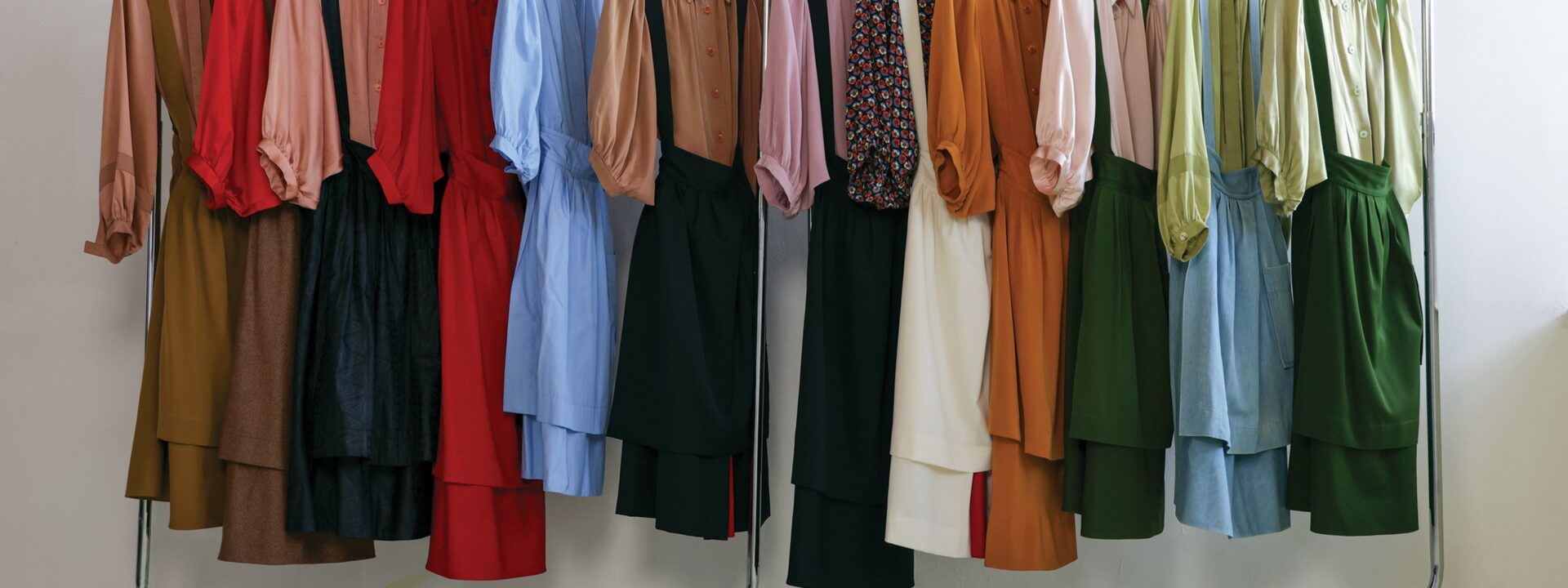
An artist’s outfit can send any number of messages. Georgia O’Keeffe, in her austere blacks and whites, created a seemingly deliberate, stark contrast with the cloudy, pastel-toned washes of her southwestern paintings. Picasso, in his jaunty Breton stripe, echoed the ten homme en tricot rayé canvases he made while living in the small French seaside town of Royan. Photographer Bill Cunningham pedaled through New York City in his French sanitation worker’s uniform—a minimalist, utilitarian jacket that allowed him to disappear behind his camera, itself a fashion statement.
If you’ve walked the streets of Manhattan for enough years, you might have caught a glimpse of another artist in a signature ensemble. For about two decades, the multidisciplinary artist Taryn Simon has worn a simple skirt that hits just below the knee, held up by two substantial suspenders, with a three-quarter-length, slightly balloon-sleeved blouse beneath. There are variations—different weights and materials—as well as evolutions. A few years back, Simon, who made the first of these outfits herself but has since hired a seamstress, added aprons with deep, wide pockets—large enough to hold a coffee thermos—and providing spare material to open a grimy door handle, a boon for germophobes, she jokes when I meet her in the studio of her friend, the photographer Thomas Dozol. Here, dozens, maybe hundreds, of these outfits in an array of colors and tones have been removed from Simon’s bedroom closet and arranged on racks.
Simon’s initial consideration was practical: much of her work is photographic, and she needed pockets for her light meter and her wallet. (She used to tuck the latter into a boot: “I never wanted to carry a bag.”) But there was a deeper consideration as well—to present herself respectably, to show consideration without excessive formality. Some of Simon’s best-known work—portraits of men exonerated from crimes by DNA evidence, for instance, or photographs of Ukrainian orphans—seems to call for an air of composed respect. When she thinks about what has happened to these outfits, she thinks about “the world leaders they’ve stood in front of.” The writer and illustrator Juman Malouf, a friend from when Simon was an undergraduate at Brown University, tells me she had a uniform even then—”very different from the one she wears now: a pair of electric blue leather pants and a black tank top.” This one, says Malouf, “will be the outfit she wears when she is one hundred. She will be buried in it.”
Simon was raised in New York by a mother who made almost all her clothing. At the studio, she pulls out a large Tupperware stuffed with handmade children’s clothes—felted toddler tent dresses and tunics with bright red pockets and matching buttons. They look like patterns the Swiss artist Sophie Taeuber-Arp might have devised if she did a collab with Marimekko—blocky, joyful designs. Simon’s grandmother was an excellent seamstress as well, able to pull off intricate smocking and lace embellishments, and her great-grandmother was an accomplished quilter. Simon learned to sew from her mother, and growing up, the two would make regular pilgrimages to Joann Fabrics. (When the fabric chain closed its physical stores in 2025, Simon and her mother held a mourning ceremony.) Nothing was thrown away in the Simon household, and whenever a functional object could be made more beautiful—a box to hold papers, for example—it was. “It contributed to how I see value,” Simon says. “I like to feel that I’m in something with heart in it.”
This September, Simon will take over the entire rotunda at the Guggenheim with a single project—her largest exhibition to date, about a decade in the making, and the largest debut of new work ever staged at the Guggenheim—titled Taryn Simon: Father Country, I Do Love You. “It’s the story of one man, and everything he toucheShe tells me that the man is an unnamed federal agent whose life will be shown in 42 separate artworks, each one hinting at the ripple effects of his actions. The exhibition, which includes text, photographs, video, and sculpture, is dedicated to Simon’s father—a restless man who lived all over the world and was diagnosed with Alzheimer’s several years ago, before Simon felt she fully understood his story. “The exhibition covers a wide range of themes and topics,” says Nat Trotman, the Guggenheim’s curator of performance and media, “but at its heart it’s about how one person’s life—any of us, really—touches so many others, opening up a universe of stories.” Much of Simon’s work follows this pattern: deeply personal yet strongly political, with figures placed starkly against a blank wall, conveying entire belief systems, historical events, or nationalist myths. In 2016, she filled the Park Avenue Armory with professional mourners from around the world to perform the traditions, rituals, and ceremonies of loss—a striking installation that turned grief outward and made it monumental, while also inviting quiet, sacred reflection. As she packs away the childhood clothes she has brought to the studio, Simon calls me over to see a single apron with a name embroidered on it. One of the mourners made it for her—a quiet sign of her art finding its way into what she wears.
Frequently Asked Questions
FAQs About Taryn Simons Uniform
What is Uniform by Taryn Simon
Its a series of photographs of flower arrangements that were displayed at major political and economic signing ceremonies around the world Simon recreated each arrangement based on archival photographs of the original events
Waitthe flowers are the subject
Yes The flowers are the centerpiece but the real subject is the ceremony the power behind it and the gap between the public image and what actually happened
Where does the title Uniform come from
It refers to the standardized look of these arrangements across different countries and decadesa kind of visual uniform that signals official importance regardless of the events politics or consequences
Why did she choose these specific flowers
She matched the species colors and composition to the original bouquets seen in press photos of each signing The goal was accuracy not artistic license
What events are depicted
Signings of treaties trade deals and agreementssome famous some obscurespanning from the 1940s to the 2000s Examples include the Camp David Accords and various IMF OPEC and armscontrol agreements
Is this part of a larger project
Yes Uniform is one component of Simons Paperwork and the Will of Capital which also includes stacks of paperweights and a paperwork archive
Whats the main idea behind the work
It explores how power is staged and remembered The flowers are beautiful and temporary while the agreements they framed often had lasting sometimes devastating consequences
Why flowers instead of the politicians
By removing the people Simon forces us to focus on the ritual and aesthetics of powerand on what the official image leaves out
Are the photographs in color
Yes theyre largeformat color prints highly detailed and almost seductive in their beauty
How is the series displayed
Usually as large framed photographs often accompanied by captions listing the event date location and flower species
Whats a common misunderstanding about the work
People often think its just about flowers or botany Its actually about politics history and the construction of official memory