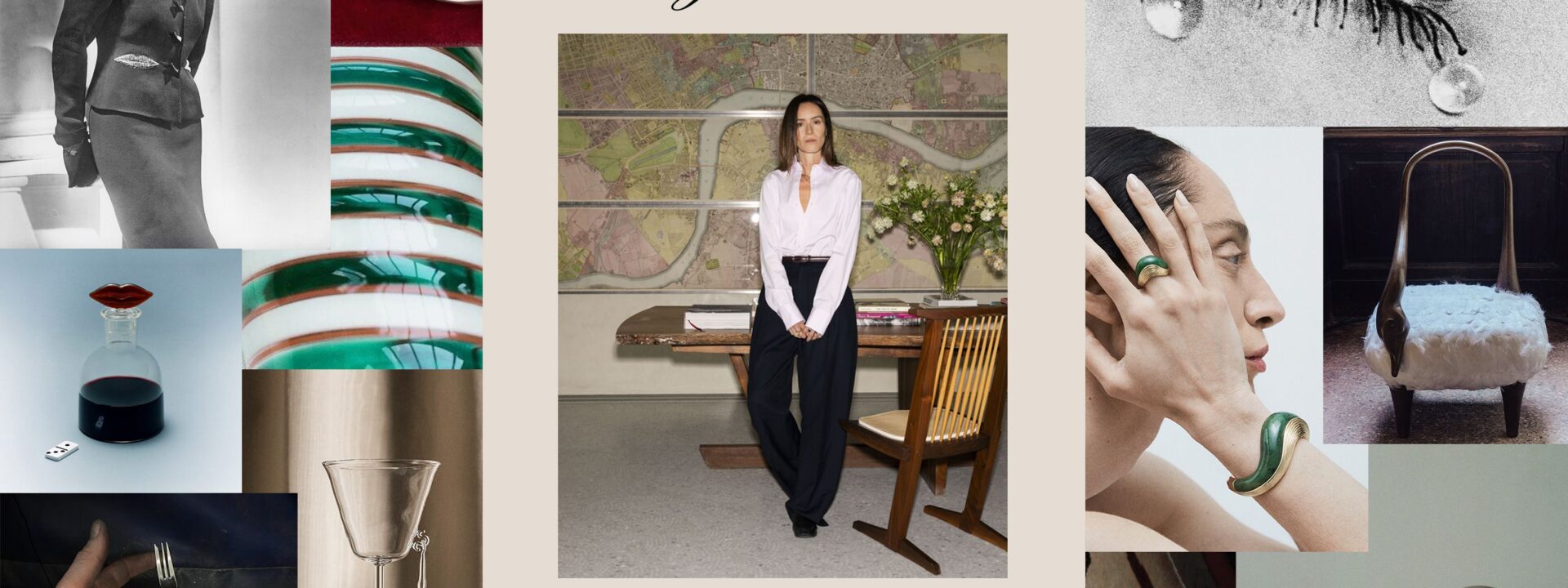
Eagle Eye exists to explain the gaps—between how we dress and how we live; between the spaces you’re drawn to and the coat you keep reaching for. Each month, London-based designer and creative director Alex Eagle will bring in her network of friends and experts to explore the “why” behind a certain theme—why we’re drawn to certain things, and how those instincts quietly build up over years without us really noticing. It’s a column rooted in interior design, with many branches (and, of course, a curated selection of shoppable products too).
The first time Surrealism made sense to me, I was quite young. Dalí’s melting clocks, which I came across in a book or on a classroom wall, did something that purely abstract art never quite managed: they let me in. So precise, so real in their detail, and then completely, quietly wrong. It’s reality with the dial turned just slightly, and honestly, I’ve never really gotten over it. The Venice Art Biennale opened this month under the theme “In Minor Keys,” curated by the late Koyo Kouoh. It’s a theme that’s intimate, poetic, and quietly unsettling—for me, that’s enough to send my mind back to Surrealism.
The term was first coined in Paris in the 1920s, when the poet André Breton published his manifesto calling for art rooted in the unconscious—dreams, desire, irrationality—as a revolt against the order that, in his view, had led Europe to disaster. The movement that followed produced some of the most striking images in art history: Dalí’s melting clocks, Magritte’s bowler-hatted men, Meret Oppenheim’s fur-lined teacup. Its relevance has never felt more immediate than it does right now, in an era of constant optimization and algorithm-approved wardrobes. As Egyptian designer Laila Gohar, whose objects and table settings are among the most Surrealist-inspired pieces being made today, puts it: “Minimalism and quiet luxury is just bloody boring. People want things with a pulse again.”
If modernism, which I wrote about last month, gives you permission to edit, Surrealism gives you permission to dream. Delfina Delettrez, a jewelry designer whose works sit somewhere between the body and the subconscious, describes it as “desiring without logic—allowing instinct, obsession, memory, contradiction, humor, sensuality, and fantasy to enter the room.” Marie-Louise Scio, CEO and creative director of Il Pellicano and one of the most instinctive collectors I know, puts it more simply: “Surrealism opens the door to emotion, fantasy, and the unexpected.”
Which brings me back to Venice and to Peggy Guggenheim, whose house on the Grand Canal feels less like a museum and more like a layered, slightly eccentric collage. What I find so compelling about her world is how un-precious it feels: art not kept at a reverent distance, but lived with, brushed past on the way to lunch, set slightly askew if that felt right. That quality is what I look for now in the things I buy and the spaces I create, and I’m not alone. Gohar owns a giant silver teapot that is, she freely admits, completely unusable: too dramatic to pour from, too beautiful to put away. “I love objects that seem functional at first and then slowly reveal themselves as emotional instead,” she says. “A home should not feel so uptight.” In the end, what Surrealism offers is the freedom to hold contradictions without needing to resolve them. Not everything needs to add up. Venice, this month, feels like exactly the right place to remember that.
Shop Alex Eagle’s Guide to Surrealism:
– The Spiral Earrings: Lié Studio Ruby earrings, $300
– The Hypnotic Coasters: Sophie Lou Jacobsen spiral coaster set, $75
– The Sculptural Trousers: Alaïa triangle gabardine pants, $1,900
– The Squiggle Rug: Nordic Knots Walled Garden, $1,195
– The Fun Flatware: Lazy Jamie spiral set, $42
– The Sensory Scarf: Prada printed silk skinny scarf, $295
– The Lipstick Candle: Fornasetti Se Poi Frutto Proibito candle, $330
A Study in Juxtaposition
The easiest way into Surrealism is also its most basic principle: taking somethingTake something completely ordinary and put it somewhere it has no logical business being. A lobster on a telephone, a fur-lined teacup, a bunch of sheep in the living room. That sense of wrongness, that little jolt of recognition, is where the pleasure lives.
Start with one thing on a table or shelf that makes someone stop mid-conversation. That’s how Surrealism enters everyday life—for example, a lemon squeezer that shows up on your kitchen table as three silver swans. Gohar World’s stainless steel design is both fully functional and completely absurd; it’s the kind of object that makes the person standing next to you at the sink do a double take. Or take the Sospesa hand-blown wine glass, with a stem so delicate and a balance so unlikely that every time you reach for it, you half expect it not to be there. “There’s a return to appetite and humor and distortion,” says Gohar.
Save to wishlist
Save to wishlist
Agustina Bottoni
Sospesa wine glass
$150 THE OBLIST
Save to wishlist
Save to wishlist
Gohar World
Trio lemon squeezers
$118 FWRD
$118 GOHAR WORLD
Save to wishlist
Save to wishlist
Victor Roman
1970s surrealist bronze daybed
$53,331 1STDIB
Save to wishlist
Save to wishlist
Loewe
Panta Amazona 31 cropped bag
$5,200 LOEWE
Save to wishlist
Save to wishlist
Junya Watanabe
Pleated polka-dot midi skirt
$760 NET-A-PORTER
Save to wishlist
Save to wishlist
Isamaya
Core Palette 2.0
$110 ISAMAYA
Save to wishlist
Save to wishlist
Leo Costelloe
Serving fork
Shop at LEO COSTELLOE
Save to wishlist
Save to wishlist
Nordic Knots
x Eagles + Hodges Walled Garden rug
$1,195 NORDIC KNOTS
Dream State Designs
“Surrealism opens hidden doors,” says Delettrez, whose work plays on the dreamlike state of accessing a different world through mesmerizing shapes like swirls and spirals. “It lets instinct, obsession, memory, and fantasy walk into the room.” After all, a swirl is kind of the shape of a dream itself. What better way to bring that movement home than with pieces that take this form?
You find it everywhere once you start looking. For the table, there’s the hand-blown Encalmo glass tumbler, its body threaded with ribbons of color that spiral through the glass as if caught mid-swirl. In jewelry, Lié Studio’s Ruby earrings do something similar: three descending discs, each one a pressed concentric spiral, worn against the body like small hypnotic objects.
Save to wishlist
Save to wishlist
Alex Eagle
Short encalmo glass
$275 ALEX EAGLE
Save to wishlist
Save to wishlist
Tiffany & Co.
Small Bone cuff
$2,100 TIFFANY & CO.
Save to wishlist
Save to wishlist
Lazy Jamie
Upward spiral flatware set
$42 LAZY JAMIE
Save to wishlist
Save to wishlist
Gohar World
Cocktail pick set
$130 NET-A-PORTER
Save to wishlist
Save to wishlist
Surrealist day bed
$6,615 1STDIB
Save to wishlist
Save to wishlist
Lié Studio
The Ruby earrings
$300 NET-A-PORTER
Save to wishlist
Save to wishlist
Sophie Lou Jacobsen
Spiral coaster set
$75 SOPHIE LOU JACOBSEN
Save to wishlist
Save to wishlist
Fernando Jorge
Stream Wave stone ring
$14,800 FERNANDO JORGE
Distorted Silhouettes
“Honestly, almost everything I live with is emotionally and aesthetically a little ‘off,’ in an interesting way,” says Scio. “My Gaetano Pesce vases are a perfect example. They feel almost alive in the room.” Dalí’s melting clock works because we know exactly what a clock is supposed to look like. The distortion only lands because the original form is so completely understood, and the same goes for fashion. Elsa Schiaparelli (who worked directly with Dalí) understood that a garment could hold the same logic—that clothes could carry a joke, too.
That tradition is alive in what’s being made right now. Alaïa’s triangle pants do something almost architectural, ballooning dramatically at the thigh before tapering to a precise, narrow ankle. It’s a silhouette that seems to defy the logic of how fabric should behave on a body. Bottega Veneta’s gathered jersey top takes a different approach—here, the fabric is twisted, knotted, and caught mid-movement, as if the garment is in the process of becoming something else entirely. These pieces borrow the Surrealist’s central trick.Start with something familiar, then push one element just far enough that the whole thing tips into a dream. “The beauty comes from freedom, from unexpected combinations—be adventurous!” says Scio. It’s a good reminder that proportion is a convention, not a law.
Save to wishlist
Save to wishlist
Gaetano Pesce
Pompitu II medium vase
$395 ARTEMEST
Save to wishlist
Save to wishlist
Bottega Veneta
Embellished gathered top
$2,650 NET-A-PORTER
Save to wishlist
Save to wishlist
Khaite
Marlow wedge mules
$1,180 NET-A-PORTER
Save to wishlist
Save to wishlist
Salvador Dalí
Glass bottles set
$733 CHAIRISH
Save to wishlist
Save to wishlist
Dries Van Noten
Croc-effect shoulder bag
$2,750 NET-A-PORTER
Save to wishlist
Save to wishlist
Loewe Eyewear
Cat-eye sunglasses
$490 NET-A-PORTER
Save to wishlist
Save to wishlist
Alaïa
Triangle wide-leg pants
$1,900 NET-A-PORTER
Save to wishlist
Save to wishlist
Toteme
Turtleneck sweater
$560 NET-A-PORTER
Sensory Exploration
Of all Surrealism’s recurring themes, the ones that have lasted the longest are also the most personal: the eye, the lip, and the body turned into an object, and the object turned into a body. That language is just as alive today as it ever was. Man Ray’s Eyeball print is one of those images that changes a room just by being in it. Similarly, the Carl Auböck bottle stopper—a glass eye set into a gold dome, staring up from the neck of a bottle—is functional, unsettling, and strangely beautiful.
This is what Surrealism understands about desire: It works through the senses first, and the mind second. Delettrez, whose entire body of work explores this territory with eyes cast in gold bracelets and anatomical forms set into rings, agrees. “Surrealism is about trusting symbols before reason. For me, it has never been about escaping reality; it’s a deeper form of truth.” In the end, that’s what all of these objects offer.
Save to wishlist
Save to wishlist
Man Ray
Eyeball photographic print
$44 ATOLLO PRINTSHOP
Save to wishlist
Save to wishlist
Prada
Printed skinny scarf
$295 PRADA
Save to wishlist
Save to wishlist
Fornasetti
Small Se Poi Frutto Proibito candle
$335 HARRODS
Save to wishlist
Save to wishlist
Delfina Delettrez
Grandma Eye bracelet
$778 DELFINA DELETTREZ
Save to wishlist
Save to wishlist
Salvador Dalí
Dali Eau de Parfum
$110 THE SCENT CITY
Save to wishlist
Save to wishlist
Carl Auböck
Face bottle stopper
$530 ABASK
Save to wishlist
Save to wishlist
Prada
Spring 2000 lip print skirt
$3,000 1STDIBS
Save to wishlist
Save to wishlist
Maison Balzac
Bisous decanter
$140 MAISON BALZAC
Frequently Asked Questions
Here is a list of FAQs about Surrealism as explained by art expert Alex Eagle
BeginnerLevel Questions
1 What is Surrealism in simple terms
Surrealism is an art movement that started in the 1920s Think of it as painting or writing your dreamsits about tapping into your imagination without logic or reason holding you back Alex Eagle describes it as the art of the unexpected
2 Who started Surrealism
The French writer André Breton is considered the founder He wrote the Surrealist Manifesto in 1924 which set the rules for the movement
3 Whats the difference between Surrealism and Dada
Dada was about being random and chaotic to mock society Surrealism as Alex Eagle points out is more focused on the subconscious mind Its less about nonsense and more about exploring hidden thoughts and dreams
4 Why are Surrealist paintings so weird
Theyre meant to be weird Surrealists wanted to shock you out of normal thinking Alex Eagle says they used automatism and dream imagery to bypass your rational brain and get straight to your emotions
5 Who is the most famous Surrealist artist
Salvador Dalí is the most famous His melting clocks in The Persistence of Memory are iconic But Alex Eagle reminds us that artists like René Magritte and Frida Kahlo are just as important
Intermediate Advanced Questions
6 What is automatism and how do you do it
Automatism is creating art without planning You just let your hand move freely Alex Eagle explains it as drawing while daydreaming You can try it by closing your eyes and scribbling then finding shapes in the lines
7 Did Surrealists only paint
No They made films wrote poetry made sculptures and even created furniture For Alex Eagle Surrealism is a way of thinking not just a style of painting
8 What is Surrealist humor
Its humor based