In 1935, German philosopher Walter Benjamin warned that mechanical reproduction would strip art of its “aura.” He argued that by allowing paintings and photographs to be endlessly copied, technology removed cultural objects from the unique times and places that gave them meaning. Half a century later, Andy Warhol’s factory turned this idea upside down. By mass-producing Campbell’s soup cans and Marilyn Monroe portraits, Warhol blurred the line between commerce and culture, suggesting that repetition and mass production could create their own kind of value.
Today, generative AI has taken both ideas to their logical extreme. Image creation is now limitless—anyone can produce a brand logo, campaign visuals, product photos, or editorial-style images in seconds. But if photography challenged the aura of the artwork, AI seems to challenge the aura of the image itself. Where Warhol imagined a factory of images, AI has made artificial production the norm, creating a crisis of memorability and meaning for brands.
Andy Warhol at his studio The Factory in New York, 1983, where he reimagined image reproduction as an art form. Photo: Brownie Harris/Corbis via Getty Images
“The bar for what counts as memorable has gone up, not down,” says Radek Wójcik, executive creative director at creative agency Made Thought. “Anyone can create beautiful things now, so beauty alone stops being a differentiator.”
Codifying brand values through distinctive logos, monograms, wordmarks, and campaigns is still essential—even though AI has dramatically lowered the cost of producing these assets, and most creative teams use the technology for storyboarding and campaign mock-ups, if not for the final images. But what remains hard to build is everything that happens after that image is created: recognition, trust, memory, and emotional connection. In this sense, AI has changed the economics of branding: execution has become abundant, but meaning has become scarce.
“The past is the last moat. Everything else is subject to imitation.” — Sean Monahan, co-founder of branding agency 8Ball.
The effects are especially clear in the luxury sector. Over the past year, brands from Loewe to Tiffany have invested heavily in showcasing their archives, doubling down on long-term storytelling and highlighting craftsmanship—not because they’ve run out of ideas, but because these are the last brand assets AI can’t speed up. “The past is the last moat,” says Sean Monahan, co-founder of branding agency 8Ball. “Everything else is subject to imitation.”
Just as AI promises endless novelty, heritage brands seem to be looking backward. Louis Vuitton’s trademark victory against Chinese tea chain Molly Tea in early July for copying its four-petal flower design showed why this meaning goes far deeper than a logo.
Chinese tea chain Molly Tea, which is facing a trademark lawsuit from Louis Vuitton over its logo. Photos: VCG/VCG via Getty Images (left), Cheng Xin via Getty Images (right)
“Of course that Louis Vuitton graphic code is beautiful, but it’s meaningless without the weight of over a hundred years of the brand,” says Andy Harvey, founder and executive creative director of creative agency Communion Studio. “That’s the part you can’t copy, in my opinion.”
This distinction gets to the heart of luxury’s AI dilemma: images can now be created instantly, but meaning still has to be built over time.
Define your reason for being
While heritage brands can compete on history, emerging brands can still create meaning from scratch. Experts say the most memorable brands start by asking what they want people to feel, rather than what they should look like.
“Everything has to begin with consumer desire,” says Monahan. “Too many brands rely on associative imagery, borrowing from well-established brand codes of others, instead of building a unique code from the ground up.”
Several experts citeNiche running brands like Satisfy and District Vision are great examples of newer, memorable labels that have successfully challenged giants like Nike and Adidas. They did this by defining their unique purpose from the very beginning. District Vision’s founders built a cult following around “slow luxury” by focusing on mindfulness and highly technical Japanese engineering. Meanwhile, Satisfy Running created a brand world centered on rebellion and a “punk” attitude for runners.
“Satisfy has built an amazing brand and original idea because the founder, Brice Partouche, had a whole philosophy about how he wanted to run, but didn’t want to dress like an athlete. He didn’t want to leave his culture behind,” says Chris Moorby, creative director at graphic design agency Commission Studio.
The resulting products—performance fabrics inspired by vintage band T-shirts and laser-cut ventilation that looks like naturally worn cotton with moth holes—feel unique because they solve a cultural problem instead of following a trend. “There was a reason for it existing,” Moorby says. “You can tell it comes from someone who wasn’t looking at the rest of the market. He was thinking: this is what I want to exist, and it doesn’t exist anywhere else.”
This ability to spot a consumer desire might be one of AI’s biggest weaknesses. While generative models are great at finding patterns in existing images, they are much less able to identify unmet cultural needs that don’t yet have a visual language.
Think like a “memory engineer”
Once a brand has identified a need and created a distinct identity, the challenge is to keep that desire alive by embedding itself in consumers’ memories. Behavioral scientists have long argued that in marketing, familiarity shapes preference. Experts say brands need to ask not just what looks distinctive, but also what people will remember.
“Think less like a designer and more like a memory engineer,” says Dan Bennett, senior partner and behavioral science lead at Ogilvy Consulting. “Brands exist as memory structures in people’s minds. Every interaction either strengthens or weakens those structures. So consistently and meaningfully showing up in their lives as a luxury brand is crucial. Codes like logos help with memory recall because they reduce mental effort and allow instant recognition.”
Bennett argues that logos become memorable when they are seen thousands of times in consistent contexts—contexts that relate to the brand’s original purpose. “Today, meaning and longevity come from repeated experiences and making sure your brand appears in front of the right audiences at the right time,” he adds.
In a digital world that turns novelty into a commodity, experts say the most successful luxury brands are embracing visual restraint. They make sure each campaign deepens, rather than disrupts, consumers’ existing brand memories.
“If you intentionally keep returning to the same thoughts and brand world without any deviation, that’s interesting and compelling in this oversaturated world. It shows an authenticity that can’t be faked,” says Harvey.
Don’t be a “museum to the past”
At the same time, the line between memorability and tired nostalgia depends on balancing repetition with relevance. Experts warn that heritage brands must draw from their archives in a way that still feels like a new chapter, through continuous reinterpretation.
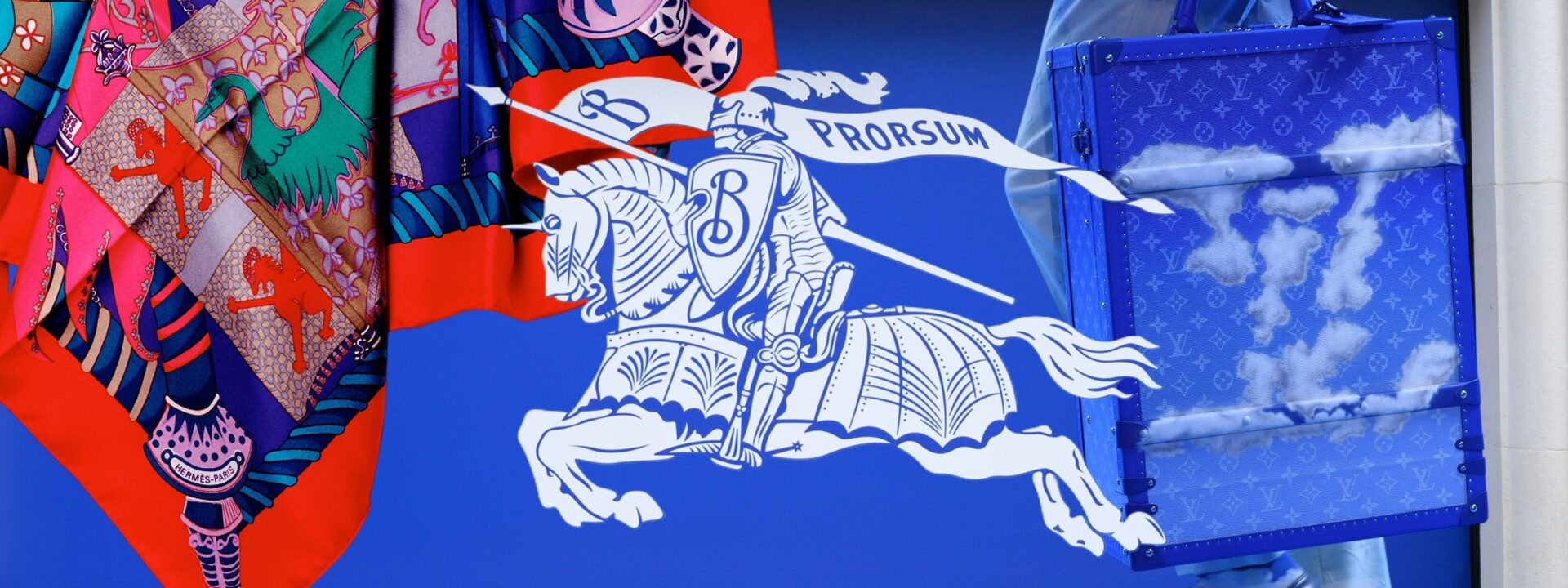
Through decades of consistent branding, Hermès’ distinctive orange and “H” motif have become some of the most recognizable symbols in luxury.Luxury’s most recognizable brand assets. Photo: Edward Berthelot via Getty Images.
Every expert Vogue Business spoke to pointed to Hermès as a model for how this works in practice. Instead of treating heritage like a static archive, the brand constantly reinterprets the same core ideas — craftsmanship, equestrian roots, visual restraint, and exceptional materials — through new products and stories. “A brand should never be a museum to the past,” says Harvey. “They’re always repeating themselves, but they never say exactly the same thing.” He also highlights Louis Vuitton’s consistent focus on travel as discovery — a strategy that reminds consumers of its core product, luggage, while continually adding fresh meaning to the brand.
Seen this way, luxury heritage is less about age and more about accumulation. While generative AI can easily mimic the Hermès look, it can’t recreate the decades of brand behavior that gave those symbols meaning, nor can it predict what the brand will do next with its collections and campaigns.
Trends are the enemy
As short-term virality on social platforms becomes less valuable and consumers increasingly seek offline brand experiences and the chance to “disconnect,” several experts say one of the most powerful things a brand can do to counter AI automation is to reject the endless cycle of content production altogether.
“Everything just needs to slow down […] constant production ironically lacks a sense of permanence.” — Chris Moorby, creative director at Commission Studio.
“Everything just needs to slow down,” says Moorby. “Brands could post half as much and none of us would miss them at all. I understand that brands need to feel always present, but constant production ironically lacks a sense of permanence.”
He points to the “private dimension” manifesto Phoebe Philo wrote before her first collection at Celine in 2009 as an example of how restraint became part of the brand’s cultural value and meaning. Philo positioned luxury as something to be experienced, not performed — reflected in the brand’s sparse advertising, rare press interviews, and her own reluctance to be in the spotlight.
“Philo knew that private dimension was Celine’s strength, because it created hype between the shows — we were all left wondering what the brand was up to,” Moorby adds. The silence became part of the brand’s identity, reinforcing the idea that true desirability didn’t need constant visibility or explanation. While just as much effort goes into frequent social media campaigns, they often disappear within hours, thanks to platform algorithms that reward endless posting rather than lasting impact.
Phoebe Philo steps out after her acclaimed debut Celine Spring/Summer 2010 show in 2009. Photo: Giovanni Giannoni/WWD/Penske Media via Getty Images.
“The brand must be bigger than Instagram,” says 8Ball’s Monahan, adding that jumping on social trends is just as harmful to brand memorability as jumping on aesthetic trends in products. “Nothing has been more disastrous for brands than competing head-to-head with memetic content in the fast-paced world of social media. Imagery needs more than a fraction of a second to make an impact on an audience.”
That’s why the strongest luxury brands increasingly find value in experiences that can’t be consumed in a quick scroll: exceptional retail spaces and memorable pop-ups, craftsmanship, service, communities, and rituals. Monahan points to Erewhon as a rare example of a modern brand that built cultural meaning and scarcity through the physical world, not digital visibility.
“Erewhon is probably the most successful new luxury brand of the last five years, achieving cult status despite its very limited footprint,” he says. “Unlike most luxury brands — which tend to be fashion brands rather than grocery stores — Erewhon hasn’t pursued a ‘growth at all costs’ approach.”Their strategy is clear. They know the most important part of a brand is how people actually experience it in the real world — for them, that means the store. Instead of chasing trends, they’ve stayed true to their values. They don’t set up pop-ups in every major global city; they’ve kept themselves exclusive and rare.
“There’s no AI button for meaning. It’s something AI can’t shortcut, because it’s not a production issue — it’s a time issue.”
— Radek Wójcik, executive creative director at creative agency Made Thought.
Even though AI hasn’t made visual branding irrelevant, it has made people better at spotting when branding is just surface-level rather than earned. AI can help bridge the gap between imagination and execution for new ideas, but it can’t speed up the real-world experience, cultural time, and memory-building that make a brand stick in people’s minds.
“There’s no AI button for meaning,” says Made Thought’s Wójcik. “What can’t be generated is history, meaning, symbolism — the consistency and coherence of a visual language that people interpret and connect with over time. That’s the part AI can’t shortcut, because it’s not a production problem, it’s a time problem.”
Frequently Asked Questions
Here is a list of FAQs based on the concept you provided
BeginnerLevel Questions
1 What does it mean for a brand to be human in the age of AI
It means the brand focuses on emotions empathy and real connections rather than just using chatbots or automation to sell things Its about acting like a person not a machine
2 Why cant a brand just rely on AI to create meaning
AI can analyze data and generate content but it cannot feel Meaning comes from shared experiences vulnerability and trustthings that only humans can truly create and understand
3 What is a shared value for a brand
A shared value is a belief that your customers and your company both care about Its the why behind your brand that people can rally around
4 Can you give a simple example of a brand telling a real story
Sure Instead of saying our shoes are made of recycled plastic a brand could share a video of a fisherman in Indonesia collecting plastic from the ocean to make those shoes Thats a real story with real people
Intermediate Advanced Questions
5 How do you balance using AI for efficiency without losing the human touch
Use AI for the boring stuff so your human team has time to focus on creative strategy customer support calls and building relationships Let AI handle the what and let humans handle the why
6 What happens if a brand tries to fake being human
Customers usually find out and it destroys trust Authenticity is key Its better to say Im a chatbot but I can connect you to a real person than to pretend youre human
7 How do you find the shared values that actually matter to your audience
Dont guess Look at your customer reviews social media comments and support tickets Listen for what frustrates them or what they celebrate Then ask yourself What value do we share that solves that frustration
8 What is the biggest mistake brands make when trying to be human
Trying to be funny or casual when it doesnt fit their identity