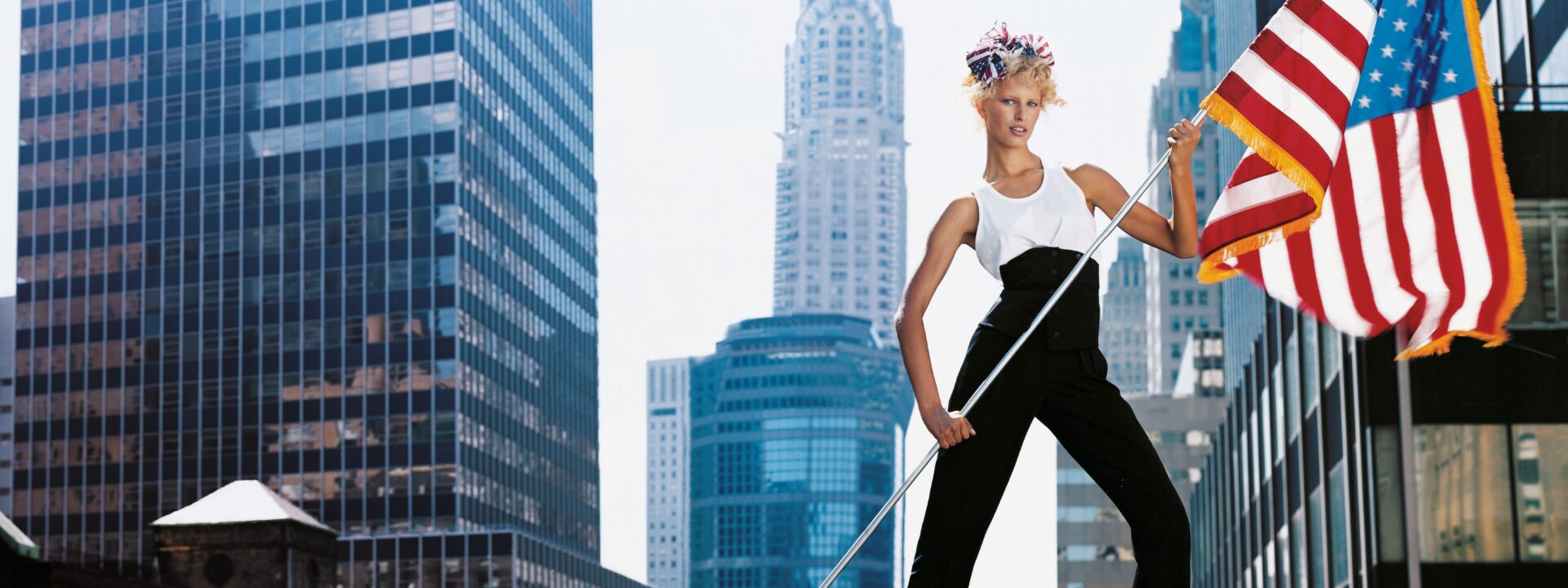
“Amazing Grace,” by Sally Singer, first appeared in Vogue’s November 2001 issue. For more standout pieces from Vogue’s archives, subscribe to our Nostalgia newsletter here.
Extraordinary times call for extraordinary responses. In this issue, we’re sharing a sneak peek at American fashion for spring 2002—a departure from our usual rule of only featuring items that are, or soon will be, available to buy by the time Vogue hits the stands. The pieces shown here won’t be in stores for a few months, but the spirit behind them—optimism, energy, confidence—feels urgently relevant right now. Maybe showcasing work that would normally have been presented under the tents in Bryant Park, Manhattan, simply satisfies our need for patriotic expression.
Before September 11, the New York shows had unfolded with their usual mix of fun (Imitation of Christ had models sitting in the front row while viewers walked the runway) and frustration (why did getting into Marc Jacobs’s show feel like a throwback to the velvet-rope hassles of the Mike Todd room at the Palladium, circa 1986?). Then came that Tuesday. All shows were canceled, and it wasn’t until the following week that the industry felt ready to move forward—and even then, only in a quiet, pared-down way. Small groups of editors were invited to simple Seventh Avenue showrooms to view a selection of each designer’s key looks, often without music.
Punctual, free of celebrities and gift bags, these events created a new kind of fashion moment. Every designer offered a few words of gratitude and sorrow, and all voiced their unwavering commitment to the city and the country. For those of us carrying pent-up grief and a quiet longing for hope, the shows provided emotional release, along with a powerful example of unbreakable resolve. At Donna Karan (who shared that September 11 was the anniversary of her wedding to her late husband), many wept as sentimental love songs by Sting, Celine Dion, and others suddenly took on unexpected meaning.
In the same way, American fashion revealed its true strengths. Recently criticized in some circles for not matching Paris’s drama, London’s inventiveness, or Milan’s undeniable allure, New York showed its real character as the global hub for exceptional sportswear: the right slim pant (sarong-inspired at Michael Kors, coral denim at Marc by Marc Jacobs), the reimagined trench (corset-backed at Narciso Rodriguez, featherlight at Donna Karan), and the crisp white shirt (slim poplin at Carolina Herrera, oversized at Calvin Klein). These unbeatable essentials and classic separates resonated more than ever, because they solved—without any fuss—the question of what to wear when you have bigger things on your mind than fashion.
Likewise, the key piece for spring from every American designer is the understated dress for day or night. At Bill Blass, Lars Nilsson offers a sequined shirtdress with an appealingly relaxed feel. Michael Kors revives the Halston spirit with a stretch-silk halter in Chinese red. Marc Jacobs’s flowing jersey pieces—decorated with patches and appliqués—brings Sant’Angelo and Stephen Burrows to life for a new audience. Calvin Klein cuts layered sheaths with thirties-style seaming out of plum tulle. What makes these dresses more than just their heritage, and thus modern, is an uncluttered prettiness that doesn’t overwhelm the wearer with fussiness. You’ll pair them with flat sandals or something high and strappy, and you’re ready. Dress and go. Life should always be that simple.
Other highlights from the home team? Hearty lace, and plenty of it: eyelet for corsets at Oscar de la Renta, Battenberg on bibs and hems at Miguel Adrover, beaded and sheer in the most romantic prairie skirts ever from Ralph Lauren, and guipure in a strapless dress from Behnaz Sarafpour. Homespun finishes and fabrics: quilting at Jacobs and Adrover, crewel embroidery at Blass, washed pajama striping in a coat lining at Marc, and linen experiments at Donna Karan.A Karan. The mood is warm, friendly, and domestic, even when the silhouette is sleek and narrow. And that’s the key to dressing well right now. It’s almost obvious that recent trends like black, military, and urban warrior styles have lost much of their overly cool, overly knowing appeal. That doesn’t mean we can’t wear all those fantastic items we bought for fall—like combat boots, faux-armor jackets, and Cossack coats—but we’ll need to style them in a way that highlights the true beauty of their design. There’s been a lot of talk in the culture pages about how the attacks marked the end of irony in American popular conversation. It would be a shame if fashion lost its sense of humor and its sly, subversive edge. Defeatist fashion is the last thing we want—and, as it happens, it’s the last thing our American designers would ever consider giving us.
Frequently Asked Questions
Here is a list of FAQs about the concept of fashion inspiring hope based on the theme From the Archives
General Conceptual Questions
1 What does From the Archives How Fashion Inspires Hope actually mean
It means looking back at historical clothing designers and fashion movements to see how people used style to get through hard times By studying these archives we find proof that creativity and selfexpression can lift spirits and create a sense of a better future even during crises
2 How can a piece of clothing inspire hope
Clothing is deeply personal When you wear something that makes you feel confident comfortable or connected to a memory it changes your mindset It acts as armor for the day Historically when the world feels chaotic making an effort with your appearance is a way of saying I believe in the future enough to dress for it
3 Is this just about expensive designer clothes
Not at all Hope through fashion is democratic It can be a handknitted sweater from a grandmother a pair of sturdy work boots that get you through a tough job or a bright lipstick that makes you feel like yourself Its about the emotional value of what you wear not the price tag
4 What are some historical examples of fashion bringing hope
The 1940s Despite fabric rationing people used Make Do and Mend to repair and repurpose clothes They added bright scarves or altered suits to keep morale high
The 1920s The Flapper look was a radical shift toward lighter freer clothing symbolizing a break from the past and a joy for a new era
The 2008 Recession Designers focused on investment piecespractical highquality items that lasted longer giving consumers a sense of stability
Benefits Practical Application
5 How can looking at the past help me feel better about my style today
It gives you perspective If you see photos of people dressing impeccably during the Great Depression or the Blitz it reminds you that style isnt vanity its resilience It encourages you to shop your own closet restyle old pieces and find new life in what you already own