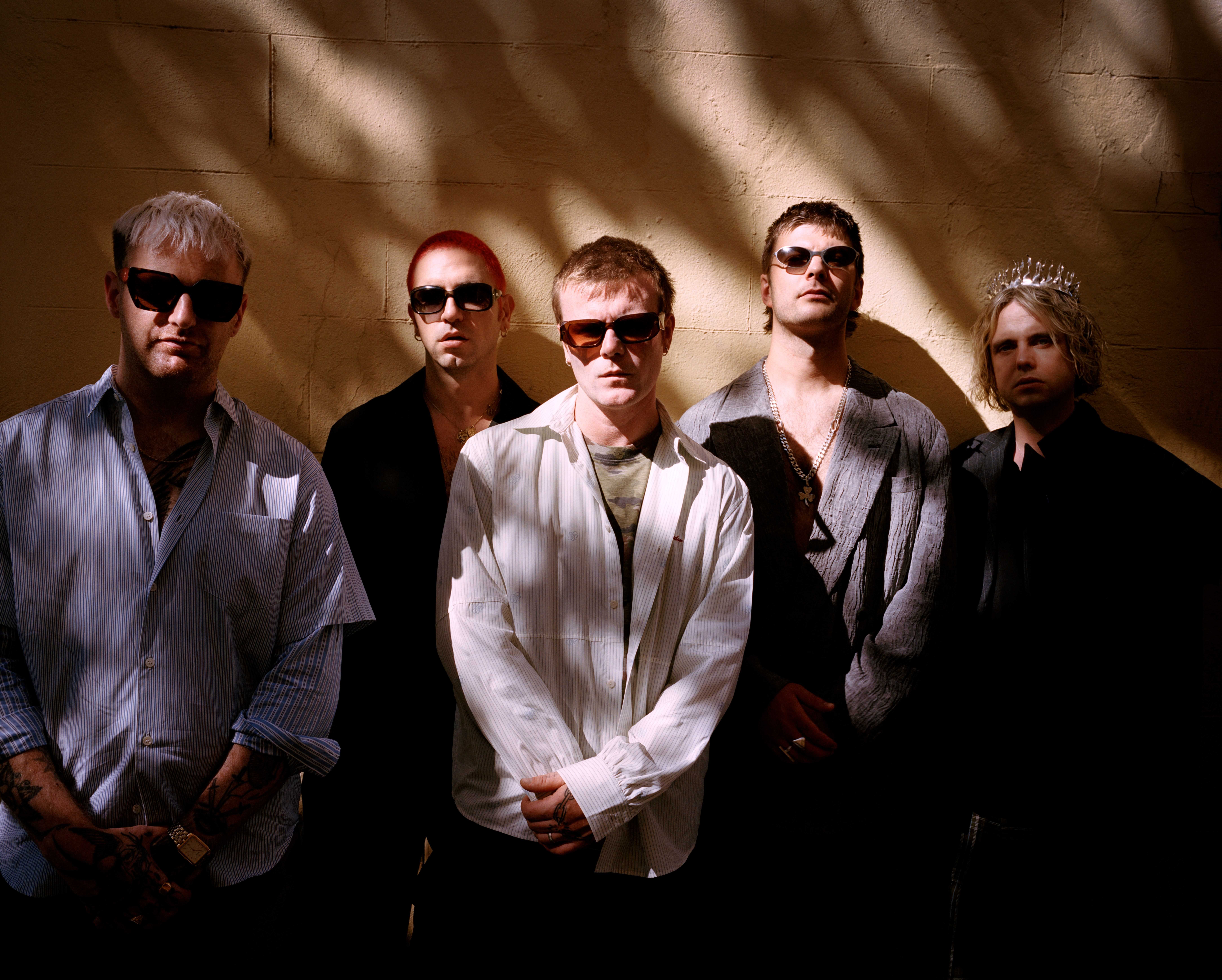
With its pulsing bass and Lynchian music video, “Marianne”—the lead single from Fontaines D.C.’s fifth album, Dopamine Chamber—was both a thrilling preview of what was to come and powerful proof of how far the band had come since the gritty guitars and half-spoken vocals of their 2019 debut, Dogrel. Of course, not everything has changed. The members of Fontaines D.C.—lead vocalist Grian Chatten, guitarists Conor Curley and Carlos O’Connell, bassist Conor “Deego” Deegan III, and drummer Tom Coll—have always been a cerebral group, as uncompromising in their creative vision as in their politics, even as their audience has grown. When I meet Chatten and O’Connell at their Brooklyn hotel in mid-September, their humility is still intact. The success of their last album, the Grammy-nominated Romance (2024), cemented the Irish band’s shift from breakthrough act to global headliners. “I think without the risk of taking a step in a certain direction, there is no impetus for me to write at all,” Chatten tells me. “If I did, it would be like a spiritual and creative death. I have no interest in that.” This isn’t to say that each record demands a total reinvention of their sound; the band’s body of work, we agree, functions more like a five-chord progression. “I wanted to follow Romance to its end, literally and metaphorically,” Chatten continues. “I like the idea of beginning in a tight recording space, sounding like a live punk band, and then morphing into something more universal, sicker, more festered, or something less human.” Before Dopamine Chamber came together, Chatten and O’Connell turned what should have been a break at the end of 2025 into a full-time writing session, sometimes with other artists in mind. Then, in the new year, the quintet went into the studio in Suffolk, England, with famed producer James Ford (Arctic Monkeys, Blur). Read More Ireland’s Fontaines D.C. Want to Romance You With Their Fourth Studio Album By Conçetta Ciarlo The direction this time was based, well, in intentionality. “Every sound, and the interaction of the arrangements, was planned out,” O’Connell explains. “That slower pace led to more listening and attention to detail, rather than getting out an intense performance and letting that intensity do the work.” Consider the opening track, the gloomy soundscape “Six Shot Morning”; Chatten’s evocative baritone riffs on Silicon Valley, while O’Connell, Curley, and Deego trade their guitars and bass for spectral synths. Or “One Man,” for which vocals were recorded in a makeshift sound booth assembled from a mattress and some cushions in Chatten’s Palermo Airbnb. (The song fades out to children playing outside the nearby cathedral.) The cover of Dopamine Chamber, with photography by Elizaveta Porodina. The idea, to hear Chatten tell it, was to shake their listeners awake with a catastrophic warning. “There was a lot of bad news around the time the album was written—from the Epstein files to other stories that render a sense of hopelessness in our sense of democracy,” he says. “You really feel your own insignificance or ineffectiveness. I wanted the album to feel like the end of the world a little bit—not necessarily a single human, but human life overall having its life flash before its eyes.” Chatten, the band’s main lyricist, was also inspired by his friend Nikolaj Schultz’s book Land Sickness, a semi-fictionalized tale of eco-anxiety. Dopamine Chamber sits at the intersection of peril and the pursuit of pleasure through distraction. “Where Is Gone,” a forlorn orchestral ballad, represents the first time the band has featured another artist on their record—that artist being Rosalía. “I knew whatever she contributed would be amazing, but I didn’t foresee that there would be a kind of synergy that would make the song so much better, witChatten says, referring to the song as “a gift” with reverence, “with the extra dynamic of the conversation between the two voices.” The album closes with “Intimate,” a song the frontman wrote on the spot at a chaotic bar in Italy. “It was carnage; that sense where everyone’s aggressively pursuing something,” he says. “It just stirred up the feelings about a party at the end of the world, and that’s what I wanted ‘Intimate’ to sound like.” A week later, at Flatbush’s historic Kings Theatre, Fontaines D.C. play their first New York gig in over a year. After 9 p.m., Luke Kelly’s “For What Died the Sons of Róisín” echoes through the venue, and the band—variously wearing sunglasses or sipping wine—takes the stage. Their set weaves together fan favorites and as-yet-unreleased songs from the new album. (“It’s nice playing songs that no one’s heard,” O’Connell told me earlier. “It reminds me of when we started, and it’s quite exciting.”) The solemnity of “Happy for You” from Dopamine Chamber quickly gives way to the heavy riffs of “Big Shot” from 2022’s Skinty Fia. Later on, for the grand finale, the band’s take on “In Heaven,” from the soundtrack to David Lynch’s Eraserhead, ushers in the chart-topping “Starburster” from Romance. Chatten raises his arms like a conductor as the room’s three thousand other voices sing the chorus back at him. (These stateside shows are downright cozy compared to the arenas the band packs in Europe; next summer, they will play to many tens of thousands of fans on back-to-back sold-out nights at Ireland’s Slane Castle.) The striking scene reminds me of a remark O’Connell had made at the hotel. “I think the most important thing in music is for it to be moving,” he said. “I’m moved by the music that we’ve made, and I’m really proud of it.”
Frequently Asked Questions
Here is a list of FAQs about Fontaines DCs song Dopamine Chamber and its parent album Romance
What is Dopamine Chamber
Its a song by the Irish postpunk band Fontaines DC released in 2024 on their album Romance
Why is it called Dopamine Chamber
The title refers to the way modern life traps us in loops of cheap constant stimulationsocial media screens consumerismthat give quick hits of dopamine but leave us feeling empty
What is the song about
Its about doomscrolling digital addiction and the disillusionment that comes when the pleasure we chase online never actually satisfies us Its a critique of how technology hijacks our brains
What does doom and disillusionment mean here
Doom is the bleak anxious feeling of endlessly consuming bad news and hollow content Disillusionment is the disappointment of realizing the things we thought would make us happylikes views buysdont
Who are Fontaines DC
A band from Dublin Ireland formed in 2014 Theyre known for literary lyrics and a evolving postpunk sound Their albums include Dogrel A Heros Death Skinty Fia and Romance
What album is Dopamine Chamber on
Romance their fourth studio album released in August 2024
What genre is the song
It blends postpunk alternative rock and art rock with some electronic and shoegaze textures
Is Dopamine Chamber a single
It was released as a promotional track ahead of Romance along with songs like Starburster and Favourite
What are the key lyrics
Lines like Im in the dopamine chamber I dont know how to get out capture the feeling of being stuck in a cycle of digital overstimulation
Why does the song sound so intense
The music mirrors the lyricsdriving bass tense rhythms and a claustrophobic atmosphere that mimics the feeling of being trapped in a stimulation loop
What is a dopamine chamber in real life
Any environment designed to hook you a phone screen a social