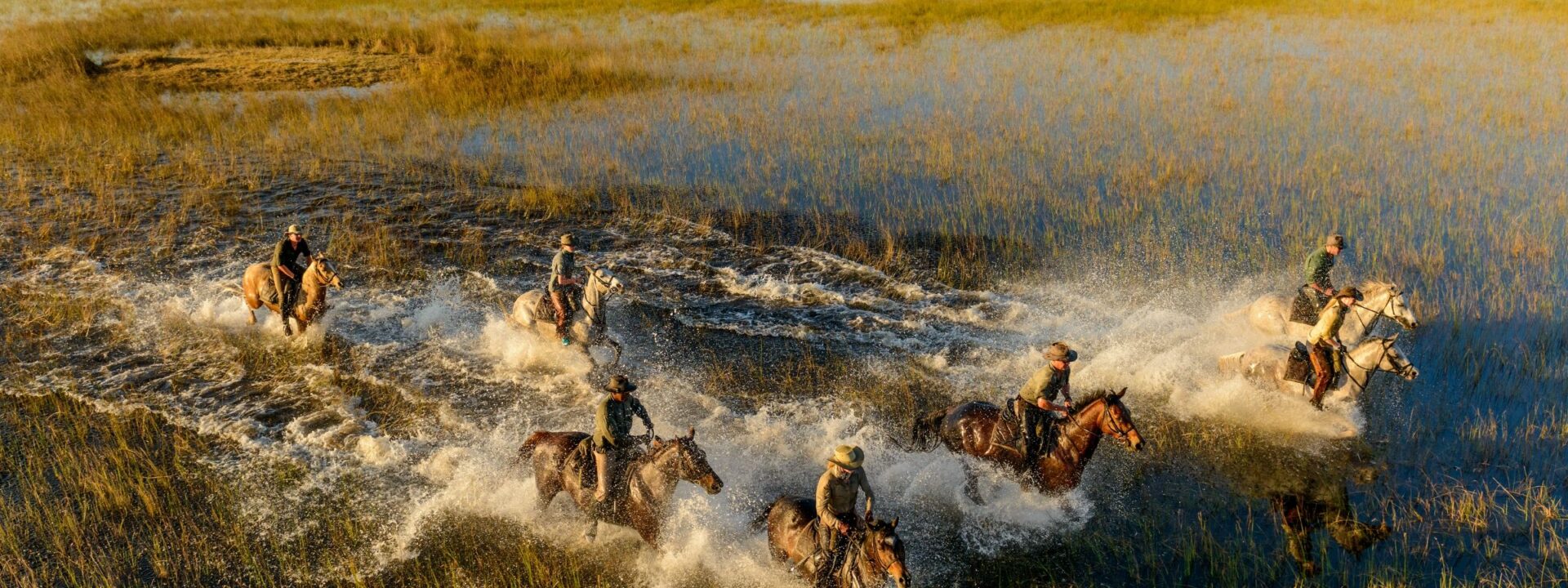
On a horseback safari, there are no roads to follow—and that’s exactly the point. You ride across open plains, splash through riverbeds, and navigate tough terrain that vehicles can’t reach. You get closer to wildlife not because you’re chasing a sighting, but because you move like something that belongs in the wild.
Unlike regular game drives, which often stick to set routes and stop at a polite distance, riding lets you blend into the landscape. Sure-footed and calm, horses move almost silently and instinctively. They fit into the bush in a way vehicles never can. And because of that, the animals react differently. You’re not an intruder—you become, for a moment, part of the herd.
Photo: Chloe Frost-Smith
On a final ride through northern Kenya’s Borana Conservancy, sightings still felt like genuine surprises, even after a week in the saddle. No radio chatter—just the thrill of stumbling upon animals in their natural home. We set out in the late afternoon, as the sky began to glow honey-colored, the horses stepping softly through grasslands that shimmered green after months of rain. Within minutes, we were cantering—first alongside a herd of zebra, their stripes scattering in every direction, then keeping pace with long-legged giraffes as they bounded toward the horizon. There’s no jostling for position. On horseback, you carry the scent and shape of another animal, so you seem less like a disturbance. Your human presence is softened by your horse.
Then came the rhino, up close. A mother and her tiny calf, near enough to see the texture of their skin and the curve of their horns. Moments later, a pair of lions emerged from the bushes. The horses sensed them before we did, ears flicking forward, bodies alert but steady—all while keeping intense eye contact. I braced myself to run, but there was no need. Just a held breath, shared between species. A spotted hyena soon appeared, watching us pass as if we were nothing more than another migrating herd.
Photo: Chloe Frost-Smith
Photo: Chloe Frost-Smith
This was the Borana Northern Ride, a new route by African Horse Safaris. It connects Borana Lodge—once a working cattle farm turned conservation-focused safari destination by the Dyer family, now a key member of The Long Run and part of one of Kenya’s most successful rhino conservancies—with Il Ngwesi, a Maasai-owned eco-lodge where tourism directly supports local communities. In the foothills of Mount Kenya, Borana Conservancy has become a global model for conservation-first tourism, with over a decade of zero poaching and a carefully managed population of both black and white rhinos, protected by round-the-clock monitoring.
It’s the first time in over ten years that these two landscapes have been linked on horseback, moving between private land and community stewardship with rare ease. Up and down rocky trails never ridden by horses before (but certainly by elephants), we climbed ridges so steep we sometimes had to dismount and lead the horses, ducking and weaving through dense, thorny patches like pioneers. Rest came in the form of hot water bottle-warmed sheets in fly camps set up by rivers and yellow fever trees, or on Il Ngwesi’s roll-out beds under the stars, with little more than a mosquito net between us and the bush.
Photo: Chloe Frost-Smith
Photo: Chloe Frost-Smith
It’s this closeness to nature and unmatched access—venturing into places off-limits even for the toughest 4x4s—that defines the horseback safari experience. It’s also about having little impact: no engine noise, no emissions, just a low-footprint way to explore fragile ecosystems with plenty of nose-to-nose encounters.
Across Africa, horseback safaris are opening up landscapes and wildlife interactions that game drives simply can’t match. From tracking migrations in Tanzania to swimming bareback in Botswana’s wetlands—these are the rides that will make you reach for the reins.The reins.
African Horse Safaris
Photo: Sinéad Thorpe / Courtesy of African Horse Safaris
Widely seen as the top experts in their field, African Horse Safaris offers the largest selection of riding experiences across Africa, covering 12 countries and a range of ecosystems—including Tanzania, Mozambique, Zimbabwe, and Namibia. Their trips range from fast-paced mobile safaris through the Okavango Delta, where riders can canter alongside herds across open floodplains, to multi-day trails in South Africa’s Waterberg and high-altitude rides beneath Mount Kilimanjaro. Every ride is personally checked, so the team can match riders not just to a destination, but to the right horses, guides, pace, and terrain.
Most of their safaris are run by family-owned businesses, often deeply rooted in the regions where they operate. Many rides support conservation efforts, such as funding models that help protect large areas of land and wildlife corridors in Kenya’s Laikipia region. This deep connection carries into the experience itself, with expert guides, well-trained horses, and a strong focus on animal welfare in every itinerary.
It also reflects a broader change in who is booking. In recent years, African Horse Safaris has seen a clear rise in solo travelers—especially women—with numbers growing each year as riders look for independent journeys and the kind of bond that comes from time spent together in the saddle. Repeat riders also get a loyalty discount on the soon-to-launch African Horse Safaris online shop, which brings together the community’s favorite equestrian brands alongside a carefully chosen selection of African labels, from Koy Clothing linen shirts (inspired by the Kenyan kikoy) to VAST Kenyan braided suede chaps.
Riding Safari Club
Photo: Francesca Avventi / Courtesy of Riding Safari Club
Founded by lifelong riders Ginevra Rossini and Irene Ferrari, Riding Safari Club has grown from a close-knit WhatsApp group into a global community of riders, many of them adventurous women. Their trips—spanning Africa, Argentina, Mongolia, and Europe—are carefully put together, combining serious time in the saddle with a strong sense of cultural immersion, right down to thoughtful details like destination-specific style guides that reflect the landscape while highlighting local artisans.
Their Kenya experience at Suyian Conservancy, created in partnership with Space for Giants, puts riders at the heart of elephant protection efforts, with chances to see—and sometimes take part in—initiatives like tracking and collaring vulnerable bulls. Time in the saddle is mixed with behind-the-scenes insight into the charity’s ongoing work, from protecting migratory corridors to reducing human-wildlife conflict in the area.
Elsewhere, their Serengeti ride follows the natural rhythm of the Great Migration, moving through remote terrain with a classic mobile camp setup that keeps pace with the herds—before ending with a few relaxing nights at Singita Serengeti House, offering a welcome change of pace after days spent riding deep in the wild.
Horseplorer
Photo: Courtesy of Horseplorer
Founded by Elodie Foltzenlogel, Horseplorer is aimed squarely at riders who want to challenge themselves in the saddle. These are physically demanding trips built around long hours, varied terrain, and horses that expect you to ride, not just sit.
In Tanzania, their Serengeti expedition drops riders into the path of the Great Migration, with routes guided by the movement of the herds. Days are long—often five to six hours in the saddle—on athletic, forward-going horses, before returning to mobile camps set up ahead of the group, where bucket showers, fire-cooked meals, and the sounds of the bush replace usual comforts.
In Namibia, the pace shifts again—an eight-day crossing of the Namib Desert covering nearly 300 kilometers, with no settlements or fences, and little to break the horizon. There’s a handOn edge during their Zimbabwe eco-safari, you might spend time out of the saddle helping to train young horses, joining anti-poaching patrols, or getting involved in the daily running of a private reserve. Each ride also supports impact projects, including contributions to women’s health initiatives in northern Tanzania.
Offbeat Riding Safaris
Photo: Courtesy of Offbeat Riding Safaris
With over 30 years of experience, Offbeat Riding Safaris is a well-known name in Kenyan horseback safaris, famous for fast-paced, big-game riding across the Masai Mara and Laikipia. These are proper point-to-point journeys, covering up to 200 kilometers a week, where riders can gallop alongside wildebeest and zebra, then moments later find themselves close to lion, elephant, and buffalo. Groups are deliberately small—usually no more than a dozen experienced riders—allowing for flexible guiding that follows wildlife rather than a fixed route.
A mobile camp moves ahead of the group, ready each evening. In Laikipia, Sosian Lodge offers a different pace, with over 30 well-trained horses and the option of shorter rides and overnight fly camps. It’s one of the few operations that can accommodate mixed groups while keeping a serious standard of riding.
Conservation is built into the experience. Around $200 per guest per day from their mobile safaris goes toward conservancy fees, protecting key habitats from farming by providing local landowners with an alternative income. At Sosian, extra contributions support women’s health programs, local clinics, teacher salaries, and school scholarships.
Horizon Horseback
Photo: Courtesy of Horizon Horseback
Operating across South Africa and Botswana, Horizon Horseback offers one of the most flexible riding options on the continent. They can cater to both first-time riders and those looking for something faster, longer, and more challenging. Their Signature Safari in South Africa’s Waterberg is built around flexibility, with riders grouped by ability and days shaped accordingly—whether that means relaxed bush rides along sandy tracks, extended canters, swimming with horses, or polocrosse sessions woven into the week.
At the other end of the spectrum, their Tuli Safari in Botswana’s Mashatu Game Reserve is an exceptionally exciting ride: a seven-night journey covering over 200 kilometers between a series of camps, on bush-wise horses that are as comfortable around wildlife as they are at speed. With resident game year-round, encounters with elephants, giraffes, and predators are consistent, and the riding—fast, varied, and often across wide, open terrain—matches it.
Their flagship African Explorer combines the two, crossing from South Africa into Botswana over a week. It’s a route designed for riders who want variety without sacrificing pace or wildlife, offering a seamless experience across borders that few horseback safaris attempt.
Tanzania Horse Safaris
Photo: Zhenya Swan / Courtesy of Tanzania Horse Safaris and Passage to Africa in Loisaba Conservancy
Personally led by founder Jo Westermark, Tanzania Horse Safaris takes a privately guided, off-grid approach to riding in East Africa. Routes are designed to go beyond established circuits and deeper into the bush. These are small, highly tailored safaris shaped by decades of experience in the region, focusing on unfenced wilderness, seasoned safari horses, and guiding that prioritizes instinct over itinerary.
In collaboration with Passage to Africa and photographer Zhenya Swan, their Kilimanjaro Elephant Ride adds a creative twist: a fully hosted, small-group expedition across northern Tanzania’s elephant country. Designed for experienced riders, the journey moves through Big Five territory, with long stretches of open riding broken up by slower, more technical sections.Thorn and Forest.
The whole experience is professionally documented, so riders can stay fully in the moment while the visual story is captured alongside them. It also has a strong female-led spirit—from guiding to hosting—and directly supports Mwandamo, a women-run organization that promotes health and education across northern Tanzania.
Okavango Horse Safaris
Photo: Courtesy of Okavango Horse Safaris
In Botswana’s Okavango Delta, Okavango Horse Safaris is based in a 90,000-hectare private concession where water levels, wildlife movements, and daily routes are always changing. Horses wade through floodplains, weave between mopane forests, and cross palm-dotted islands, often coming face to face with elephants or red lechwe at close range.
What makes this experience special is its sense of space and privacy: with just a handful of tents and a maximum of eight guests, you can go days without seeing another vehicle or camp. The itinerary is balanced with mokoro trips through reed-lined channels, walking safaris, boat rides, and night drives—offering a rich, layered way to explore the Delta that goes far beyond riding.
Now run by Alex Smith and her husband Gareth Peake—who recently moved there with their young family to take over the operation—the safari has a distinctly lived-in feel. Between guiding guests and raising four children in the bush, their presence shapes the atmosphere in subtle ways: informal, grounded, and shaped by the realities of living and working in a remote wilderness.
Frequently Asked Questions
Here is a list of FAQs about experiencing a safari on horseback designed to feel natural and cover all levels of interest
Beginner Questions
1 Ive never ridden a horse before Can I still do a horseback safari
Yes many operators offer trips for beginners Youll usually ride a calm welltrained horse on flat terrain However you need to be reasonably fit and comfortable with the idea of being on a horse for a few hours
2 Isnt it dangerous to be on a horse near wild lions and elephants
It sounds scary but the horses are actually a big safety advantage Predators like lions see a horse as a large predator not as prey so they are much less likely to see you as a threat The horses are also very attuned to danger and will calmly walk away from trouble
3 How is a horseback safari different from a regular jeep safari
In a jeep you are an observer On a horse you become part of the landscape You can follow game trails walk right next to grazing animals and hear every sound without the noise of an engine Its a much more intimate and quiet experience
4 What kind of animals will I actually see up close
Youll see the same animals as in a vehicle zebra giraffe antelope wildebeest and often elephants and rhinos The key difference is that you can get very close to the nonpredatory animals without them running away
5 Do I need to be a very experienced rider
Not necessarily You need to be a confident walktrot rider who can steer and stop reliably You dont need to be an expert jumper or galloper Most trips are at a walk and trot with occasional short canters on open plains
Intermediate Advanced Questions
6 What happens if a lion charges the horse
This is extremely rare but guides are trained for it The horse is trained to stand its ground or move away calmly The guide will also use a loud voice or a whip to deter the animal The horses size and movement usually make a charge a bluff rather than an attack
7 How do the horses react to the smell of a predator
Welltrained safari horses are desensitized to the smell of dung and urine from predators They will