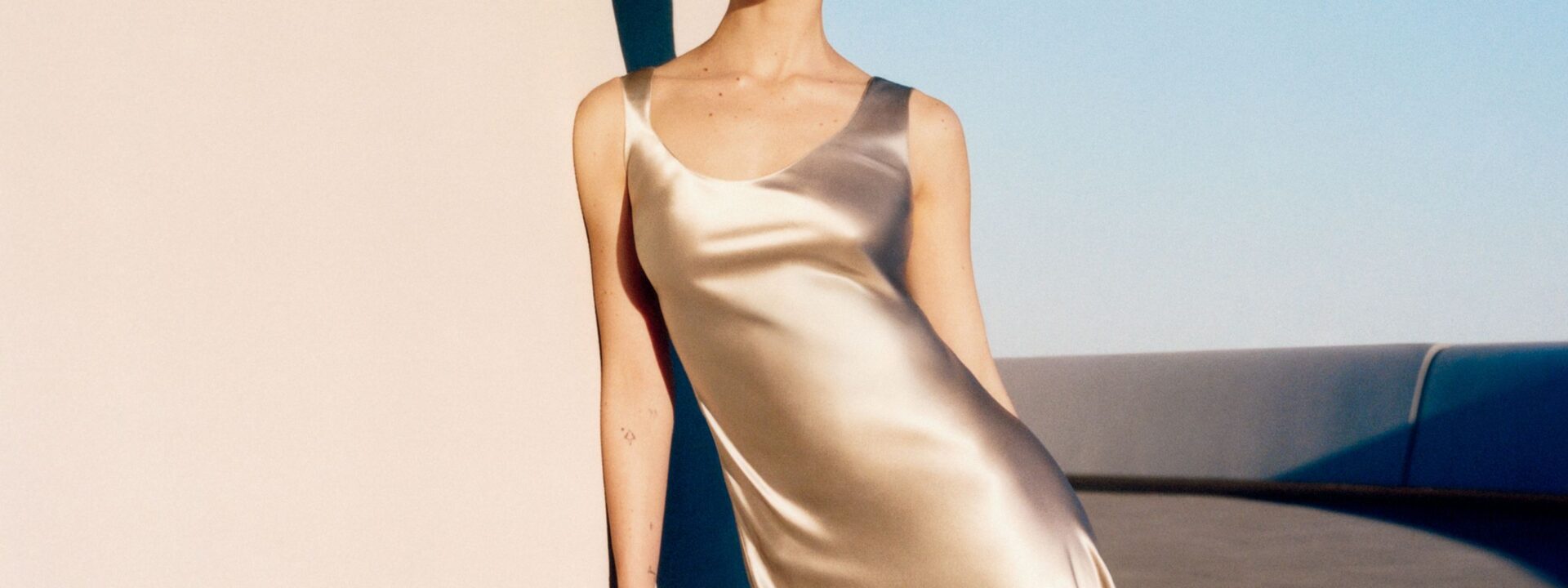
In the parking lot of Rustic Canyon Recreation Center, Gracie Abrams is kneeling in the grass next to her long-haired dachshund, Weenie. It’s a quiet Friday afternoon in Los Angeles, and we’re the only two people here, so she’s easy to spot. She hurries toward me wearing cargo pants, a sweatshirt with “BUG” in block letters, and a navy Red Sox cap covering her dark brown pixie cut.
With her casual dog-walking look, the 26-year-old Abrams could almost pass for a college student visiting her parents on break. For a second, you might forget she’s a global, Grammy-nominated pop star backed by big names like Taylor Swift, Olivia Rodrigo, and Lorde.
In some ways, she really is like a kid home for a quick visit. Abrams now spends time in London with her boyfriend, actor Paul Mescal. Her parents—filmmaker J.J. Abrams and producer Katie McGrath—raised Gracie and her two brothers nearby in Pacific Palisades. They used to bring her to Rustic Canyon every Friday to hang out with parents they met through Mommy & Me classes. Abrams tells me she still has friends from those days and is determined to soak up as much time as possible—with them, with her parents, and with Weenie.
Maybe especially with Weenie, who’s been stuck in LA. “There are so many papers,” she says, unhooking his leash as we sit on a shady bench. “Paul’s desperate to get him out to London.” Abrams’s parents have stepped in to take care of him—which, she admits, is probably a good thing. Even her time in LA has been hectic. Just the Sunday before, she was on Mescal’s arm at the Oscars, wearing a glittering black two-piece outfit from Chanel that showed her midriff. They both screamed enthusiastically when Mescal’s Hamnet co-star Jessie Buckley won Best Actress.
Chaos is something Abrams has gotten used to. Eight years ago, she arrived in New York as a first-year student at Barnard with a cult following she’d built on Instagram, where she posted videos of herself singing songs from her bedroom. A year later, she dropped out to pursue music full-time, signed with Interscope, and released her debut EP, Minor, in July 2020. It was the height of the pandemic, and her heartfelt, honest songs connected with many people craving that kind of music. When the world reopened, Abrams went on her first tour in late 2021, put out a second EP, This Is What It Feels Like, and joined Olivia Rodrigo—already a known fan—on her Sour tour the following spring.
Things sped up even more in 2023. Her debut album, Good Riddance—16 tracks of simple, delicate pop—came out in February. Two months later, she joined Taylor Swift’s Eras Tour, opening 49 dates of that worldwide stadium tour. By the end of 2024, Abrams had been nominated for a Best New Artist Grammy and released what would become her sophomore breakthrough: The Secret of Us. It was a bolder statement, still folk-influenced and heartfelt, but with pop hooks that showed new confidence. Touring behind it, she filled arenas.
She finally took a break last summer. “There’s been such quiet,” she says, sounding relieved. “You don’t realize until you stop: ‘Oh, I haven’t seen my friends in a long time. I haven’t cooked a meal in a long time.’ Your sleep schedule becomes regular for the first time in, like, four years.”
Eventually, she found her way back to upstate New York’s Long Pond Studio—the famous hub of her closest collaborator, producer and musician Aaron Dessner, and the place where they wrote and recorded both of her albums. Abrams first met Dessner as a fan of his band, The National. “Growing up with him has felt like being plugged into some electrical force,” Abrams says. “And also like standing in a river and just feeling actual calm.”
Her deep affection for Dessner is as much a fan’s as it is a friend’s.He’s as well-known for his talent in the studio as he is for the quiet life he’s built in the Hudson Valley. “The way he’s navigated the industry really moved me—living in the middle of nowhere, having a family and friends. It was a huge relief to see someone who had a career and still managed to find some kind of balance in life.”
Dessner understood what Abrams needed. “A lot of pressure comes with the spotlight and constant touring,” he says. “Gracie handles it pretty well, but it takes a toll on anyone. I think at some point it just became a bit overwhelming.” He told her there was no rush to follow up her last album. Abrams wasn’t even sure she had much more to say. “I felt talked out,” she admits.
Abrams had spent her career writing about feeling insecure in relationships, turning her emotions into songs. (She says past boyfriends usually only heard her honest thoughts through her lyrics.) Now, in her relationship with Mescal, she was talking more openly and communicating in a healthy way. Was there anything left for songwriting? “I was worried that feeling secure and stable was threatening my drive to write music,” Abrams says. “It freaked me out.”
Eventually, she and Dessner unlocked something new—without needing a dramatic reinvention. “I’ve learned from Aaron that it’s okay to dig deeper and refine what you’re naturally drawn to, even if it doesn’t look flashy or new on the surface,” she says. Dessner’s own career inspired her. “There’s something about longevity that I really hope to keep working toward.”
So she did dig deeper, coming to terms with the kind of girl she used to be—a tornado child who caused chaos at home and then had to grow up fast on stages in front of thousands. The sessions started and ended at Long Pond, and in the end, she created Daughter from Hell, a portrait of who she was and where she is now.
The songs sound like her: honest, introspective, and folk-inspired. But the production is richer, deepened by orchestration, and big enough to fill the rooms she’s playing now. To Abrams, the album, out in July, is “the sum of all my parts,” she says. “It feels like me in progress.”
“That’s the actual daughter from hell,” Abrams says, watching Weenie nervously interact with a new dog that’s wandered into our shady spot. We’ve been talking for just under an hour, but Abrams has already shared the story of her past few years with surprising honesty.
“I remember what it felt like when a stranger would find a song I’d posted to Instagram,” Abrams says. “It sounds crazy, but I loved it.”
Abrams is naturally open. Lately, in photo dumps and Stories, she’s shared sweet pictures of hanging out with Mescal at Glastonbury and celebrated the hard work he and the Hamnet cast and crew put into the film. She tells me she was with him in London for much of the Hamnet shoot, spending evenings together after long days on set, talking about the material he was working on. “It feels like every day you come home and read the greatest book ever—that’s what it’s like to be in conversation with someone making something like that,” she says. She describes director Chloé Zhao and his costar Buckley as “witches”—high praise. “The person you love gets to be surrounded by witches,” she says. “It’s magical.”
Meanwhile, Mescal bought Abrams a 1960s reel-to-reel and helped her record on it. Mescal is a skilled guitar player and has gotten even better preparing to play Paul McCartney in Sam Mendes’s planned Beatles biopics. “So much better than I’ve ever been,” she admits. Every room in their home is filled with instruments, including a Bechstein piano that Abrams would start most mornings with.
Abrams tells me she’s taken up pastel drawing and FaceTimes her mom four times a day.The desire to settle down comes from the kind of life she’s been living. It was just too relentless. She pushed through bad days on the road, kept going even when she was exhausted, and often went beyond her limits. “I just wasn’t listening to myself all that much,” she says.
The new album’s lead single, “Hit the Wall,” let Abrams channel the feeling of hitting her physical and emotional breaking point. Big and anthemic, it’s an arena pop banger that fits her rock star side. It’s also personal and detailed—a reminder to find calm before burning out. “If you’re not listening to the parts of yourself that are sounding the alarm and asking for attention,” she says, “then it inevitably erupts in some other way.”
Abrams spent her early twenties building a single life between both coasts. Her first time in Manhattan was short: she left Barnard College, where she planned to study international relations, without finishing her degree. In 2023, she moved into an LA apartment with her best friend, Audrey Hobert, a TV writer turned pop star.
Hobert and Abrams, a year apart in age, first met at Abrams’s fifth-grade graduation, thanks to their mutual friend Clem (who now lives near Abrams in London). “I was walking into the bathroom; she was walking out,” Hobert remembers of their teenage meeting. “She was wearing white high-top Converse, and I stopped her. I said, ‘I wore white high-top Converse to my graduation.’ The rest is history.”
Abrams and Hobert bonded over music in middle school—sneaking into classrooms to play guitar and singing Ed Sheeran on the bus. Abrams had already started writing songs, but only in her bedroom. That changed in high school, as Hobert made early attempts at movie scripts. They encouraged each other. “We were always very in sync,” Hobert says. Then Abrams posted songs online and started to feel the relief of building a community.
“I remember what it felt like when a stranger would find a song I’d posted to Instagram. It was surreal,” Abrams says. “That sounds absolutely crazy, but I loved it,” she adds. Posting online “didn’t require me to face anyone on the other side,” she says. It felt like writing in her journal. “I loved how impulsive I felt with my songs.”
By 2023, Abrams’s career was in full swing; Hobert worked as a staff writer on Nickelodeon’s The Really Loud House. The pair started writing music, turning the frantic energy of their lives—split between LA, Long Pond, and Electric Lady Studios on the East Coast—into songs. “I feel like you have these premonitions tied to relationships,” Hobert says, “where it’s like, ‘This is something bigger.’ That’s how I’ve always felt with Gracie.”
Abrams and Hobert worked together on much of The Secret of Us. They also have another collaboration on Daughter from Hell: “Minibar,” one of the earliest songs made for the album. “It’s really fun,” Hobert says. “It’s not about some problem in any of our lives. It’s what it’s like to hang out with Gracie.”
Hobert also had her own songs to write. These would fill her 2025 debut album, Who’s the Clown?, which Abrams loves and which Hobert has been touring behind. “I was lucky enough to grow up my whole childhood with her voice in my head,” Abrams says. “She always knew herself so well and was such a guiding light in my life.” Seeing her friend succeed “has been the joy of my life.”
As a kid, Abrams “always chased what made me feel electrified,” she says. She was the middle child, between a “very tender and gentle” older brother and a younger brother who “learned what not to do” from his sister. She says she did “things that now keep me up at night. I got good at sneaking around—noIt wasn’t just about leaving the house—it was also about some of my behavior.
“Gracie often acted older than she really was,” her mom tells me. “She had a confidence that seemed real—and sometimes it was—but I think it also hid some deep insecurity.” Abrams always kept a journal, and one day in high school, McGrath found open pages left on her daughter’s bed. “I read less than a page, then stopped and never looked again,” she says. “It was her safe space and her hiding spot, and it wasn’t my business. I felt strongly that I needed to trust her, even when she worried me—and there were times she really worried me.”
As Abrams was finishing her album, she texted her mom an apology. “I was like, ‘Damn, I really was a terror. I took years off your life, didn’t I?’ And she just said, ‘Absolutely.’”
All of that went into the song “Daughter from Hell.” The title track is kind of an apology. “I wish I could go back and spend all the time I spent fighting my mom just listening to every bit of wisdom she has for me,” Abrams says. “I’m so aware of how fast time is moving right now, and that makes me nervous sometimes.”
So does the internet—that once safe space that lately feels much less safe. Abrams’ phone has no social media apps. She’s not interested in jokes at her expense or the dismissals that flood platforms like X and Instagram. She’s a Hollywood kid who didn’t earn her music career. She can’t sing. Once algorithms started showing her that kind of “cruelty,” as she calls it, she began to step away.
These are all thoughts she’s already had about herself. Abrams isn’t shy about any of this: She seems to know exactly who she is and what she wants to be. “I’m the first to say I’m not a vocalist,” she tells me. She never had any training, and her soft, whispery voice comes from years of not wanting anyone in her house to hear what she was doing. “I understand not liking how my voice sounded. I didn’t like it a lot of the time either…” She’s worked to strengthen her singing, and it’s paid off on the new album, where she often belts out lines—a sound fuller and warmer than ever.
Abrams compares the trolling she’s faced to the flood of real news—harrowing updates that demand her attention. As the child of proudly progressive parents, she’s always been outspoken about her politics. She spoke out against the Supreme Court’s decision to overturn Roe v. Wade, performed alongside Kamala Harris during her presidential campaign, and has posted about the struggles of Palestinian children in Gaza. The state of the country and the current leadership in Washington weigh on her. “Being a citizen right now is so dark,” she says. “This country is a great experiment, and I think it’s hurting so badly right now.”
A few days later, it’s a damp New York spring morning, and Abrams is bundled up against the weather in a black turtleneck. She’s waiting for me at the Chelsea Hotel, her pixie cut pinned back delicately with two barrettes.
She and Dessner have been finalizing the mixes for her new album at Electric Lady Studios, a few subway stops south. She orders a black coffee and a fruit plate for us to share, and sketches out her extended musical family tree. There’s Dessner’s twin brother, Bryce, who composed the orchestrations on the album. “The idea of twins really blows my mind,” Abrams says. “They’re so brilliant and just felt so in sync. I’m like, ‘This has to be on a cellular level. Something is going on.’”
There’s Justin Vernon (also known as Bon Iver), who came from Wisconsin to join Abrams and Dessner at Electric Lady for some of the “rowdiest” days of the album sessions. Producer Daniel Nigro contributed from his base in Los Angeles. Marcus Mumford also helped out.She sang on one of the tracks. Even songwriter Sarah Aarons, who worked with Abrams on her debut EP, makes an appearance.
“Since spending time in London, I’ve had such a vivid imagination about the rest of my life,” she says. “I’m leaning into whatever makes me feel most alive.”
“I think that as you grow up, there are these different milestones where you get to reflect on your community,” she explains. That community—a network of friendships—has opened up new opportunities for Abrams. The next step is acting. She met filmmaker Halina Reijn three years ago over breakfast, when Reijn was looking for songwriters to contribute to her 2024 film, Babygirl.
“I completely forgot it was a business meeting,” Reijn says of that encounter. “I wanted to be her friend.” And when Reijn started writing her next project after Babygirl—a script for a film called Please—Abrams was “immediately” on her mind, this time to play the lead. Plot details are under wraps (the studio A24 will only tell me it’s “sexy and romantic”), but Reijn says it “touches on something all women can relate to,” and she was impressed by how Abrams connected during an audition. “She’s incredibly relatable,” Reijn says.
“This wasn’t something I imagined for myself,” Abrams says, “but every time I read the script, it sparks something in me.” Abrams has been preparing for the shoot (actors Tom Burke and David Jonsson have also been cast), reading a lot of plays, making playlists, and even writing music inspired by her character. “It led me down a lot of dark and twisty paths,” she says.
Then it’s back to London, where Mescal is waiting for her, deep into filming Mendes’s Beatles biopics. Her little brother is there too, now a student at Northeastern University and living with the couple during his semester abroad.
“I’ve had such a vivid imagination about the rest of my life,” she says. It’s more than just album, tour, album, tour. “I want consistent time to be with my people,” she says. “I want to be a mom, eventually.”
And she wants to keep creating. Maybe after Please it will be more films. Or poetry. Or theater, which she did in school and found exciting. “I’m interested in being challenged,” she says.
She’s open to it all. “I think about when I’m 85,” she says, “if I’m lucky enough to get there, I want to look back and say, ‘I did that weird thing.’ I want a full life.”
In this story: hair, Tamás Tüzes; makeup, Emi Kaneko; manicurist, Caroline Cotten; tailor, Irina Tshartaryan for Susie’s Custom Designs. Produced by Hyperion. Set Design: Patience Harding.
The Summer issue is here. Subscribe to Vogue.
Frequently Asked Questions
Here is a list of FAQs about Gracie Abramss Brave New World Vogues Summer 2026 Cover Story written in a natural tone with clear direct answers
BeginnerLevel Questions
Q Who is Gracie Abrams
A Shes a singersongwriter known for emotional intimate pop songs Shes also the daughter of filmmaker JJ Abrams but shes built her own career in music
Q What is the Brave New World Vogue cover story
A Its the feature article and photo shoot for Vogues Summer 2026 issue with Gracie Abrams on the cover The title references her upcoming album and her mindset entering a new era
Q Why is this cover story a big deal
A Its her first major solo Vogue cover It signals shes moved from being an opening act to a headlining artist in her own right
Q What is the Brave New World album about
A Gracie describes it as a record about stepping into the unknownnavigating early adulthood selftrust and the scary but exciting feeling of starting over
Q Where was the Vogue photo shoot done
A The shoot was done outdoors in California using natural light and open landscapes to match the albums themes of openness and change
IntermediateLevel Questions
Q How does the Vogue article connect to her music
A The article frames her new album as a sonic diary of her life posttour It talks about her writing process in a rented house away from Los Angeles to get clarity
Q Did Gracie talk about her famous parents in the interview
A Yes but lightly She mentions that her dad gave her advice on handling public pressure but she focuses more on her own artistic identity
Q Whats one surprising fact from the story
A She revealed she almost scrapped the entire album halfway through because she felt the songs were too vulnerable Producer Aaron Dessner convinced her to keep going
Q How did she describe her songwriting process for this album
A She said she wrote in f