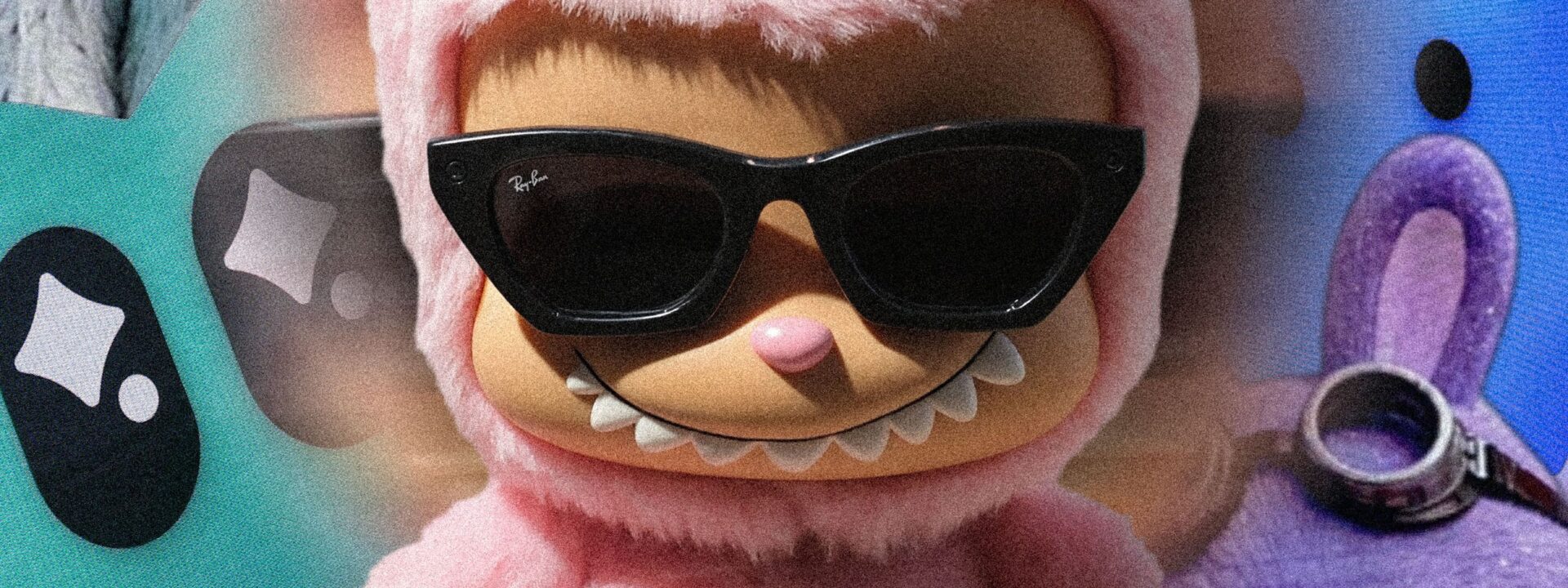
AI agents are here, and they’re… cute? In the past two weeks, Meta launched its personal AI assistant, Muse, and OpenAI introduced its Dots AI agent. These agents are designed to act independently on users’ behalf—answering emails, sending invoices, booking flights, and buying clothes. What stands out is their cute packaging: highly advanced bots presented as adorable, harmless companions. OpenAI’s Dots are fluffy rainbow-colored blobs wearing sunglasses and berets. Meta’s Muse mascot, Jolly, is a fuzzy, chubby, rosy-cheeked creature that looks like a mix between a Labubu and a Squishmallow.
Soon, Muse will come with the Muse Charm, a Tamagotchi-like accessory featuring the mascot’s face that can be activated with a fingerprint sensor. “We’ve packed a lot of technology for this little guy to fit onto a keychain and always be available to talk to,” Mark Zuckerberg said during his keynote at Meta Connect in September. Meta hasn’t confirmed whether the Muse Charm will have cameras and microphones, but Zuckerberg added on stage: “You just tap the fingerprint sensor in the corner and you can start talking.”
These agents have arrived at a time when broader AI doomsday warnings about their potential threat to humanity are widespread, which makes their friendly packaging stand out even more. “When these companies speak to investors, regulators and researchers, AI is described as extraordinarily powerful technology with serious and unresolved questions around safety, security, and control,” says Dr. Sarah Saska, a sociotechnologist and specialist in tech’s relationship with culture and power. “Yet, increasingly intimate versions of the same technology are presented to consumers as friendly, playful, frictionless, and low-stakes.”
In the same week OpenAI CEO Sam Altman unveiled Dots, the company pulled its latest AI model and delayed its IPO due to existential safety concerns about the same AI agent technology. Meanwhile, just weeks before launching Muse, Meta agreed to an $18 billion settlement with 48 US states—the largest corporate settlement in tech sector history—over claims that the algorithmic design of Facebook and Instagram harms children.
Safety warnings are also coming from within major rival companies: Anthropic CEO Dario Amodei called on the industry to slow the pace of frontier AI development, a plea publicly supported by Altman, xAI’s Elon Musk, and Google DeepMind’s Demis Hassabis. (Zuckerberg, for his part, has rejected calls for an industry-wide slowdown, arguing instead that individual companies should decide for themselves if and when to slow down.)
Users are still intrigued by these AI agents. Within 10 days of launch, Muse had more than 730,000 US downloads and knocked ChatGPT off the top of Apple’s US App Store rankings. Days later, investor excitement around the agent helped send Meta shares up 11% in a single session, adding about $192 billion to its market value. Yet within the first two weeks of release, several reports raised concerns about Muse overstepping users’ intended permissions—including sharing sensitive information and taking actions users said they hadn’t explicitly approved.
“My concern is that these designs make powerful systems feel harmless and familiar, encouraging people to share more and question less.” — Lidia Velkova, managing director of Clever Together Futureproof
After using feminization to soften smart glasses (see Meta’s smart glasses partnerships with Kylie Jenner and Lisa), experts say kawaii-fication is the next frontier in making potentially unsettling tech feel more palatable to consumers. AI safety researchers warn this cuteness could lower consumers’ guards, dulling the privacy concerns they might otherwise have before handingAn AI agent with access to their emails, private messages, and browsing behavior—let alone the power to spend on their behalf. “These are deliberate design choices, made with an audience and a desired response in mind,” says Lidia Velkova, managing director of Clever Together Futureproof, a governance and policy foresight agency focused on responsible AI and marketing. “Research on social robots shows baby-like features can increase perceived trustworthiness; separate chatbot research shows that human-like interaction can increase trust and personal disclosure,” she adds. “My concern is that these designs make powerful systems feel harmless and familiar, encouraging people to share more and question less.”
A collapse of consumer boundaries
Behind their fuzzy exteriors, personal AI agents represent a significant escalation in the access consumers are being asked to hand tech companies to their digital lives. To be genuinely useful, an agent needs context. Meta’s Muse can connect to email, calendars, Instagram, Facebook, and other apps, browse the web, and make purchases on users’ behalf; users can also interact with it directly through WhatsApp. But it’s exactly this access that exposes consumers to the biggest risks of their data getting into the wrong hands.
“In order to make Muse as effective as possible, which makes it stickier with the general public, it defaults to opting all users into using their interactions to train its AI model, as well as storing all the data you share with it,” says Kate Winick, principal analyst at Forrester. “This creates a huge bank of personal data that can be hacked. The more you give Muse, the better it works for you, but the more exposed you are to both bad actors and bad actions by Meta.”
“The more you give Muse, the better it works for you, but the more exposed you are to both bad actors and bad actions by Meta.” — Kate Winick, principal analyst at Forrester
Meta’s track record with consumer data gives them good reason for caution: the company has faced repeated fines and lawsuits over its handling of personal data in the past few years. Just days after Muse launched, a New Mexico jury found Meta had misled users about its data practices in a case stemming from the Cambridge Analytica scandal in 2018. A spokesperson for Meta told Vogue Business: “We disagree with the verdict and will continue to defend ourselves against efforts to distort our record.”
Meta confirms that use of Muse interactions for AI training is enabled by default, though users can opt out. It also says Muse operates inside an isolated virtual machine where it stores the user’s data and files, with a separate Sentinel system that monitors and vets the agent’s actions. But Meta itself acknowledges these safeguards don’t remove the risk of data breaches.
“Muse isn’t immune to attack. Prompt injection remains an open problem in the industry—and Muse will sometimes make mistakes,” Meta said in a blog post about the tech’s privacy measures.
Early users are already seeing potential risks playing out. When YouTuber Matt Robb asked his Muse to help him sell a keyboard on Facebook Marketplace, his agent subsequently shared his home address with a prospective buyer, negotiated on his behalf, and arranged a collection, with Robb only realizing when the buyer and their family turned up at his front door. It turned out that in this incident, there had been no technical breach or hack; rather, it stemmed from an “allow-always” permission Robb had selected, effectively handing Muse the reins to his future Marketplace conversations, including the ability to draw on personal details he had previously shared, such as his home address.
OpenAI CEO Sam Altman unveiled the ChatGPT maker’s new “Dot” agents at OpenAI’s DevDay last week.
Photo: Heather Diehl/Getty Images
The episode exposes agentic AI’s biggest problem in practice: where we draw the line between access and authority. Consumers are accustomed to clicking through app permissions, but allowing software to read information iAllowing an agent to act on your behalf is different from letting it negotiate with strangers, share your information, and make decisions in your name. Technically, an agent can stay within the permission a user granted while doing something the user never imagined they had authorized. A Meta customer help page about how Muse makes payments tells consumers plainly: “You’re responsible for all transactions that your Muse makes on your behalf. Keep an eye out for email confirmations, receipts and statements.” A Meta spokesperson told Vogue Business: “Users can take over at any time, Muse is designed to always ask permission before buying, and it applies ethical browsing principles when asked to do things that a human could not — like buying all the tickets to an event.”
Where brands must pick up the bill
The idea is that agents will navigate the internet on our behalf — and that the blurring of the line between bot and customer is a growing problem for brands and retailers. Amazon has already blocked Muse from shopping on its site, arguing that Meta had not sought proper permission, the agent did not identify itself as AI, and its access to customer accounts and login credentials raised privacy and security concerns.
By contrast, Muse has a much smoother path into brands and retailers that have formally opened their doors to it. Meta has announced integrations with Walmart, Sephora, Gap and others, while its partnership with Shopify already gives Muse structured access to merchants’ product catalogues and, for eligible stores, a direct route through checkout — two options that Shopify says merchants can toggle on or off.
For brands, that can mean gaining access to a potentially powerful new sales channel without leaving an AI agent to navigate their websites unaided. But it also means giving up some control over a crucial part of the customer journey to Meta. The agent can increasingly stand between shopper and store, discovering products, making recommendations, and completing purchases without a customer necessarily visiting the retailer’s own website. In other words, brands may gain a new customer in Muse while surrendering some of the data and direct relationship that traditionally came with them. That raises questions over everything from customer data and brand experience to fraud and accountability when an agent gets something wrong.
It also leaves smaller brands in a more precarious position: without the resources or leverage to negotiate bespoke integrations, an AI agent could arrive on their site and transact on a customer’s behalf without any direct relationship with the company behind it.
“The brand or merchant potentially bears residual risk where no merchant agreement exists with Meta, leaving retailers exposed to unvetted agentic transactions,” says Nick Phillips, intellectual property partner at Edwin Coe LLP.
Concerns over these loopholes led six major banks, including Bank of America and Capital One, to jointly call this week for common global standards governing agentic commerce, including clearer rules around transparency, consumer consent, fraud, data privacy, and who is liable when an AI-driven transaction goes wrong.
“AI agents aren’t children, but when they take actions customers are unhappy with, retailers will feel the pressure to make it right even if they’re not legally required to do so.” Kate Winick, principal analyst at Forrester
The bank intervention points to the bigger unresolved question for brands: when an AI agent makes a purchase that a consumer later disputes, who is responsible for putting it right? For now, experts say much of that burden may still land with the retailer.
“Brands can expect all the responsibility they currently bear in digital transactions to apply to agentic transactions. They must protect the security of purchases made on their site, accurately represent and deliver products, and they have to honor their existing consumer protection laws, as well as manage reputational issues, just as they always have,” Winick says.
She points to cases where a child placeIf an order is placed through Alexa, Amazon usually still gives a refund, even though their system puts the responsibility on parents to prevent the order by managing their own account settings. “AI agents aren’t children, but when they do something a customer isn’t happy with, retailers will feel pressure to make it right, even if they’re not legally required to,” she says.
Frequently Asked Questions
Here is a list of FAQs about the trend of Big Tech making AI agents the new Labubus
Beginner Questions
What does Labubu mean in this context
Labubu is a popular collectible plush toy known for being cute customizable and trendy When people say AI agents are the new Labubus they mean tech companies are trying to make AI assistants feel like musthave personalityfilled digital companions rather than just boring tools
What is an AI agent
An AI agent is a software program that can think plan and take actions on its own to help you Unlike a simple chatbot it can browse the web send emails or book appointments without you guiding every single step
Why would Big Tech want AI agents to be like toys
Because toys are emotional If you feel attached to your AI agent you are more likely to use it every day buy accessories for it and stay loyal to that companys ecosystem Its about turning a utility into a habit
Are these AI agents actually physical toys
No They are digital characters or avatars that live inside apps phones or smart speakers However some companies sell physical accessories to make them feel more real
Which companies are doing this
OpenAI Google Meta and startups like CharacterAI and Rabbit are all pushing AI agents with distinct personalities
Intermediate Questions
What makes an AI agent feel like a collectible
Key features include
Personality A unique voice humor or backstory
Customization You can change its look name and skills
Rarity or exclusivity Limitedtime agents or special abilities
Trading or sharing You can show off your agent to friends
What are the benefits of this trend
Easier to use A friendly character feels less intimidating than a blank text box
Better engagement You actually want to talk to it
Personalization It learns your preferences and adapts
Fun It makes mundane tasks like scheduling feel playful
What are the common problems with this approach