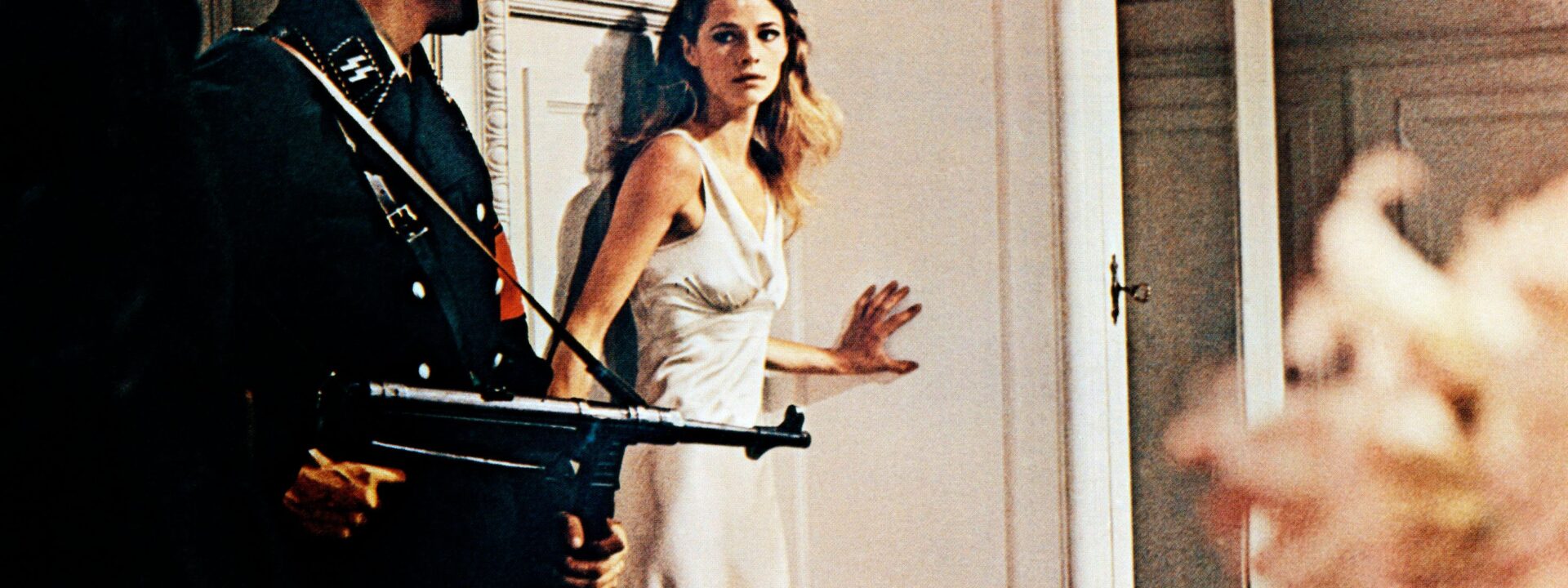
For over six decades, Charlotte Rampling has built a dark, sexy, and thrillingly complicated body of work that is truly unmatched. Now, at 80, the Oscar-nominated icon shows no signs of slowing down. In celebration of her recent interview for British Vogue’s April 2026 issue, here are seven of her most essential performances—each one well worth revisiting.
The Damned (1969)
In Luchino Visconti’s chilling portrait of an ambitious German family entangled with the Nazis in the 1930s, a 23-year-old Rampling is captivating as a young wife whose life spectacularly unravels—an early sign of her extraordinary promise.
The Night Porter (1974)
That piercing stare, that delicate fragility, that unsettling slipperiness—only Rampling could have played Lucia in Liliana Cavani’s controversial cult classic. She portrays a former concentration camp inmate who, years later, encounters the SS officer (Dirk Bogarde) with whom she had a sadomasochistic affair. The film’s power remains undimmed, and this may still be her most memorable and endlessly discussed role.
Under the Sand (2000)
In François Ozon’s wistful mystery, Rampling is in exquisite form as a professor whose husband (Bruno Cremer) vanishes while they vacation on France’s southwest coast. Weaving together confusion, sorrow, hope, and a sphinx-like poise, she delivers a masterclass—earning nominations from the César Awards, European Film Awards, and the National Society of Film Critics.
The Swimming Pool (2003)
Equally juicy is this sun-soaked reunion with Ozon. Here, Rampling—who won Best Actress at the European Film Awards for this role—plays a crime novelist with writer’s block, sent to her publisher’s country house to recover. Her peace is shattered by the arrival of another guest (Ludivine Sagnier), sparking tensions, unexpected bonds, and secrets lurking beneath murky waters.
Restless (2012)
Her formidable turn in this gripping BBC series—written by William Boyd and directed by Edward Hall—earned her Emmy and SAG nominations. She plays a straight-talking, gun-toting, and merciless WWII spy on a perilous mission. Underestimate her at your peril.
45 Years (2015)
The Academy finally recognized her brilliance with this intimate Andrew Haigh film about a long and fractured marriage. As a wife of nearly 50 years whose husband (Tom Courtenay) remains haunted by a lost love, Rampling is transfixing—winning the Silver Bear for Best Actress at the Berlin Film Festival, a Critics’ Choice Award nomination, and her first Oscar nod.
Hannah (2017)
Next came the Venice Film Festival’s Volpi Cup for Best Actress, awarded for Andrea Pallaoro’s quiet, acutely felt study of a woman crushed by loneliness. With minimal dialogue and plot, Rampling is an enigmatic wonder, conveying a world of emotion, regret, and yearning through her eyes alone. No one does it quite like her.
Frequently Asked Questions
FAQs Seven Essential Charlotte Rampling Performances to Revisit Now
Q Who is Charlotte Rampling and why is she considered such an important actress
A Charlotte Rampling is a legendary English actress with a career spanning over six decades Shes renowned for her intense enigmatic presence and her fearless choices in complex often psychologically challenging roles making her a true icon of European cinema
Q What makes these seven performances essential
A These performances are considered essential because they showcase her incredible range from early breakthroughs to latecareer masterpieces They highlight her unique ability to portray profound inner turmoil mystery and strength defining her status as one of the greatest screen actors of her generation
Q Im new to her work Which film is the best starting point
A For a beginner The Night Porter is a powerful if controversial starting point Its her most iconic role and perfectly demonstrates her fearless intensity For a more recent and accessible entry 45 Years is a stunning quieter performance that earned her an Academy Award nomination
Q Ive heard The Night Porter is a difficult watch Is it
A Yes it deals with extremely challenging themes of trauma power and a disturbing relationship between a former Nazi officer and a Holocaust survivor Its a seminal but intense film that requires viewer discretion
Q What are the benefits of revisiting her older performances now
A Revisiting them allows you to appreciate the depth and consistency of her craft You can trace how she developed her signature styleusing minimal dialogue to convey vast emotional landscapesand see how her earlier daring choices paved the way for her acclaimed later work
Q Are there any common themes in these essential performances
A Absolutely Common threads include memory and the past repressed trauma and desire isolation and identity and existential searching
Q Can you give an example of her less is more acting style
A In