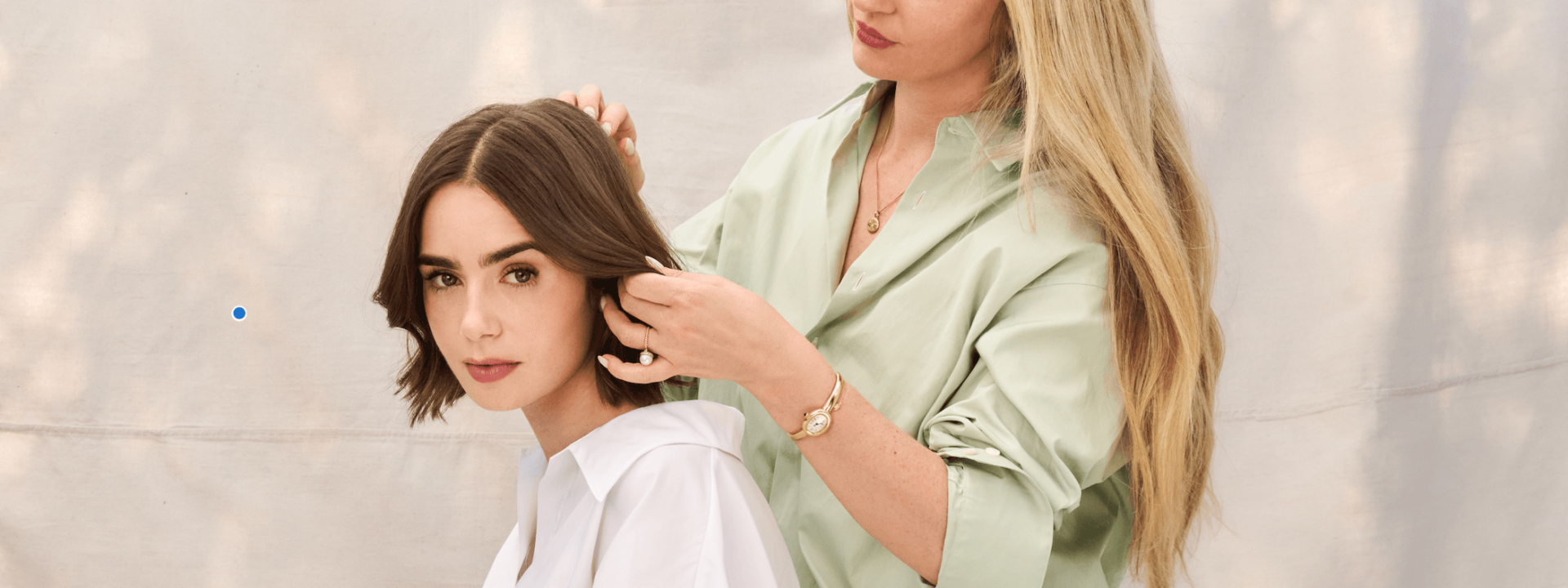
Sometimes, the most unexpected things can completely change the course of your life. When actor Lily Collins and I connect by phone, we’re talking about a few of those very things: having a baby, a great haircut, and a wonderful friend.
“I really identify with hair as a gateway into a new person, a character, or even a new phase of life,” she says. We’re speaking less than 48 hours after it was announced that Collins will play Audrey Hepburn in a film about the making of the pop culture classic Breakfast at Tiffany’s. Today, she’s starring in a campaign with longtime beauty collaborator Mara Roszak and Roszak’s clean haircare line, Rōz. “Mara doesn’t just style hair—she really listens to what you’re feeling and what you want from a style or a cut. Woman to woman, she’s also there as a sounding board,” says Collins.
The two have worked together for nearly 15 years. “Mara gave me my pixie cut when I was 25. I’d been dreaming about it and decided I needed to make the change,” she shares. “I wanted to cut off all this emotional baggage at the same time. I think a lot of women love to change their hair when they’re feeling something new. That cut took me to a totally different place.” In her current phase of life—as a new mother to baby girl Tove, the star of the Netflix hit Emily in Paris, and more—Collins is embracing a look that’s easy but with an edge: “My short hair best represents who I am right now. It’s a cut that looks really awesome and intentional, but it’s also practical because my daughter can’t grab it.”
Today, Roszak and Collins (who was an early investor in Rōz) are speaking to women in every phase of life through the brand’s first campaign, which features real women. “Our hair journey is something that unites women,” Roszak says, noting that whether it’s a big color change, hair loss, or a postpartum shift, she sees these transitions daily in her salon. “Hair stylists really hold all these stories and the emotions of our clients and their hair. By telling these stories, we’re reminding you that you aren’t alone.”
It’s the bond between the two—Collins describes them as “sisters,” while Roszak calls the actor “one of the most thoughtful and intentional people I know”—that creates a safe space for this entire conversation to flow, from a campaign to the dialogue between a hairstylist and client. They hope other women feel empowered to do the same.
“Changing your hair is an emotional process,” Collins reflects. “But supporting yourself by feeling all the feelings, and taking care of your hair with the right products, is what makes it great.”
Have a beauty or wellness trend you’re curious about? We want to know! Email Vogue’s senior beauty & wellness editor at beauty@vogue.com.
Frequently Asked Questions
Of course Here is a list of FAQs about Lily Collins being willing to cut her hair for a role designed to sound like questions from real fans and movie enthusiasts
General Beginner Questions
Q Is it true Lily Collins cut her hair for a role
A Yes she has done it at least twice Most notably she cut her signature long dark hair into a chinlength bob for her role as Fantine in the BBCPBS miniseries Les Misérables
Q Why would an actor cut their hair for a part Isnt that extreme
A For serious actors its a common commitment to authenticity A drastic hair change can help them physically and mentally become the character especially for period pieces or roles based on real people where a specific look is crucial
Q What other role did she change her hair for
A For the Netflix series Emily in Paris while not a cut she committed to a specific bold hairstyle that defines the character She also had a more tousled natural look for To the Bone
Advanced CareerOriented Questions
Q How does cutting her hair compare to other physical transformations actors do
A Its on a similar spectrum While not as extreme as massive weight lossgain hair is a huge part of public identity especially for actresses Cutting it signifies a strong dedication to the craft over personal brand similar to how Christian Bale or Charlize Theron transform their bodies
Q Did she use a wig instead for any major roles
A Yes often For Tolkien she wore a periodappropriate wig The choice between cutting and wearing a wig depends on the directors vision the shooting schedule and the actors other commitments A wig offers more flexibility
Q What are the practical challenges of cutting hair for a film
A The main challenge is continuity If filming takes months the hair will grow This requires clever styling potential hairpieces or digital editing to maintain the same length in every scene It also limits the actors ability to work on other projects with different looks simultaneously
Q Has she spoken about the emotional impact of cutting her hair
A Yes In interviews about cutting