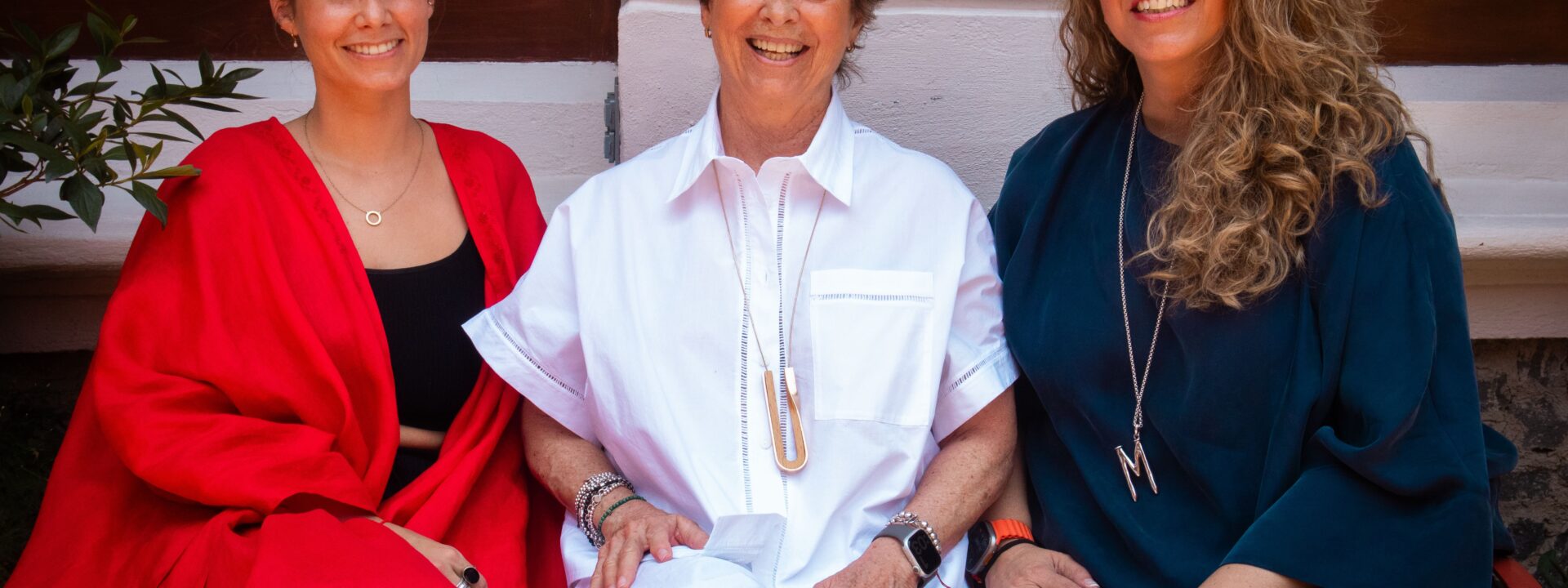
The UV index in Mexico City hit 13 that April day. I learned this while sitting in the sun-drenched courtyard of Casa Kahlo, the ancestral home of the Kahlo family, in the southern neighborhood of Coyoacán. Across from me were the artist’s closest living relatives and former residents of the home-turned-museum: Cristina Kahlo’s granddaughter, Mara Romeo Kahlo, and her two daughters.
Frida Kahlo’s grandniece and great-grandnieces kindly agreed to show me a lesser-known side of the one-of-a-kind painter, who they insist would still reject the common label of surrealist. “She painted her reality,” said Mara Romeo Kahlo, the artist’s grandniece. “And Diego always said she was the better artist of the two.” Diego Rivera was definitely not the focus of my time with the Kahlos. They believe that during the famous muralist’s life, Frida Kahlo was often seen as a public distraction—“the wife of Diego,” as they put it.
The family in front of the painting that Frida Kahlo showed to Diego Rivera, asking for his opinion on her work.
Photo: Thomas Robinett
In recent years, Kahlo’s legend has only grown, as many social movements have rediscovered her wide-ranging activism. Her legacy has found new energy among LGBTQIA+, Indigenous, disability, feminist, and Latin American empowerment movements. Kahlo’s cultural presence reached a peak with the record-breaking sale of El Sueño (La Cama), a haunting work that sold for $54.7 million in November 2025.
Her fame after death, often called “Fridamania,” has brought an almost unprecedented level of commercialization, both authorized and illegal. During my time with them, the Kahlo family was remarkably kind and measured, especially for a group caught in a long legal battle over the rights to their great-aunt’s name, image, and likeness.
Mexico City served as both muse and mistress to Kahlo. She held only one solo exhibition there during her lifetime. “The best artists are only recognized after their time,” her great-grandniece Frida Hentschel assured me. Much of her art needed international acclaim before it was valued in her home country. For visitors to Mexico City looking for a deeper Frida experience beyond the usual sites, here are some personal recommendations from her closest living family.
Museo Casa Kahlo
Opened to the public in late 2025, Museo Casa Kahlo—also known as Casa Roja or Casa Aguayo—is the heart of the Kahlo family. It was originally bought by patriarch Guillermo Kahlo in 1930 and later paid off by Diego Rivera. A hibiscus-red facade hides an inner courtyard and a thoughtful restoration by Rockwell Group and local architect Mariana Doet Zepeda Orozco, who happens to be the granddaughter of one of the “Big Three” Mexican muralists of the 20th century, José Clemente Orozco.
Frida Kahlo in Casa Kahlo, with nephew Antonio Pinedo Kahlo (left), niece Guadalupe Calderon (left), and niece Isolda Pinedo Kahlo.
Photo: All Rights Reserved © 2015 Mara Cristina Teresa Romeo Pinedo, CDMX, Mexico
An inscription near the museum’s entrance reads, “This is your house,” and that welcoming spirit flows throughout. Highlights include the first painting Kahlo showed to Diego Rivera, asking for his opinion on her work. “You must paint,” he told her, reflecting on her talent, according to Frida Hentschel. The painting hangs in her childhood bedroom, along with Guillermo Kahlo’s photography. He was hired to carefully capture the colonial architecture that dominated the city’s Parisian ambitions during the brutal Porfiriato era.
“No one knows that Frida was funny,” Mara Romeo told me. “She was always using double meanings.” Painted on the kitchen wall is a phrase Kahlo used: “El mesón de los gorriones,” which literally means “the tavern of the sparrows,” but is eerily close (by design) to the Spanish word for “freeloaders,” los gorrones. The kitchen was a meeting place for Kahlo’s many students.When she was an art professor at the nearby school La Esmeralda, I walked through the home with her family. In the living room, art historians were reframing an original drawing by Kahlo. I felt a deep, physical sense that her legacy is still alive.
Antiguo Colegio de San Ildefonso
Just two blocks from the city’s central Zócalo is the Colegio de San Ildefonso, a former Jesuit seminary. The building is ornate and old, founded in 1588 as a boarding and prep school for boys. In 1922, a fourteen-year-old Frida Kahlo was one of 35 girls in a class of over 2,000 students. This hinted at her trailblazing spirit and showed how ambitious her father was for his favorite daughter.
Kahlo was a quick learner who loved human anatomy and wanted to become a doctor. She soon joined a group of intellectual outsiders called Los Cachuchas, named after the flat caps they wore, which broke the school’s dress code.
A young Frida Kahlo wearing a “cachucha.”
Photo: All Rights Reserved © 2015 Mara Cristina Teresa Romeo Pinedo, CDMX, Mexico
Today, the school is a museum and event space open to the public, filled with amazing murals. In fact, when Kahlo attended in the 1920s, the building featured the first murals of the Big Three Mexican muralists, and it’s widely seen as the birthplace of that movement. While at San Ildefonso, Kahlo began to question systems of power and gender norms. From this school, she took a bus ride home that would change her life forever.
La Parroquia de San Juan Bautista
In the busy center of Coyoacán stands another Jesuit landmark, a tall church and monastery. The Kahlo family—led by Frida’s mother, the devout Matilde Calderon—went there every Sunday. Frida and her sister Cristina were baptized there. According to Mara Romeo, Kahlo wasn’t very religious. As she grew up, she moved toward a more agnostic view, which she shared with her father.
The family sits in a pew inside the Parroquia San Juan Bautista.
Photo: Thomas Robinett
The Parroquia de San Juan Bautista was finished around 1552. It’s a remarkable church with ornate hand-painted ceilings and grand arches. Today, it serves both as an active congregation and a cultural landmark, deeply woven into Coyoacán’s lively community. Visitors to this southern neighborhood can tour the church grounds outside of worship hours, including the tall nave and a leafy atrium attached to it.
Los Viveros
Near the UNESCO World Heritage Site UNAM campus in southern Mexico City are the Viveros, a public park with large gardens. According to Frida Hentschel, this is where Kahlo’s fascination with insects began. As a young girl, the artist joined her father on many trips to this public space, collecting bugs and branches to study at home.
Frida Kahlo posing outdoors.
Photo: All Rights Reserved © 2015 Mara Cristina Teresa Romeo Pinedo, CDMX, Mexico
Birds and butterflies especially fascinated Kahlo, and she included them in many of her works, like Self-Portrait with Thorn Necklace and Hummingbird (1940). Mara Romeo told me that Kahlo was obsessed with nature as a child. Today, the park sits quietly in the city, surrounded by skyscrapers and traffic. Miles of shaded paths make it a perfect spot for walking or jogging, and on a hot April afternoon, Mexico City’s runners seemed to be using it often.
The Canals of Xochimilco
Every good Mexico City trip includes a visit to the canals of Xochimilco. And nothing brings Frida Kahlo to life quite like the colorful trajinera boats that travel those ancient waterways. When I asked what artistic inspiration Kahlo found in Xochimilco, the family’s answer surprised me. “She drank, she hung out with friends,” laughed great-grand-niece Mara de Anda. In my rush to turn one of the twentieth century’s most iconic figures into a myth, I had forgotten the simple truth.I completely overlooked the possibility that she took part in that very Mexican tradition of gathering over good drinks and good conversation. If you do go, do as Kahlo did: bring beers and friends along on your trajinera.
Frida Kahlo on a trajinera, accompanied in the front row from left to right: Antonio P. Kahlo (nephew), Cristina Kahlo (sister), Isolda Kahlo (niece), and Esteban Volcov (Leon Trotsky’s grandson).
Photo: All Rights Reserved © 2015 Mara Cristina Teresa Romeo Pinedo, Mexico City, Mexico
Frequently Asked Questions
Here is a list of FAQs about exploring Mexico City through the eyes of Frida Kahlo guided by her descendants
BeginnerLevel Questions
1 What exactly is this Frida Kahlo with her descendants tour
Its a guided experience led by a member of Frida Kahlos familylike a greatniece or nephew They take you to places Frida actually lived worked and loved sharing personal stories and family memories that you wont find in guidebooks
2 Do we get to go inside Fridas famous Blue House
Yes most tours include a visit to the Casa Azul However because the house is a very popular museum the guide usually gives you a private familyfocused explanation outside first then you go inside on your own or with the group at a reserved time
3 How long does a typical tour last
Most tours last between 4 to 6 hours This includes walking transportation between sites and time to explore each location
4 Is this tour just for art lovers
Not at all While youll see art the focus is on Fridas life her personality her love story with Diego Rivera and her daily routines Its for anyone interested in history culture or just a unique personal way to see Mexico City
5 Where does the tour start and do I need to get there on my own
It usually starts in the Coyoacán neighborhood near the Casa Azul Youll meet the guide at a specific café or plaza You are responsible for getting to that meeting point
Advanced Practical Questions
6 What specific places do we visit that a regular tourist wouldnt know about
Descendants often take you to hidden spots like the San Ángel market where Frida shopped for ingredients the secret studio Diego built for her at the San Ángel Diego Rivera Frida Kahlo Studio Museum and the Jardín Centenario in Coyoacán where she liked to sit and peoplewatch
7 Are there any physical demands for this tour
Yes You will be on your feet for several hours walking on cobblestone streets and possibly uneven sidewalks You should be comfortable walking 35 miles 58